
Charred Wood Blog
What Is Thermowood? How It’s Made, Grades, Pros and Cons

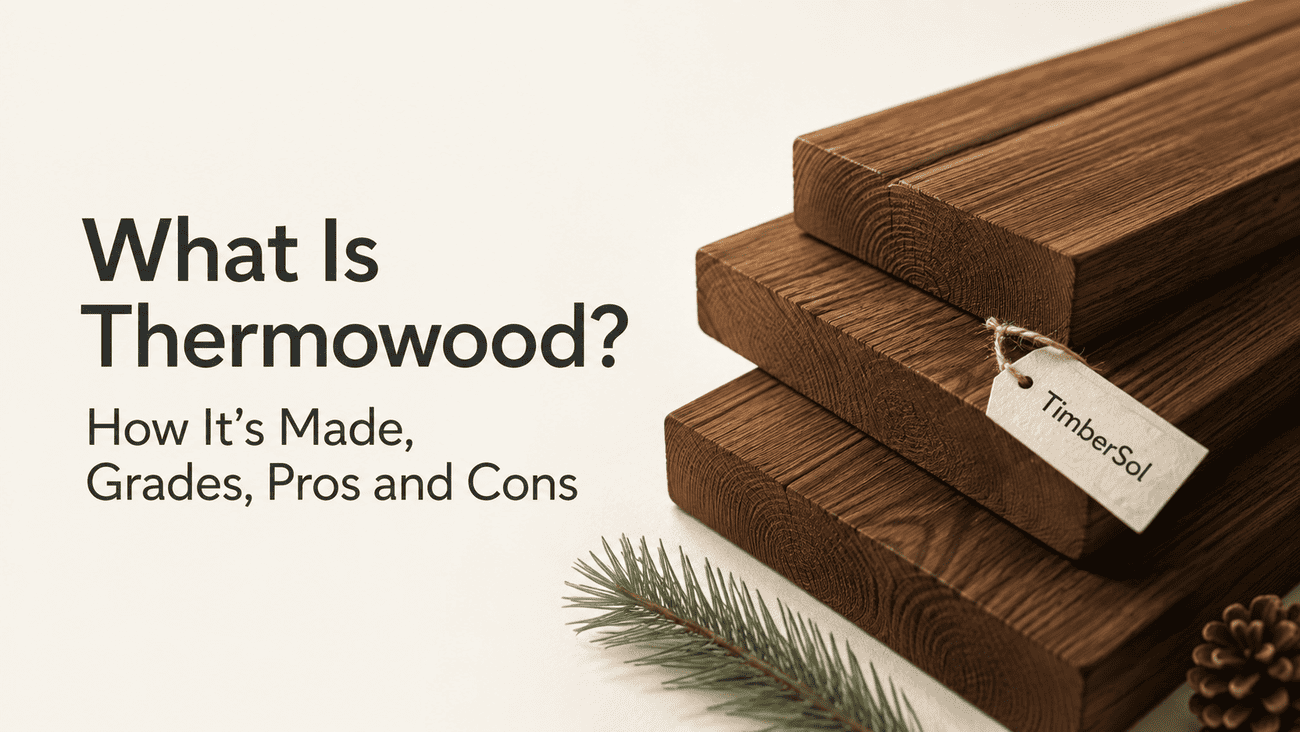
Not all timber is created equal. Two boards may start as the same fast-growing Scandinavian pine, yet perform very differently after years of exposure to rain, fluctuating temperatures, and constant moisture. That’s why thermowood has become an increasingly popular choice for cladding, decking, and other exterior applications. Through thermal modification, ordinary softwood is transformed into a more stable, rot-resistant material without the use of chemical preservatives.
The process, however, comes with trade-offs. While heat treatment improves durability and significantly reduces the wood’s tendency to absorb moisture, it also affects its strength, making thermowood better suited to some applications than others. Understanding the differences between Thermo-S and Thermo-D, how thermowood compares with cedar, and where its limitations lie is essential before choosing it for a project.
This guide explains how thermowood is made, what happens during the thermal modification process, the differences between the available grades, and the advantages and limitations you can realistically expect. You’ll also learn how long thermowood typically lasts, what maintenance it requires, and whether it’s the right material for your next cladding or decking project.
What Is Thermowood and How Is It Made?
Thermowood is softwood, typically Nordic pine or spruce, modified using only heat, steam, and time. No chemicals are added during the process. The treatment improves rot resistance and dimensional stability, making this affordable softwood suitable for exterior cladding and decking.
The method was developed and standardised in Finland by the International ThermoWood Association. Thermowood, thermally modified wood, and heat-treated timber all describe the same material, while ThermoWood® is the protected trade name.
The mechanism is simple: heat permanently reduces the wood’s ability to absorb moisture. Since fungi need moisture to grow, and wood movement is driven by changes in moisture content, the timber becomes both more durable and more dimensionally stable.
What Is Thermowood Made Of?
Most thermowood is made from Scandinavian pine or spruce, although ash, ayous, and radiata pine are also thermally modified for specific applications.
Using inexpensive plantation-grown softwood is the point. Thermal modification upgrades a fast-growing, low-cost species to durability class 2 (“durable”) under BS EN 350, the same class that Western red cedar naturally achieves, according to manufacturer declarations such as Lunawood’s fact sheet.
Species choice influences colour, price, and end use. Pine and spruce dominate cladding and decking applications, ash is also thermally modified for decking, and ayous is the preferred choice for sauna interiors.
The Thermal Modification Process
Thermal modification takes place in a kiln over three phases: high-temperature drying, heat treatment at peak temperatures of approximately 180–220°C, and cooling followed by reconditioning to a usable moisture content of 4–7%. Steam surrounds the boards throughout the process, acting as an oxygen barrier that prevents the wood from combusting.
Peak temperatures are precisely controlled. According to the ThermoWood Handbook 2025 published by the International ThermoWood Association, Thermo-S is treated at 190°C ±3°C, while Thermo-D is treated at 212°C ±3°C.
The heat breaks down hemicellulose, the sugars fungi feed on, and crystallises resins. As a result, the timber resists brown, white, and soft rot, stops bleeding resin in summer heat, and takes on a caramel-brown tone that runs through the entire board, not just the surface.
For a deeper look at the chemistry, see our guide to thermal modification of wood.
Thermowood Grades: Thermo-S vs Thermo-D Explained
The ThermoWood® classification defines two treatment classes, and the letters indicate their purpose: Thermo-S stands for Stability, and Thermo-D stands for Durability. The grade you choose determines where the timber can be safely used.
The difference comes down to peak kiln temperature and the resulting use class:
- Thermo-S: treated at 190°C ±3°C; Use Class 3.1 (limited wetting); suited to windows, doors, and interior joinery; lighter honey-brown tone.
- Thermo-D: treated at 212°C ±3°C; Use Class 3.2 (prolonged wetting); suited to exterior cladding and decking; deeper caramel-brown colour.
These classifications are taken from the ThermoWood Handbook 2025, published by the International ThermoWood Association.
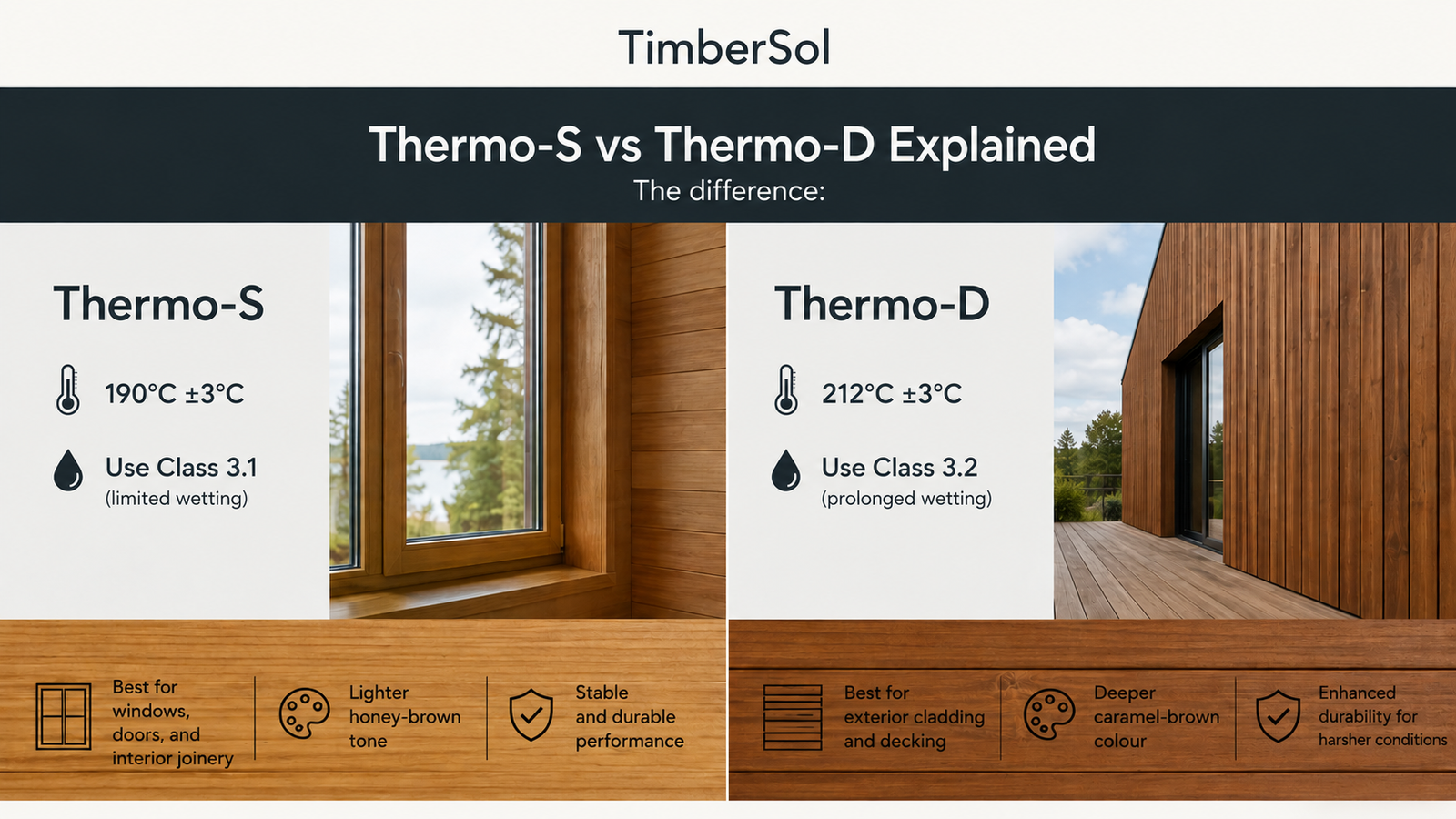
For exterior projects in the UK climate, the rule is simple: always specify Thermo-D. According to a Virginia Tech technical release, modification temperatures above 200°C provide measurably greater decay resistance, which is exactly what a rain-soaked British façade demands.
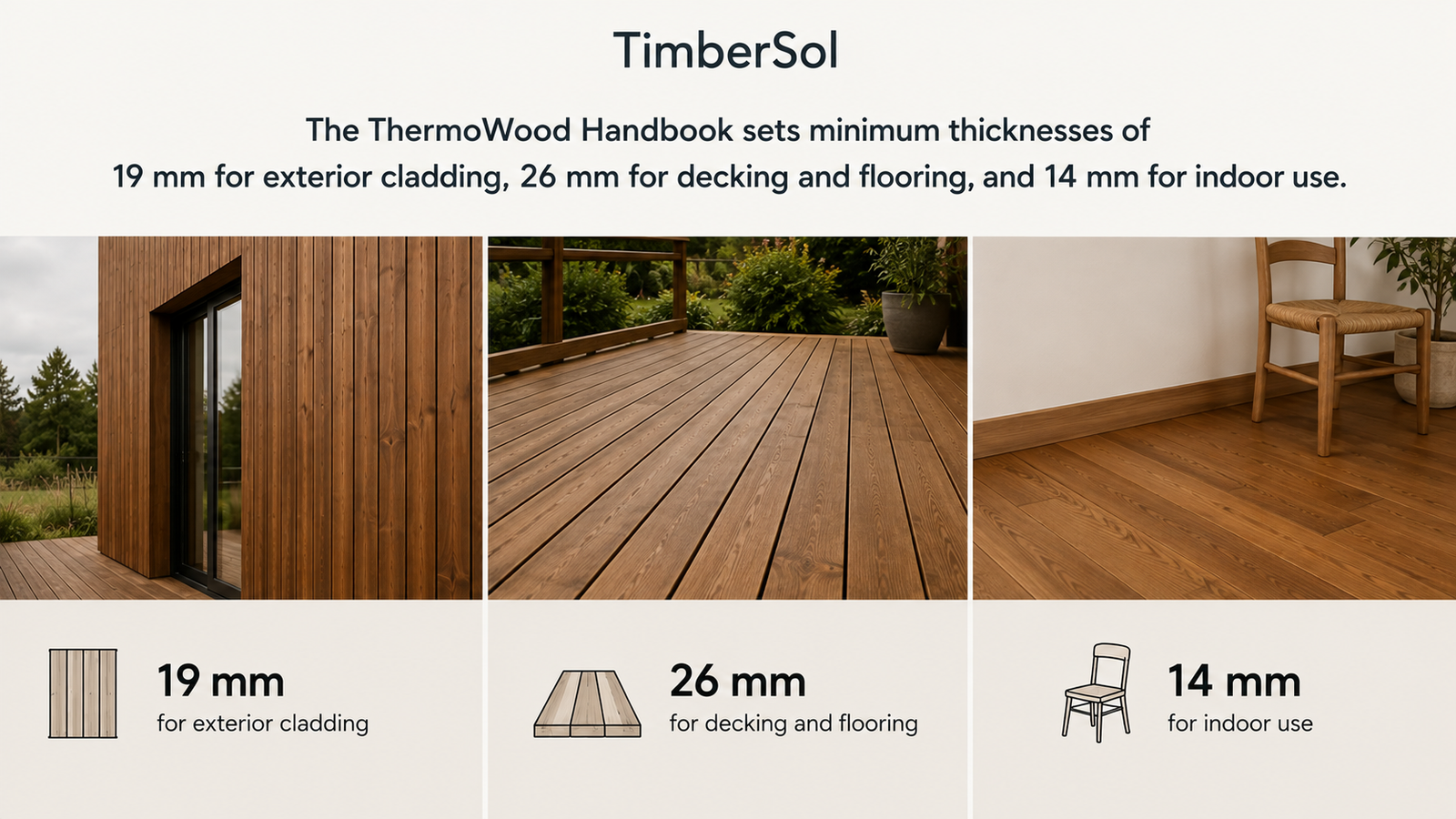
Thickness matters too. The ThermoWood Handbook sets minimum thicknesses of 19 mm for exterior cladding, 26 mm for decking and flooring, and 14 mm for indoor use. Thinner boards used outdoors are more prone to distortion, so treat these figures as minimum requirements, not suggestions.
Is Thermowood Better Than Cedar and Untreated Softwood?
Thermo-D thermowood matches Western red cedar’s BS EN 350 durability class 2 rating at a noticeably lower price, but cedar retains higher natural strength and a distinct grain. Therefore, whether thermowood is “better” depends on your budget and application rather than on a universal answer.
On stability, thermowood pulls clearly ahead of untreated softwood. According to Virginia Tech research, its equilibrium moisture content is 40–50% lower than that of untreated wood, and shrinkage and swelling are reduced by 40–80%, depending on the species. The ThermoWood Handbook puts it more starkly: at a modification temperature of 220°C, equilibrium moisture content is halved compared with untreated spruce. Thermal conductivity also drops by 20–25%. In practice, boards cup and gap far less during a wet British winter.
Untreated pine or spruce costs less upfront. However, it requires pressure treatment or regular coating to withstand outdoor conditions, and it bleeds resin in summer heat. Thermal modification drives that resin out during processing, so the boards stay clean and dry to the touch.
As a general rule, cladding and decking favour Thermo-D for value, saunas favour thermowood or ayous, and cedar is the better choice where strength or its distinctive grain matters. For a wider species comparison, see Best Wood for Cladding, or compare acetylated timber in Accoya vs Thermowood.
Disadvantages of Thermowood and Problems with Thermally Modified Wood
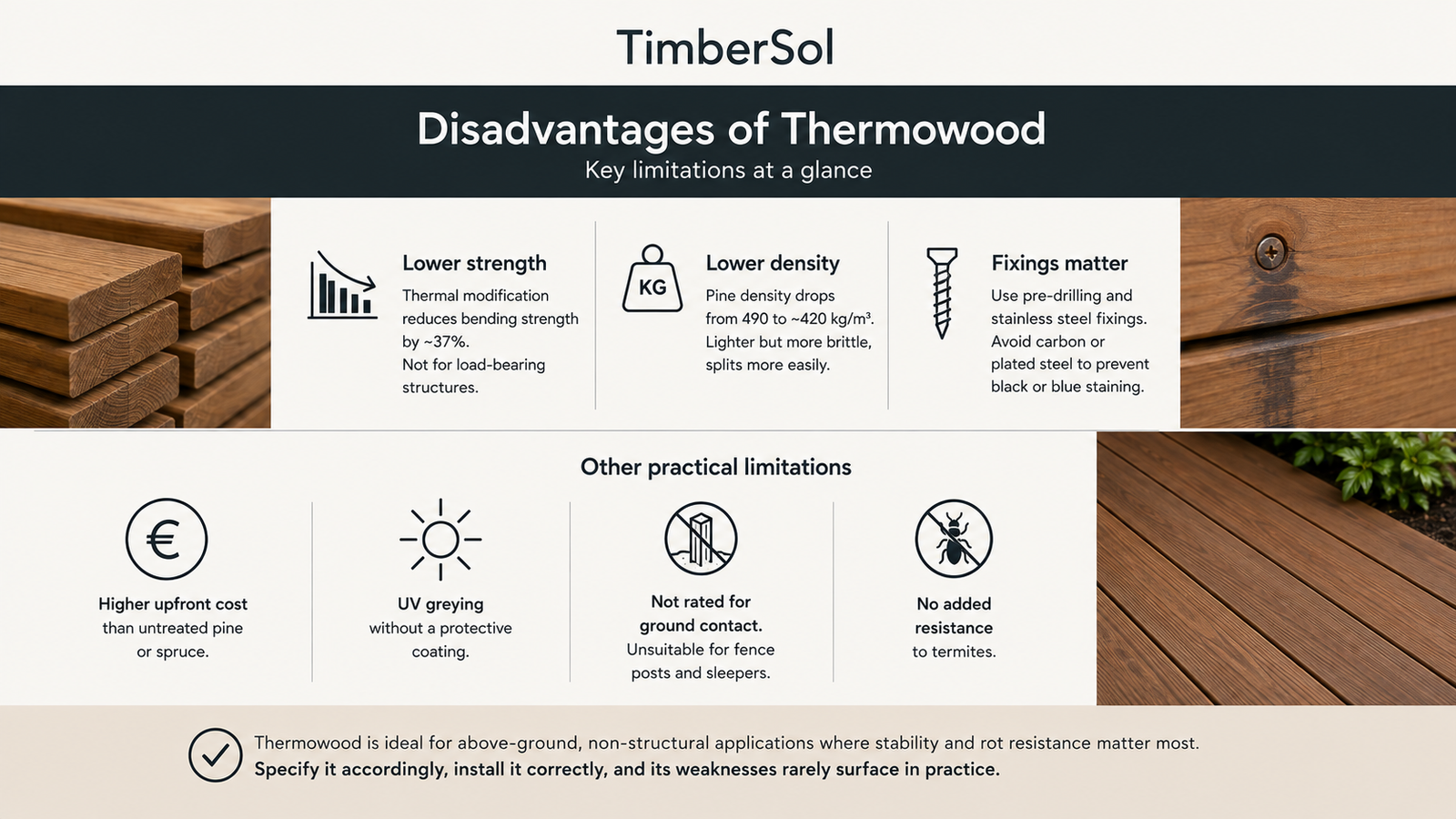
Thermal modification trades strength for durability. According to the ThermoWood Handbook 2025, pine’s bending strength falls from 60.7 N/mm² in its untreated state to 38.1 N/mm² after Thermo-D treatment, a reduction of roughly 37%, and spruce follows the same pattern, decreasing from 74.2 N/mm² to 47.5 N/mm². Consequently, ThermoWood must never be used for load-bearing structures, as it is not available as strength-graded timber.
The heat also reduces density, with pine dropping from 490 to around 420 kg/m³. Boards become lighter to handle but more brittle, so they split more easily near the ends and edges. Pre-drilling and stainless steel fixings for cladding and decking are essential because tannins and resins in the timber react with plated or carbon steel, leaving black or blue staining that cannot be sanded out.
Beyond strength, the remaining limitations are practical rather than critical:
- Higher upfront cost than untreated pine or spruce.
- UV greying without a protective coating.
- Not rated for ground contact, so it is unsuitable for fence posts and sleepers.
- No added resistance to termites.
None of these rules out thermowood for cladding, decking, or interior walls. They simply define its intended use: above-ground, non-structural applications where stability and rot resistance matter most. Specify it accordingly, install it correctly, and its weaknesses rarely surface in practice.
How Long Does Thermowood Last, and What Maintenance Does It Need?
As a durability class 2 timber used above ground, Thermo-D thermowood cladding is generally expected to last around 30 years in UK conditions. That is the minimum service life manufacturers declare for uncoated thermally modified façades and the service life used in a peer-reviewed life-cycle assessment of the material (Búryová & Sedlák, Coatings, 2021). Decking typically lasts somewhat less because horizontal boards retain water for longer and are subject to foot traffic. The quality of detailing can significantly affect service life.
Maintenance requirements are low. No coating is needed for durability, as protection comes from the modified wood structure itself. Light cleaning and optional re-oiling every 5–10 years help maintain colour depth and surface protection.
Colour behaves differently from durability. According to the ThermoWood Handbook, UV radiation causes untreated surfaces to turn grey, so uncoated boards weather from caramel brown to silver-grey. Re-oiling is therefore optional for durability but necessary for colour retention.
In the case of TimberSol, boards are charred, brushed, and sealed in-house in Boston, Lincolnshire, with Hi-Tech Hybrid Oil, a penetrating finish that never peels. Recoating requires only washing and one fresh coat, with no sanding or stripping.
For installation, thermowood suits both vertical and horizontal cladding, provided you use a ventilated cavity, the correct fixings, and proper profile detailing. Our boards are 20 mm thick and available in 95, 120, and 145 mm widths and 3.0–4.2 m lengths, comfortably exceeding the ThermoWood Handbook‘s 19 mm minimum thickness for outdoor use, with a 10 m² minimum order.
What Is Thermowood: FAQ
What is thermowood used for?
The main applications are exterior cladding, decking, battens, saunas, garden rooms, fence boards (not posts), and interior feature walls.
Its dimensional stability and rot resistance make it well suited to exposed outdoor applications, while ayous thermowood is the preferred choice for sauna interiors. You can compare profiles and species across our timber cladding range.
How much does thermowood cladding cost in the UK?
TimberSol’s thermowood cladding costs £59/m², whether natural or charred. That places it in the mid-range: around £13/m² more than charred spruce, £4/m² less than charred larch, and well below Accoya.
The premium over untreated softwood buys improved stability and durability class 2 rot resistance in an affordable species. Furthermore, minimal maintenance helps offset the higher upfront cost over the cladding’s lifespan.
Does thermowood need treating or oiling?
No treatment is needed for durability because protection comes from the modified wood structure itself rather than from any coating. The boards resist rot without oils, stains, or preservatives.
However, uncoated thermowood weathers to a silver-grey colour under UV exposure. A UV-protective oil is only required if you want to retain the caramel-brown tone.
Is thermowood good for decking?
Yes, thermowood is well suited to decking because its dimensional stability helps keep gaps even, and resin bleed is eliminated during thermal modification.
But specify it carefully. The material is more brittle than untreated softwood, so use boards that are at least 26 mm thick, stainless steel fixings, and the correct joist spacing.
Thermowood earns its place on a façade through chemistry, not coatings: heat, steam, and time turn an affordable Nordic softwood into a stable, rot-resistant board. At TimberSol, we take that engineered base a step further by charring, brushing, and oiling every board in-house in Lincolnshire to pair Class 2 durability with a finish that genuinely enhances a building’s character.
The easiest way to judge it is to see it in person. Order a few thermowood samples in the shades you’re considering, see how the grain and char look in your lighting, and our team will happily talk you through profiles, fixings, and quantities for your project.
