
Kebony vs Accoya: Which Modified Wood Is Better for Decking, Cladding and Joinery?

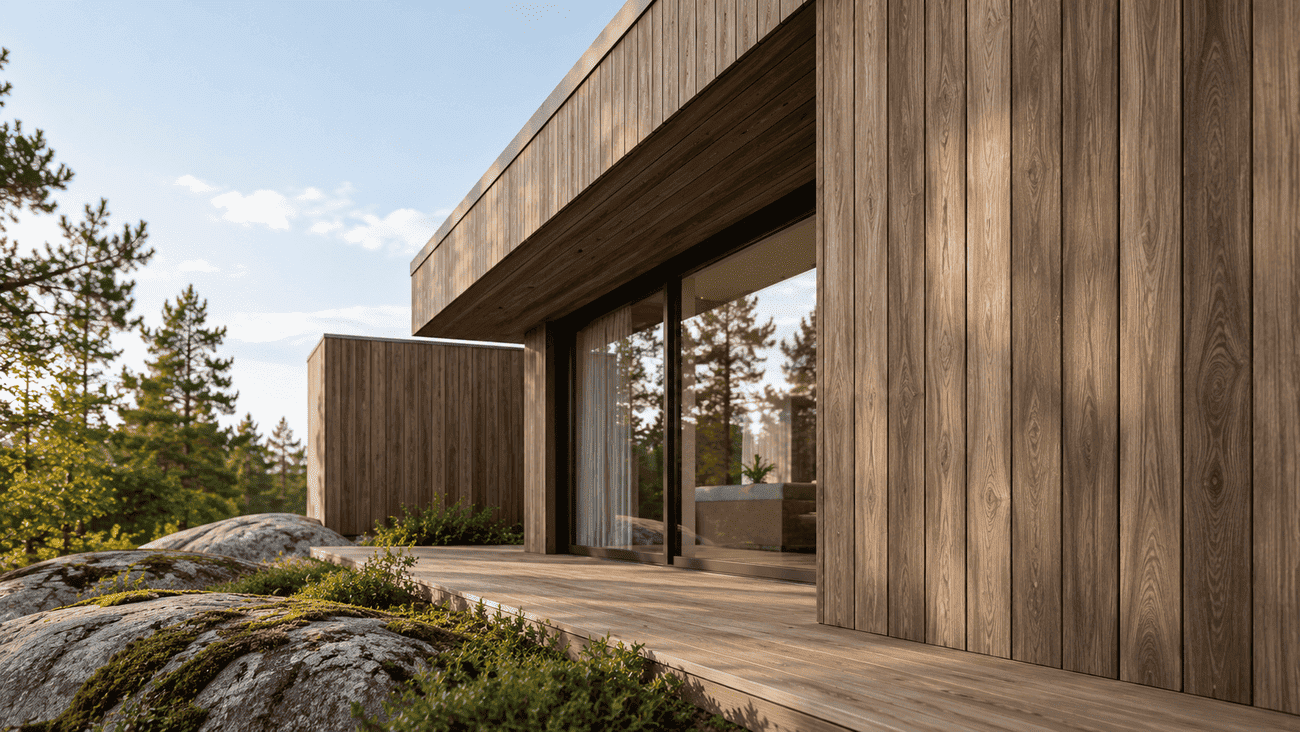
Kebony vs Accoya comes down to a trade-off: Accoya offers very high dimensional stability, a 50-year above-ground warranty and a pale board that can be coated or charred, while Kebony is harder and denser and arrives dark brown before weathering towards grey. Both offer high resistance to fungal decay, so durability alone may not decide the choice.
The difficulty for self-builders and architects is that the two brands use different warranty structures, fixing guidance and movement figures, and their technical information is not always presented side by side. A deck in full sun, cladding next to zinc flashings or a window frame that must hold paint can each favour a different choice.
What follows compares the two on lifespan, warranty terms, price per m² against oak and larch, and practical installation considerations. Alternatives such as Thermowood and charred cladding are covered too, because Accoya is not always the most suitable option.
Kebony vs Accoya: How Acetylated and Furfurylated Wood Are Made
Both are chemically modified softwoods used as alternatives to tropical hardwoods, but Accoya is acetylated radiata pine, while Kebony is furfurylated softwood. The two treatments modify the timber in different ways.
Accsys treats radiata pine with acetic anhydride at its plant in the Netherlands. According to the Accoya datasheet, acetylation reduces the availability of water-attracting hydroxyl groups in the wood cell wall, so Accoya absorbs less water and moves less.
Kebony instead impregnates softwood with furfuryl alcohol, derived from agricultural waste such as sugar cane and corn cobs, then heats it so the furfuryl alcohol polymerises within the wood. According to the Mantanis 2017 BioResources review, acetylation involves no polymerisation, while the extent to which furfurylation chemically modifies the wood cell wall remains debated.
Kebony Clear uses radiata pine and is modified through the board. Kebony Character uses Scots pine and can only be cross-cut, since ripping or further machining can expose untreated heartwood. Accoya is a single modified timber material used for applications including decking, cladding and joinery.
Thermowood takes a third route, using heat rather than chemical modification, as explained in our guide to thermal modification of wood.
| Accoya | Kebony | |
| Process | Acetylation | Furfurylation |
| Base timber | Radiata pine | Radiata pine (Clear), Scots pine (Character) |
| Density | ~515 kg/m³ | ~670 kg/m³ (Clear) |
| EN 350 class | Class 1-equivalent | Class 1 (Clear), Class 1–2 (Character) |
| Warranty headline | 50 years above ground, 25 years in freshwater contact | Varies by product and application |
| Colour delivered | Pale | Dark brown |
| Fixings | Follow Accoya fixing guidance | Follow Kebony fixing guidance |
| Price position | Premium | Varies by product and supplier |
Kebony vs Accoya Durability: Lifespan, Warranty and Rot Resistance Compared
Those headline figures show some clear differences: both offer high resistance to fungal decay, but Accoya’s above-ground warranty runs longer, while Kebony Clear is denser and harder.
Accsys rates Accoya as durability class 1, backed by a 2013 TRADA Technology letter that found the available data consistent with that rating while noting that no European standard at the time classified the durability of modified wood. Kebony’s warranty table lists Clear as class 1 and Character as class 1–2.
Accoya’s warranty gives 50 years for use classes 1–3 and 25 years for use class 4. Products installed less than 20 cm above ground, or without adequate drainage or water evaporation, are treated as use class 4. Dimensional movement is also covered where swelling or shrinkage exceeds 2.5% and independent testing confirms that the wood no longer performs its intended function.
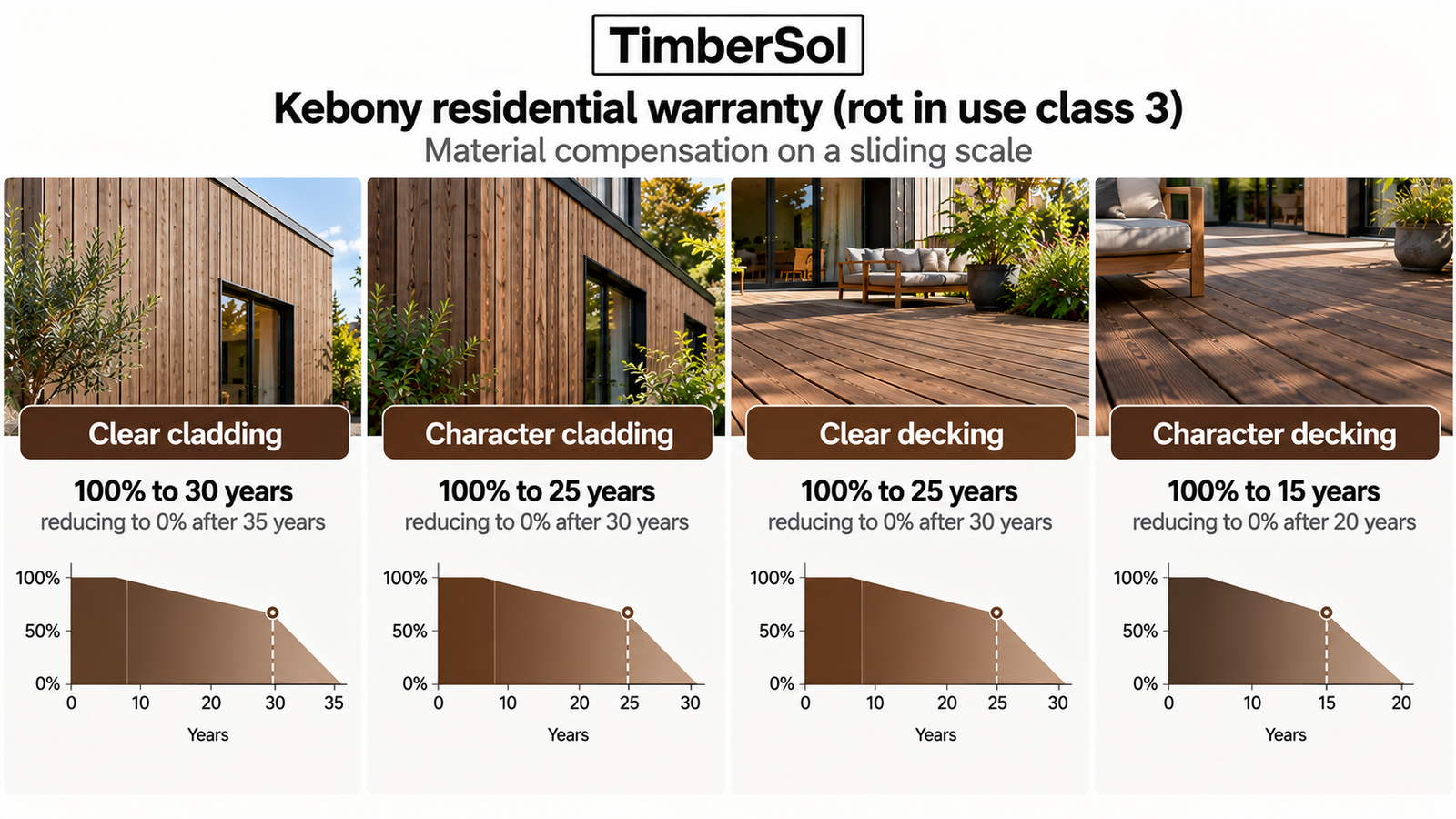
Kebony covers rot in use class 3, with material compensation on a sliding scale for residential applications:
- Clear cladding: 100% to 30 years, reducing to 0% after 35 years
- Character cladding: 100% to 25 years, reducing to 0% after 30 years
- Clear decking: 100% to 25 years, reducing to 0% after 30 years
- Character decking: 100% to 15 years, reducing to 0% after 20 years
For commercial applications, Kebony provides 100% material compensation up to the specified warranty period, with no compensation after that point.
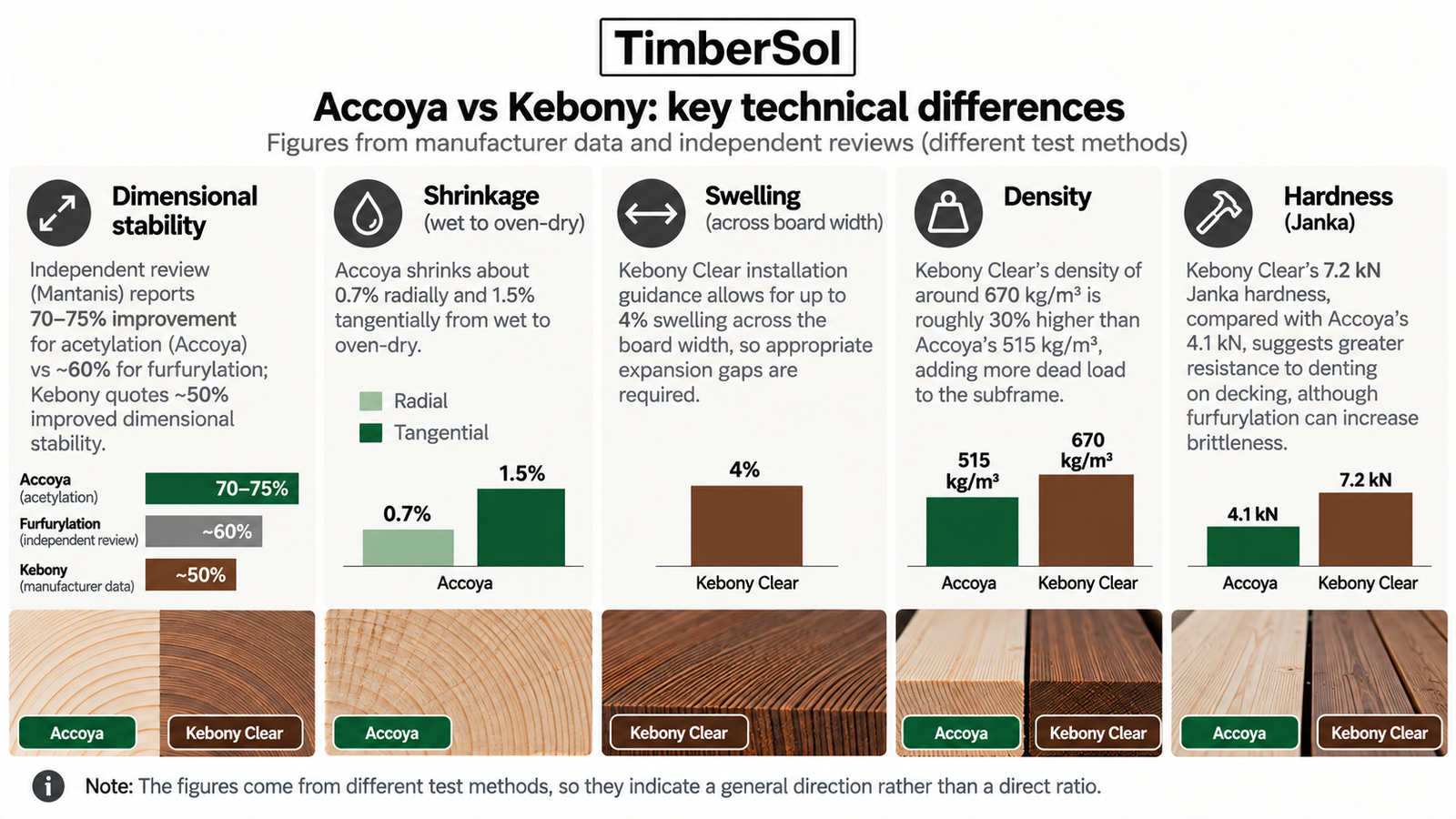
Stability generally favours Accoya: acetylation can reduce swelling and shrinkage by around 70–75%, while the same Mantanis review reports around 60% for furfurylation; Kebony quotes approximately 50% improved dimensional stability. Accoya shrinks about 0.7% radially and 1.5% tangentially from wet to oven-dry, while Kebony Clear installation guidance allows for up to 4% swelling across the board width, so appropriate expansion gaps are required. The figures come from different test methods, however, so they indicate a general direction rather than a direct ratio.
Kebony Clear’s density of around 670 kg/m³ is roughly 30% higher than Accoya’s 515 kg/m³, adding more dead load to the subframe. Its 7.2 kN Janka hardness, compared with Accoya’s 4.1 kN, suggests greater resistance to denting on decking, although furfurylation can increase brittleness.
In full sun, Accoya’s low movement can suit wider boards and tighter joints, while Kebony’s dark brown surface can become hotter and gradually fades towards grey. Both can weather unevenly, while gaps, ventilation and drainage also play an important role in managing moisture and movement.
On fire performance, Accoya can achieve Euroclass D with 22 mm or thicker square-edged boards, or with a charred finish on 21 mm boards. Standard Kebony cladding is D-s2,d0, while fire-retardant-treated Kebony Clear cladding can achieve B-s1,d0. In England, Regulation 7(2) of the Building Regulations requires materials in the external walls of relevant buildings with a storey at least 18 m above ground level to achieve A2-s1,d0 or A1, subject to specified exemptions, so neither classification meets that requirement.
Kebony vs Accoya Price: What Decides the Cost per m²?
Neither timber is consistently the cheaper one: the price per m² of Kebony and Accoya depends on grade, profile, finish and supplier, so compare quotes for the same profile and area. Kebony positions Kebony Character as its value-conscious grade compared with Kebony Clear. Both modified timbers generally cost more than larch, Douglas fir or ThermoWood.
What moves the price:
- Grade: knot-free Kebony Clear or knotty Kebony Character; Accoya is supplied in different quality grades depending on the product.
- Finish: bare, factory-coated or charred boards.
- Profile and coverage: allow for wastage, and remember that shadow gap and shiplap profiles cover less than their nominal board width.
- Fixings: both timbers require corrosion-resistant fixings, with stainless steel commonly recommended.
- Subframe: Kebony Clear has a density of around 670 kg/m³, so board weight should be considered in the subframe design.
- Yield: Kebony Character can be cross-cut but should not be ripped to width on site.
Value over the service life matters as much as the purchase price. Accoya carries a 50-year above-ground warranty, while Kebony Clear residential cladding carries a warranty of up to 35 years. Lower movement and longer coating maintenance intervals can help offset a higher purchase price on long-life projects. For a current price on charred Accoya, request a quote.
Downsides of Kebony and Accoya: Acidity, Fixings, Colour Fade and Sizing
Price is only one drawback. Both products offer high resistance to fungal decay; the practical considerations instead include fixings, colour behaviour and board format, and they differ by brand.
Accoya drawbacks
Accoya is slightly acidic, so Accsys recommends corrosion-resistant fixings such as A2 or A4 stainless steel, with A4 used in particularly challenging environments such as coastal areas or highly polluted industrial zones. Base metals and galvanised metals can corrode in damp conditions when in direct or indirect contact with Accoya, so metal junctions should be detailed to avoid incompatible contact.
Colour needs equal attention. Bare Accoya is pale and can grey unevenly, which is why it may be coated, stained or charred. Accsys confirms that charring does not affect the warranty and that the charred effect can be more stable on Accoya than on other timbers, yet outdoor charred Accoya cladding still needs a maintained coating, roughly every 5 years on south-facing elevations and every 10 years on north-facing ones.
Format and cost can also be drawbacks: non-standard sections, quote-only stock with higher minimum orders at some UK suppliers, and a premium price among softwood-based products. Its lower Janka hardness means decking can mark under heavy furniture. The 50-year warranty also drops to 25 years for boards installed less than 20 cm above ground or without adequate drainage.
Kebony drawbacks
Kebony arrives dark brown and weathers towards silver-grey over time, with the rate depending on exposure. The transition can appear uneven. New boards can also release surface run-off, which Kebony warns can discolour and corrode zinc and other metals below.
Movement is the second issue. Kebony Clear can swell by up to 4% in width, so installers need to allow appropriate gaps and can expect more visible seasonal movement than with Accoya. Kebony Character cannot be ripped without exposing untreated heartwood, which limits on-site adjustment.
At around 670 kg/m³, Kebony Clear is roughly 30% denser than Accoya, so long boards can require more handling effort and add more load to the subframe. Furfurylation can also increase brittleness.
Finally, the residential warranty covers materials on a sliding scale, with Character decking receiving 100% material compensation for 15 years. UK stockists and profiles can be more limited, and Kebony’s naturally dark brown colour makes a pale finish less straightforward.
Kebony vs Accoya Alternatives: Thermowood, Oak, Larch and Composite Decking
If those drawbacks rule out Accoya, Kebony remains a close like-for-like alternative; Thermowood, larch, Douglas fir and oak can offer cheaper timber routes, charred (Yakisugi) cladding can deliver a dark modern look for less, and Millboard-type composites can reduce maintenance.
Thermowood is thermally modified timber, commonly pine or spruce, with durability depending on the species and modification process. It can cost less than Accoya or Kebony but can be more brittle and less dimensionally stable than Accoya. The Accoya vs Thermowood comparison covers the detail.
Larch and Douglas fir (class 3–4) and European oak heartwood (class 2) rely on natural durability and can cost less than modified wood. In exchange, they can move more and bleed resin or tannins. Charred and oiled larch gives much of the visual effect of charred Accoya at a lower price, in exchange for more movement and a class 3–4 base timber.
Composite decking such as Millboard can suit projects where low maintenance and slip resistance matter, but it can become hotter underfoot in full sun and does not have natural timber grain.
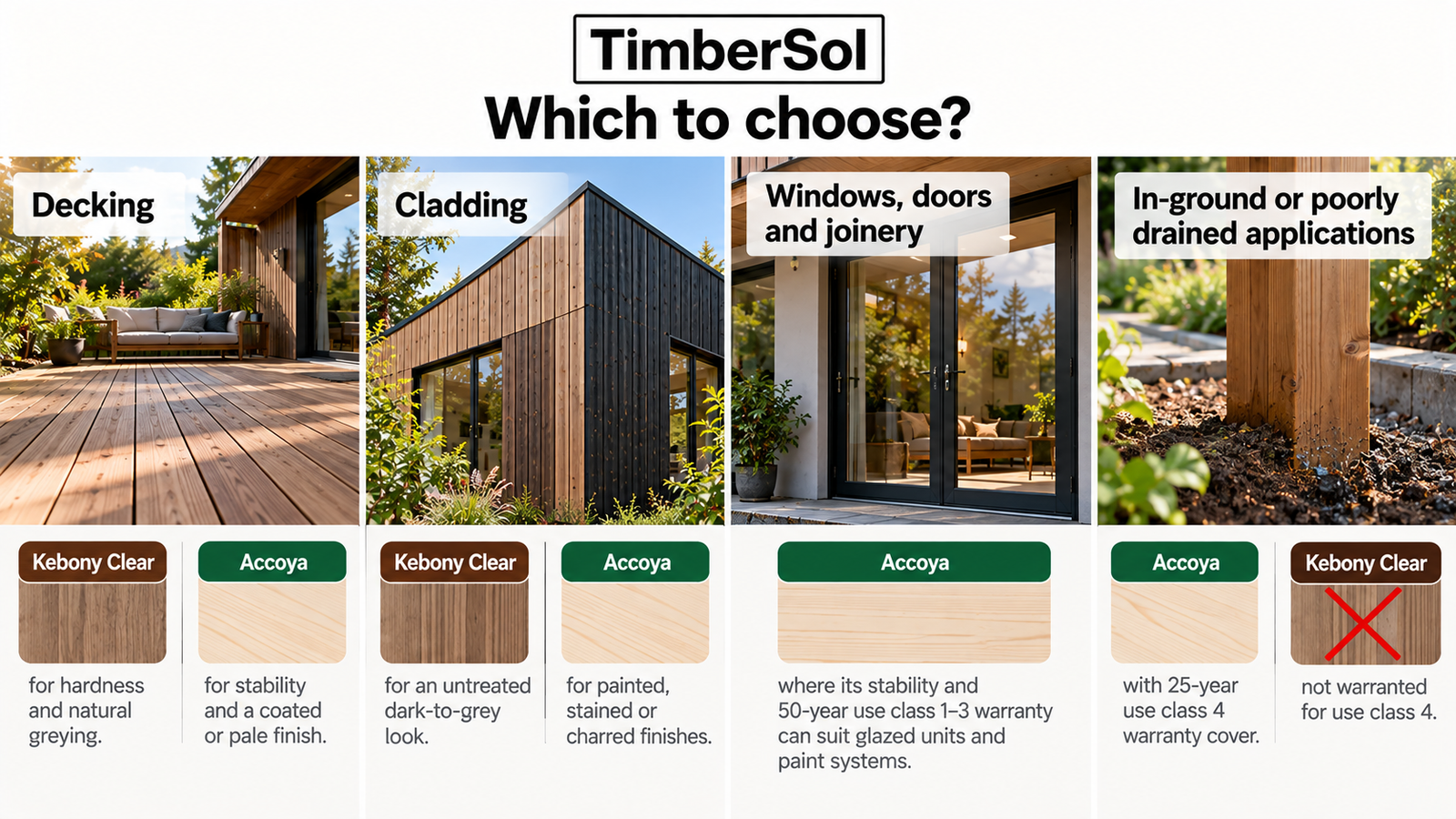
Which to choose:
- Decking: Kebony Clear for hardness and natural greying; Accoya for stability and a coated or pale finish.
- Cladding: either; Accoya for painted, stained or charred finishes, Kebony for an untreated dark-to-grey look.
- Windows, doors and joinery: Accoya, where its stability and 50-year use class 1–3 warranty can suit glazed units and paint systems.
- In-ground or poorly drained applications: Accoya, with 25-year use class 4 warranty cover; Kebony is not warranted for use class 4.
Still weighing species? Our guide to the best wood for cladding compares them side by side.
Kebony vs Accoya: FAQ
What are the downsides of Accoya wood compared to Kebony?
Accoya can cost more, requires appropriate corrosion-resistant fixings, can come in non-standard sections with minimum orders, dents more easily than Kebony Clear, and needs a coating or char to retain a more stable colour. Kebony, on the other hand, fades from brown to grey, can stain or corrode metals with early run-off, can swell by up to 4% in width and carries a materials-only sliding residential warranty. Both offer high resistance to fungal decay, so the main differences are in detailing and appearance.
What is the average lifespan of Accoya and Kebony wood?
Accoya is warranted for 50 years in use classes 1–3 and 25 years in use class 4, with class 1-equivalent durability. Kebony Clear (class 1) carries 100% material compensation for 30 years on residential cladding and 25 years on residential decking; Character (class 1–2) gets 25 and 15 years respectively, tapering to zero five years later. Real service life, however, depends on drainage, ventilation and appropriate fixings.
Is Kebony cheaper than Accoya?
Not consistently. Prices vary by grade, profile, finish and supplier, so compare quotes for the same profile and area. Kebony Character is Kebony’s value-conscious grade and is generally cheaper than Kebony Clear. Both modified timbers generally cost more than larch or ThermoWood, so value depends on service life and maintenance as much as on the purchase price.
What can I use as a substitute for Accoya?
Kebony is a close like-for-like substitute, offering high durability in a darker board. Thermowood can suit cladding at lower cost but is generally less dimensionally stable than Accoya. Oiled or charred larch, Douglas fir and oak can cost less, but may move more and require recoating. Millboard-type composite can reduce decking maintenance, though it does not have natural timber grain.
Is Kebony or Accoya better for a south-facing deck in full sun?
Accoya suits a stable, coatable or pale deck because it has low dimensional movement; Kebony Clear suits buyers who want a harder board and accept the brown-to-grey fade. Board gaps, subframe ventilation and drainage also play an important role in managing movement. For an even dark finish, a charred cladding sample lets you see shades such as Teak Accoya or deep-char Carbon Accoya in real light before committing.
Kebony and Accoya are both premium modified timbers, so the final choice rests on what your project needs most: Kebony Clear for a harder, denser board, or Accoya for low dimensional movement and a surface that takes charring and coatings well. At TimberSol we work with Accoya for that second reason, charring, brushing and oiling boards in-house in Boston, Lincolnshire, so the carbon layer sits on a dimensionally stable timber.
Because Accoya stock fluctuates, our charred Accoya cladding is supplied on a quote basis, with boards ready for vertical installation and other profiles available on request. If a south-facing elevation, garden room or full house wrap is on the drawing board, request a quote with your dimensions and preferred shade, and we will talk through gaps, fixings and finish before a single board is cut.
