
A Guide to Thermal Modification of Wood

Ever wondered how a simple coffee bean transforms when it’s roasted? The heat changes its very makeup, deepening its colour and unlocking new aromas without a single chemical additive. Thermal modification of wood is surprisingly similar. It’s a process that uses carefully managed high temperatures and steam to permanently re-engineer the wood at a cellular level, making it far more stable and durable.
What Exactly is Thermally Modified Wood?
At its heart, thermally modifying wood is a high-tech, computer-controlled process that gives natural timber a serious upgrade. Think of it as ‘baking’ the wood in a purpose-built kiln, taking it well beyond simple drying to trigger lasting changes in its chemical and physical structure. This isn’t just about removing water; it’s a complete transformation.
The process strategically breaks down hemicelluloses—the sugary compounds within the wood’s cells. Why does that matter? Well, these compounds are essentially a buffet for mould, fungi, and insects. By removing their food source, the wood becomes inherently unappetising to pests and rot. It’s a clever, natural way to boost its defences.
The Three Key Stages of Transformation
The journey from ordinary timber to a high-performance material unfolds over three distinct phases, all meticulously controlled to guarantee a consistent, high-quality result. The entire process is surprisingly quick, usually taking just 48 to 72 hours from start to finish.
- Phase 1: High-Temperature Drying: First, the wood is gently heated inside the kiln, slowly raising the temperature to bring its moisture content down to almost zero. This careful preparation is vital to prevent the wood from cracking under the intense heat that follows.
- Phase 2: Intense Heat Treatment: Now for the main event. The kiln’s temperature is ramped up significantly, typically to between 180°C and 215°C. At the same time, steam is pumped in. This isn’t to wet the wood, but to protect it from catching fire and to help guide the chemical reactions taking place deep inside.
- Phase 3: Cooling and Conditioning: Finally, the wood is carefully cooled down, often with water spray systems. This step re-introduces a tiny, controlled amount of moisture, stabilising the wood at an ideal level of around 4-6%.
This controlled re-moisturising is absolutely critical. It stops the wood from becoming too brittle and ensures it’s ready for real-world use, equipped with a newfound stability that untreated timber just can’t offer.
The table below breaks down the practical changes that occur, showing how the process turns regular wood into a superior building material.
Key Changes in Wood After Thermal Modification
| Property | Untreated Wood | Thermally Modified Wood | Benefit |
|---|---|---|---|
| Dimensional Stability | Swells and shrinks noticeably with moisture changes. | Significantly reduced swelling and shrinking (up to 50%). | Resists warping and cupping, ideal for the UK’s variable climate. |
| Durability | Susceptible to rot, fungi, and insect attack. | Highly resistant to decay and pests. | Lasts much longer outdoors without chemical preservatives. |
| Moisture Absorption | Absorbs water easily, leading to faster decay. | Much lower water absorption rate. | Stays drier and more stable, even in damp conditions. |
| Colour | Varies from pale yellows to light browns. | A consistent, rich, and dark brown hue throughout the wood. | Offers an attractive, exotic-like appearance without staining. |
| Insulation | Standard thermal conductivity. | Improved thermal insulation properties (up to 25%). | Provides better energy efficiency for applications like cladding. |
This process results in a timber that not only looks stunning with its rich, darkened colour but is also incredibly resilient. Its enhanced dimensional stability is a game-changer, especially given the UK’s notoriously damp and fluctuating weather.
Ultimately, thermal modification unlocks the true potential of wood, making it an outstanding choice for everything from garden decking and external cladding to beautiful interior panelling—all achieved through science, not chemicals.
What’s Happening Inside the Wood? A Look at the Science
To really get why thermally modified timber performs so well, we need to go beyond the kiln and look at what’s happening on a microscopic level. It’s not just about heating wood; it’s a precise, scientific process that fundamentally changes its chemical makeup, giving it a whole new level of resilience. Think of it less as magic and more as a controlled reaction that permanently alters the very nature of the timber.
The entire transformation hinges on changing the three core components of the wood’s cellular structure: hemicellulose, cellulose, and lignin. Each one has a specific job, and understanding how the heat treatment affects them is the key to understanding why this timber stands up so well, especially in the notoriously damp UK climate.
Removing the ‘All-You-Can-Eat Buffet’ for Pests
Imagine you’re trying to bake a cake, but you remove all the sugar. It’s not going to be very tempting, is it? Especially not for anyone with a sweet tooth. The thermal modification process works on a very similar principle by targeting the wood’s natural sugars, which are known as hemicellulose.
Hemicellulose is a complex polymer that helps bind the wood cells together, but it’s also the main food source for all the things we don’t want: fungi, mould, and insects. During the intense heating phase, these sugary compounds are literally cooked off and broken down, effectively removing them from the wood’s structure.
By getting rid of this ‘buffet’ for pests, the wood becomes inedible and naturally resistant to biological decay. This is precisely why thermally modified wood earns such a high durability class without a single drop of chemical preservative.
This change is permanent. It’s not a surface coating that can wear off; it’s a deep, structural alteration that keeps the wood protected from rot for its entire life.
Why It Doesn’t Warp: Achieving Superb Dimensional Stability
Another game-changing alteration happens within the wood’s cellulose structure. Cellulose is what gives timber its strength, but it’s also highly absorbent. It’s packed with something called hydroxyl groups (OH groups), which act like tiny magnets for water molecules. This is the reason untreated wood swells up in the rain and shrinks back as it dries.
The thermal modification process forces a profound change in these cellulose chains. The high heat makes them rearrange their structure, becoming much more orderly and crystalline.
This crystallisation has a critical knock-on effect:
- It permanently reduces the number of free hydroxyl groups available to bond with water.
- The wood’s ability to soak up moisture from the air is drastically cut, in some cases by up to 50%.
- As a result, the wood’s tendency to warp, cup, or swell with changes in humidity is dramatically reduced.
This enhanced dimensional stability is one of the biggest wins for thermally modified wood. For applications like external cladding and decking, where the timber is constantly battling rain and sun, this stability means joints stay tight and boards stay straight for years to come.
Locking in Strength and Colour
The third key component, lignin, is the natural polymer that gives wood its rigidity and compressive strength—it’s the glue holding everything together. During the heat treatment, the lignin softens. As the wood cools, it re-solidifies, essentially locking the re-arranged wood fibres into their new, more stable formation.
This process also contributes to that beautiful, consistent dark colour that is so characteristic of thermally treated timber. The outcome is a material that not only performs brilliantly but also has a rich, sophisticated look that’s often compared to expensive tropical hardwoods.
This table neatly summarises how these scientific changes translate into real-world benefits.
| Cellular Component | Change During Treatment | Practical Benefit |
|---|---|---|
| Hemicellulose | Decomposes and breaks down, removing natural sugars. | Enhanced Durability: Becomes resistant to rot, fungi, and insect attack. |
| Cellulose | Crystallises, reducing water-attracting hydroxyl groups. | Dimensional Stability: Significantly less swelling, shrinking, and warping. |
| Lignin | Softens and re-hardens, locking fibres into a new structure. | Improved Rigidity: Locks in the new stable structure and deepens the colour. |
Ultimately, the science is all about enhancing the best qualities already present in the wood. It takes what nature has provided and, using only heat and steam, perfects it into a high-performance, sustainable, and beautiful building material that’s perfectly suited for modern construction.
Exploring Different Thermal Modification Methods
When we talk about “thermally modified wood,” we’re not referring to a single, cookie-cutter technique. It’s really a family of sophisticated processes, and while they all share the core principle of using intense heat to improve timber, the way they get there can be quite different. Understanding these variations is the key to appreciating why one method might be chosen over another for a specific job.
Across Europe, and particularly here in the UK, a handful of highly developed systems lead the way. Each has its own carefully refined recipe—a specific blend of heat, time, and atmospheric control—to produce high-performance timber. These aren’t just surface treatments; they are deep processes that transform the wood right down to its cellular structure.
Leading Industrial Processes
The world of thermally modified timber is home to several patented methods, each with its own subtle but crucial differences. These often come down to the medium used to protect the wood from simply catching fire at such high temperatures, as well as the precise heating and cooling cycles involved.
Here’s a look at some of the most recognised industrial methods you’ll come across:
- ThermoWood®: This is probably the best-known process, first pioneered in Finland. It cleverly uses only high heat and steam inside the kiln. The steam is ingenious—it stops the wood from combusting while also kick-starting the chemical changes that give the final product its fantastic durability and stability.
- Plato® Process: A Dutch innovation, this method takes a multi-stage approach. The wood first goes through a hydro-thermolysis phase (essentially, treating it with hot water under pressure) before it’s moved to the final curing and drying stage. It’s a thorough process designed to produce exceptionally stable timber.
- Rectification Process: Developed in France, this technique heats the wood in an atmosphere with very little oxygen. Instead of steam, it often uses nitrogen to push out the air. By removing the oxygen, the risk of ignition is eliminated, giving operators precise control over the modification.
All of these industrial processes aim to achieve the same fundamental changes within the wood, as this visual breakdown shows.
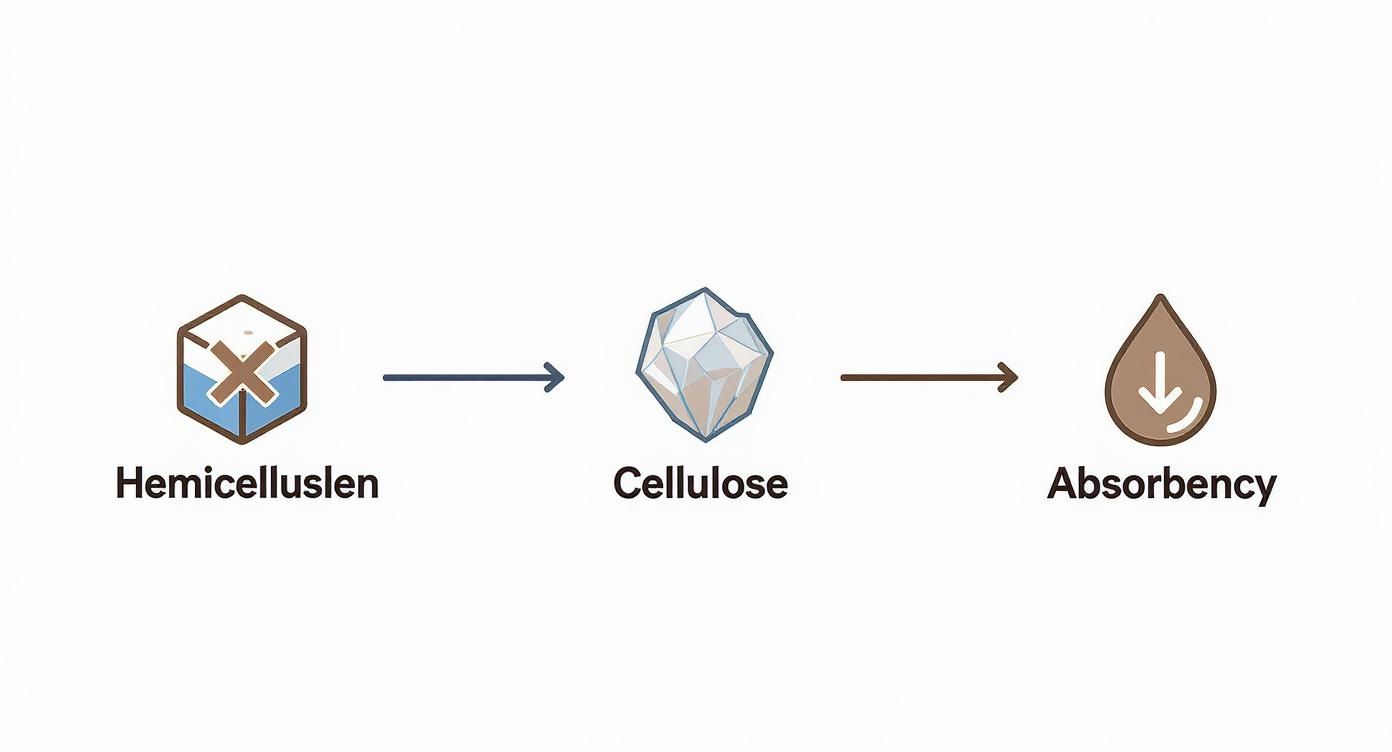
As you can see, the sugary hemicellulose is broken down, the cellulose crystallises, and as a result, the wood becomes far less absorbent. It’s these core changes that are responsible for the huge boost in durability and stability.
To give a clearer picture of how these leading methods compare, this table highlights their key features.
Comparison of Common Thermal Modification Processes
This table provides a comparative overview of leading industrial thermal modification methods, highlighting their key characteristics and typical applications.
| Process Name | Origin | Key Process Feature | Primary Applications |
|---|---|---|---|
| ThermoWood® | Finland | Uses high heat (180-215°C) and steam as a protective medium. | Cladding, decking, saunas, outdoor furniture |
| Plato® Process | Netherlands | A multi-stage process involving hydro-thermolysis followed by curing. | Window frames, doors, façade elements |
| Rectification Process | France | Heats wood in a low-oxygen environment, often using nitrogen. | Joinery, flooring, structural components |
Each of these technologies produces a premium, long-lasting material, but they achieve it through slightly different scientific pathways, making them suitable for a range of demanding applications.
A Contrast in Technique: Yakisugi
While modern industrial methods focus on deep, uniform modification, an ancient Japanese technique achieves incredible durability through a completely different philosophy: Yakisugi. This art, sometimes known as shou sugi ban, involves charring the surface of the wood with fire.
Unlike oven-based thermal modification that alters the wood’s internal structure, Yakisugi creates a protective carbon layer on the exterior. This charred surface acts as a powerful barrier against water, pests, and even fire.
The two approaches couldn’t be more different. Industrial modification is a slow, penetrating heat treatment that takes place in a highly controlled kiln. Yakisugi, on the other hand, is a rapid, intense application of raw flame directly to the wood’s surface.
Although both result in a beautifully darkened, highly durable material, they get there via two very distinct paths. One changes the wood from the inside out; the other builds a tough, protective shield on the outside in. The choice between them comes down to the aesthetic and performance you’re looking for. Industrial processes like ThermoWood® create a uniformly stable product, perfect for projects needing precision and consistency. Yakisugi offers a unique, textured appearance with robust surface protection, ideal for the kind of striking and resilient charred timber cladding we specialise in.
The Big Wins: Why Choose Thermally Modified Wood?
When you’re weighing up materials for a project, the case for thermally modified wood is incredibly strong. It’s not just a pretty face; this is a high-performance material, scientifically re-engineered to handle the toughest conditions. This translates into real-world value, offering a long-lasting, low-maintenance solution for everyone from homeowners to architects.
The magic all happens at a cellular level. The heat treatment fundamentally alters the wood’s structure, unlocking a new level of performance that its untreated counterparts simply can’t touch.
Incredible Resistance to Rot and Decay
One of the standout benefits is a massive boost in durability. The thermal process breaks down hemicellulose—the natural sugars in timber that are a magnet for mould, fungi, and insects. By essentially removing the all-you-can-eat buffet, the wood becomes a very unappetising home for these destructive organisms.
What you get is timber that’s naturally protected against rot from the inside out, without a single chemical preservative. This built-in defence ensures a much longer lifespan, which is a huge advantage in the damp UK climate where ordinary timber often gives up the ghost.
Exceptional Dimensional Stability
Ever noticed how a wooden deck can warp, cup, or twist over the years? That’s usually down to moisture. Wood absorbs water and swells, then shrinks as it dries, and this constant movement causes distortion. Thermally modified wood pretty much puts a stop to that.
The treatment makes the wood’s cell structure more crystalline, drastically reducing its ability to absorb water. The result is a remarkable improvement in dimensional stability—we’re talking reductions in swelling and shrinking of up to 50%.
This stability is a complete game-changer for outdoor projects. It means your cladding stays straight, your decking remains flat, and your joints stay tight. Your project will hold its clean, precise lines for years, no matter what the weather throws at it.
This predictable performance makes it a go-to material for professionals who can’t afford to take chances. It just works.
A Sustainable and Eco-Friendly Choice
In an era where sustainability is front and centre, thermally modified wood really shines. The entire process uses just heat and steam. There are no toxic chemicals, resins, or plastics that you’d find in many pressure-treated timbers or composite materials.
This makes it a safe choice for families and the planet. At the end of its long life, the wood can be recycled or disposed of without leaching nasty chemicals into the ground. If you’re keen to learn more, our guide on how to protect wood outdoors using non-toxic methods is a great read.
This chemical-free approach has sent its popularity soaring. Europe has embraced this technology, with the market now estimated to be worth over US$ 1.5 billion a year. That accounts for a 35% share of the entire global market, with the UK’s focus on sustainability being a key driver of that growth.
Rich Colour and Consistent Aesthetics
Performance aside, thermally modified wood is just beautiful. The process caramelises the wood, deepening its natural colour to a rich, luxurious brown that runs right through the entire board.
This allows more affordable, locally sourced softwoods like pine or spruce to take on the elegant look of expensive tropical hardwoods. It’s a stunning and sustainable alternative. While the wood will naturally weather to a classic silvery grey if left untreated, you can easily maintain that gorgeous original colour with a good UV-protectant oil.
This blend of beauty, durability, and eco-friendliness makes thermally modified wood a superior choice for a huge range of applications, delivering lasting value and total peace of mind.
Popular Applications and Use Cases in the UK
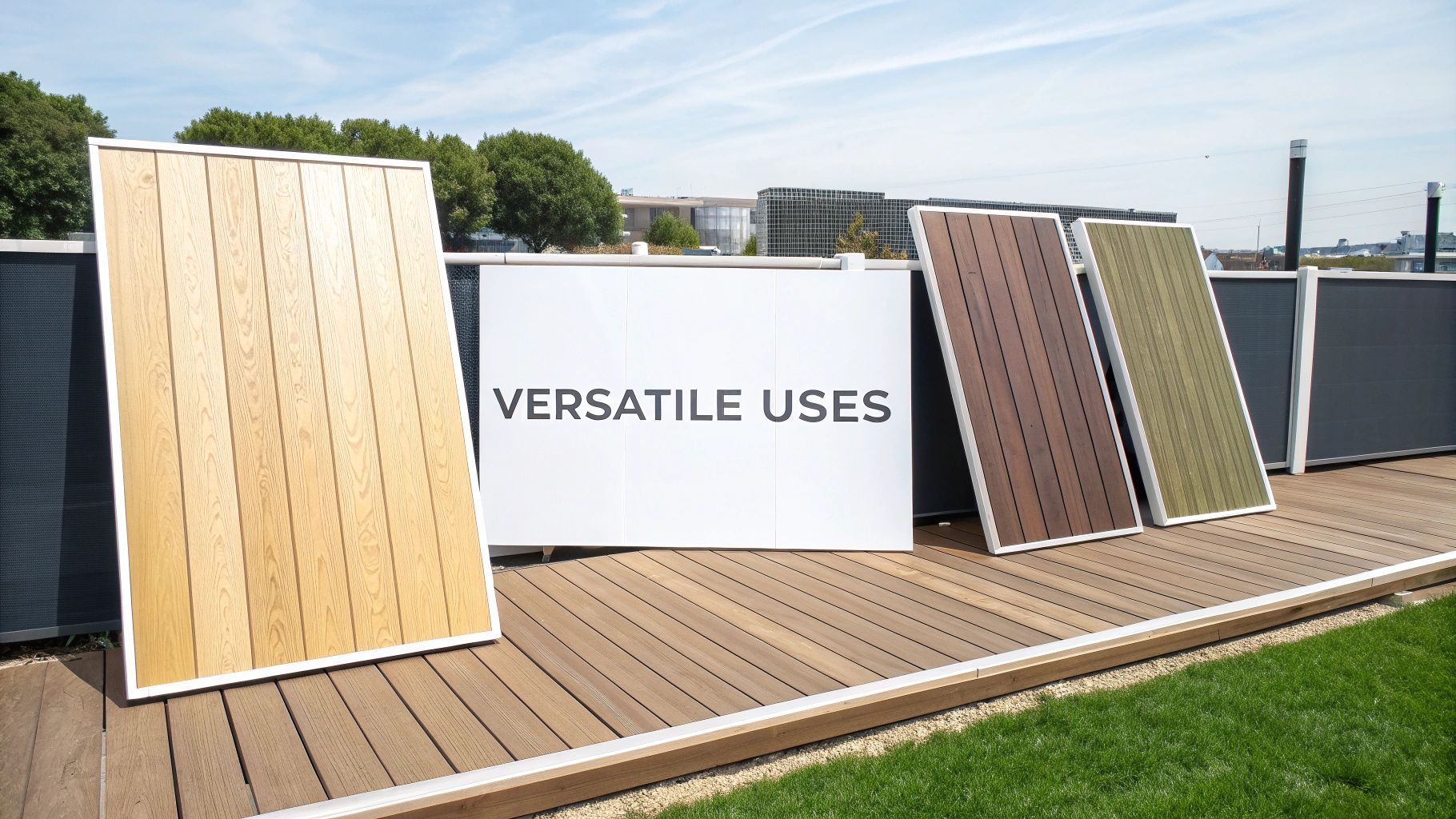
The best way to appreciate what thermally modified wood can do is to see it in action. Across the UK, you’ll find it everywhere from sleek city architecture to quiet garden getaways. It has quickly become the go-to material for projects that need to look good and last for years, offering a perfect blend of natural beauty and high performance.
The UK’s strict building regulations and focus on sustainability have really pushed this material into the spotlight. In fact, thermal treatment now makes up over 48% of the global modified wood market by revenue. This trend is especially strong in the UK, where the technology is well-established and has a proven track record.
Resilient External Cladding
External cladding is perhaps the most popular use for thermally modified timber, and for good reason. Its incredible dimensional stability is a game-changer. The wood simply refuses to warp or twist, keeping the lines of a building crisp and clean, even after years of facing the UK’s famously unpredictable weather.
This stability, coupled with its natural resistance to decay, results in a low-maintenance building exterior that’s built to last. It’s an ideal choice for siding, as seen in these Breeze Siding applications.
Whether it’s used to clad an entire home or just as a feature wall, it brings a warmth and character that can soften even the most modern designs. For a particularly striking finish, premium options like teak thermowood cladding offer an elegant look that truly stands the test of time.
Durable and Safe Garden Decking
This is another area where thermally modified wood shines. We’ve all seen traditional timber decks that have started to rot or splinter, but the thermal process creates a much safer and more durable surface for any outdoor living space.
Because the treatment is entirely natural and chemical-free, the decking is completely safe for bare feet, children, and pets. It also absorbs far less moisture, meaning it dries faster after a downpour and is less likely to become a breeding ground for slippery mould and algae.
The rich, deep colour of thermally treated decking gives you the luxurious look of an exotic hardwood, but with the sustainable credentials of locally sourced timber. It turns a simple patio into an elegant outdoor room.
Stylish and Long-Lasting Fencing
When it comes to marking a boundary, you need fencing that can take a beating from the elements. Thermally modified wood delivers both style and strength, giving you the natural aesthetic of timber without the short lifespan of untreated softwoods.
It’s the perfect material for crafting contemporary slatted screens or solid privacy fences that won’t twist or degrade. Its sheer longevity means fewer replacements down the line, offering fantastic value over the long term.
Interior Uses in Demanding Environments
The benefits aren’t just for the outdoors. The wood’s resistance to heat and humidity makes it an excellent choice for tricky interior spots where moisture is a constant battle.
You’ll often find it used for:
- Sauna Panelling: It holds its shape in high temperatures without warping or leaking sticky resin, creating a comfortable and safe atmosphere.
- Bathroom Cladding: In steamy bathrooms, the wood’s low moisture absorption prevents it from swelling and decaying.
- Flooring with Underfloor Heating: Its dimensional stability is crucial here, ensuring the floorboards remain flat and gap-free when laid over heating systems.
From exterior façades to interior wellness spaces, thermally modified wood is proving itself to be a reliable, beautiful, and versatile solution for projects all over the UK.
Your Questions Answered
As more people discover the benefits of thermally modified wood, a few common questions tend to pop up. Let’s tackle them head-on, so you have all the facts you need to decide if it’s the right choice for your project.
Does It Need Special Maintenance?
Although it’s incredibly tough against rot, thermally modified wood isn’t completely ‘set it and forget it’ when it comes to looks. Just like any timber, when left exposed to the sun, it will naturally weather to a beautiful silver-grey patina over time. It’s worth noting this is purely cosmetic – the wood’s durability isn’t affected one bit.
If you want to hang on to that rich, dark colour it had on day one, a simple coat of UV-protectant oil or sealant every few years will do the trick. How often you’ll need to reapply really just depends on how much direct sunlight the wood gets. A quick clean to get rid of dirt and grime now and then will also keep it looking its best.
Is It Actually Stronger Than Regular Wood?
This is a really common misunderstanding. The heating process actually makes the wood a bit more brittle, slightly reducing its bending strength compared to untreated timber. Because of this, you wouldn’t typically use it for heavy-duty structural jobs like load-bearing beams unless it’s been specifically engineered for that purpose.
But don’t let that put you off. Its strength is perfectly suited for its most popular uses.
For things like cladding, decking, and fencing, the huge improvements in durability and dimensional stability are what really matter. This trade-off is precisely what makes it a far superior material for these outdoor applications.
How Does the Cost Stack Up?
There’s no getting around it – thermally modified wood is a premium material, and the price reflects the advanced process it goes through. You can expect to pay more upfront than for standard pressure-treated pine, but it’s often a more budget-friendly option than some of the high-end exotic hardwoods.
The best way to think about the cost is as a long-term investment. Thanks to its incredibly long lifespan and low maintenance needs, it often works out to be more cost-effective over the entire life of your project. This is especially true when you compare it to cheaper timbers that might need replacing much sooner, or other treated options you can read about in our guide to non-toxic wood preservatives.
At TimberSol, we specialise in crafting exceptional charred timber products using the Yakisugi technique, offering unparalleled beauty and durability for your architectural projects. Explore our range of cladding, decking, and fencing to find the perfect sustainable solution for your design. Discover the possibilities at https://timbersol-backup.elnoirstudio.com.
