
Best Nails for Cladding: How to Choose the Right Type, Material and Size

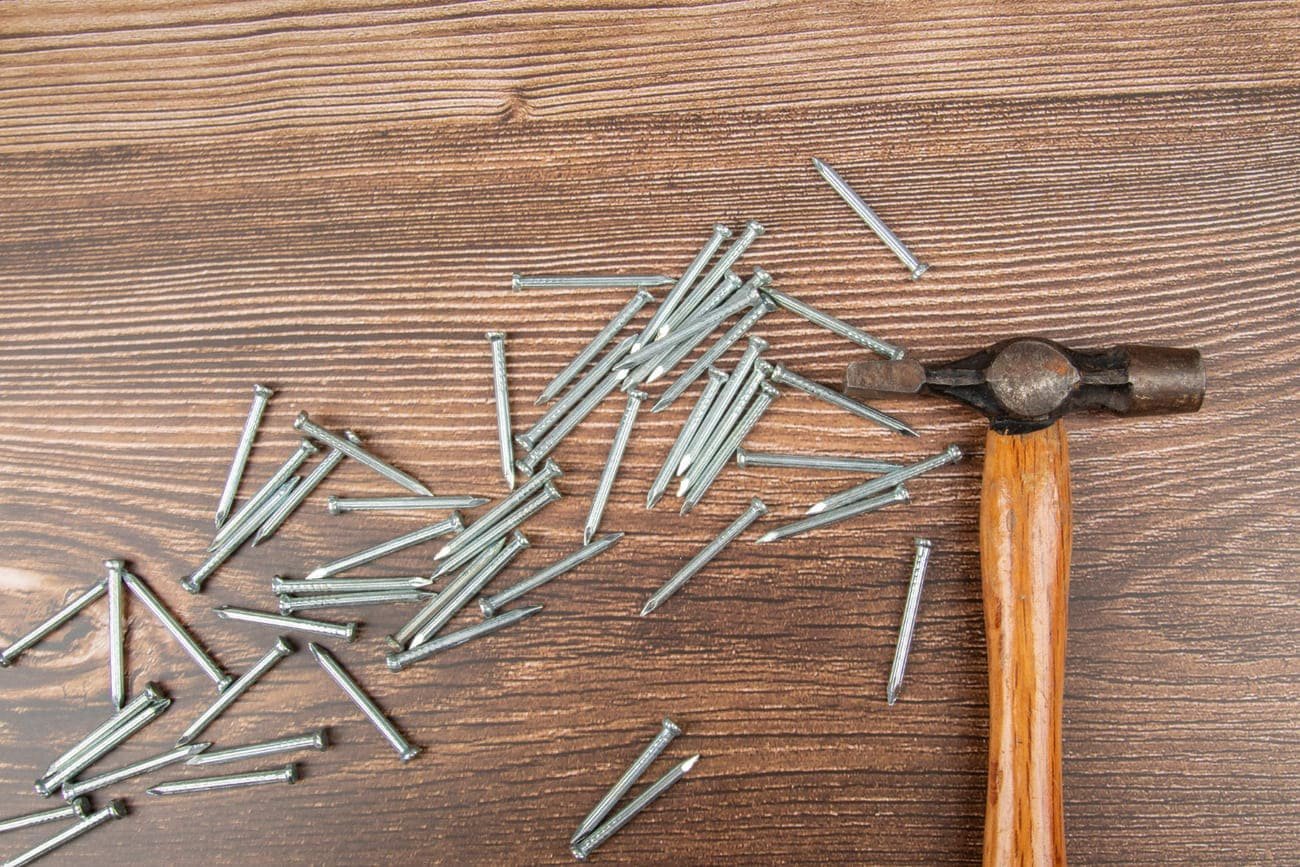
Stainless steel ring shank nails are commonly used for cladding and should be long enough to penetrate the batten adequately, although dense species such as oak and larch are often better fixed with stainless steel screws in pre-drilled holes. The appropriate stainless steel grade, such as 304 or 316, depends on the exposure conditions, particularly proximity to salt water.
Many cladding failures can be linked to incorrect fixings rather than the board itself. Plain wire nails can work loose as timber swells and shrinks, unsuitable metal fixings can react with extractives in cedar, larch and oak and cause staining, and nails driven too close to board ends can split the timber.
Getting it right means matching three things: the shank type to board movement, the metal to the species and site, and the fixing length to the board thickness. The sections below cover each choice in turn, then apply them to shiplap, feather edge and charred timber.
Choosing the Best Nails for Cladding: Ring Shank, Stainless Steel and Galvanised Explained
Stainless steel annular ring shank nails with a flat or round head, at least 2.3 mm in diameter and with a head at least twice the shank diameter, are recommended for external timber cladding in the TTF/TDCA Timber Cladding Handbook.
The TDCA lists austenitic stainless steel, high-performance coated steel and hot-dip galvanised steel to BS 7371-6 as suitable fixing materials. Aluminium, electroplated steel and brass are listed as unsuitable. Specification-gradecladding and fencing fixings are available for these applications.
Annular Ring Shank vs Smooth Shank Cladding Nails
Cladding boards swell and shrink with seasonal changes in moisture, and that movement can work a smooth wire nail loose. The USDA Wood Handbook records that withdrawal resistance can fall to roughly 25% of the value measured soon after driving when timber undergoes moisture changes. Under changing moisture conditions, annularly and helically threaded nails of the same diameter can provide about four times the withdrawal resistance of common wire nails, because the threads engage with the wood fibres.
Head size matters too. A board drying and cupping can pull over a small nail head, which makes lost-head, brad and pin nails unsuitable for face fixing. The Handbook therefore recommends large nail heads unless a proprietary secret-fix system is used.
For hidden fixing on shiplap and shadow gap profiles, a smaller head may be acceptable where the fixing is concealed by the next board. The shank should still provide adequate withdrawal resistance.
Stainless Steel vs Galvanised Nails for Cladding
Iron in unsuitable steel fixings can react with acids and extractives in timbers such as Western Red Cedar, oak and Douglas fir, causing permanent black spotting and corrosion staining. The Scottish Executive recorded black stains on unseasoned European larch within two weeks of galvanised steel fixings being installed.
Grade 304 (A2, 1.4301) stainless steel is suitable for most UK sites. In coastal or industrial environments, specify grade 316 (A4, 1.4401); see cladding for coastal houses.
Hot-dip galvanised ring shank nails can be suitable for treated pine or spruce feather edge and painted boards, where staining is less of a concern. The TDCA warns against damaging the zinc coating during installation, as exposed steel can corrode.
USDA FPL tests found thermally modified oak roughly 50% more corrosive to carbon steel and thermally modified ash nearly three times more corrosive. Stainless steel fixings are therefore recommended for thermally modified timber.
Screws or Nails for Cladding? Best Fixings for Cedar, Larch, Oak and Softwood
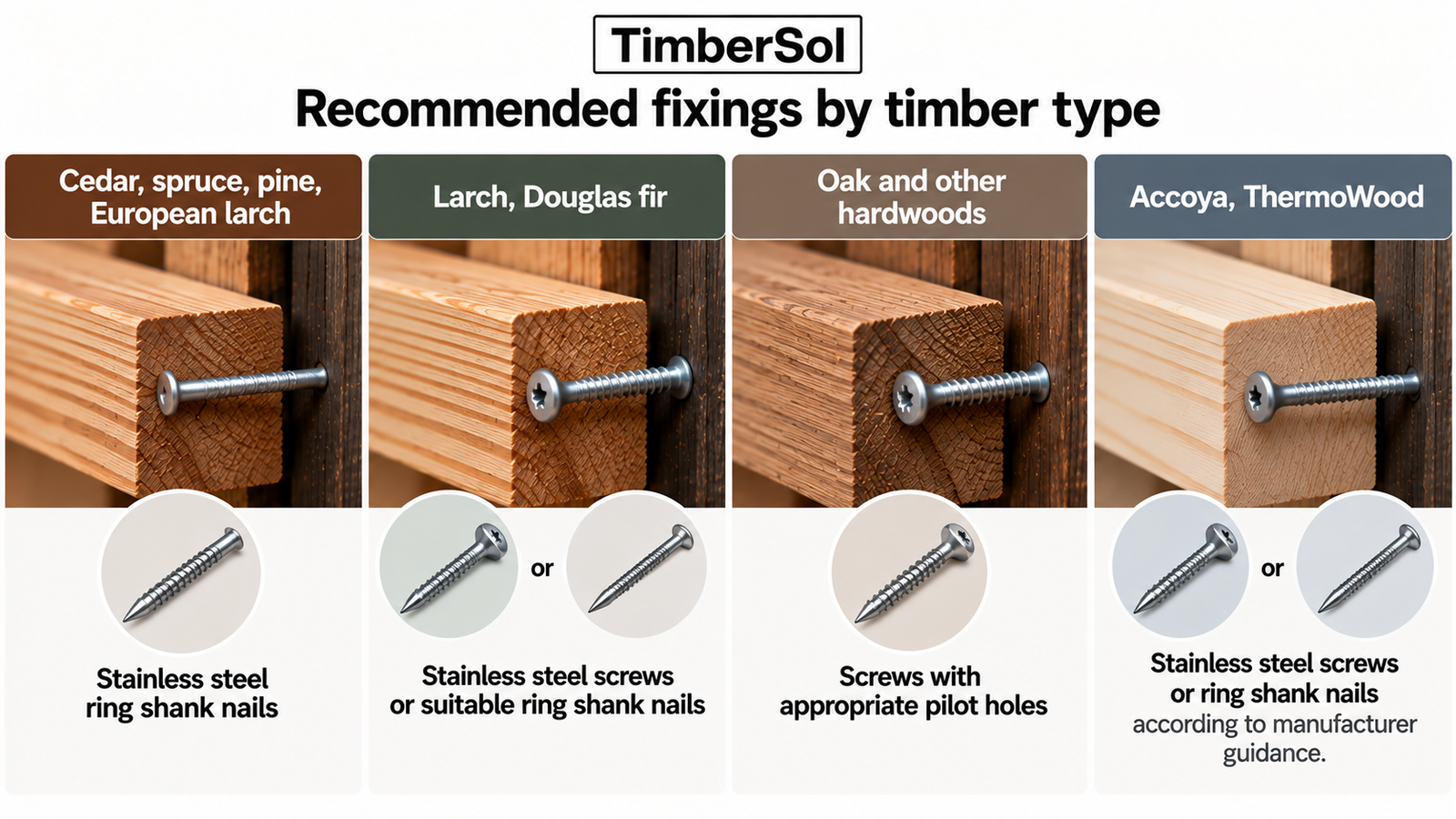
Timber density influences the choice of fixing. The TDCA recommends ring shank nails for most cladding softwoods, and stainless steel screws with pilot holes for hardwoods and denser softwoods such as larch and Douglas fir. Screws also allow boards to be removed and re-fixed.
Nails are generally faster and cheaper per fixing. Screws, however, can provide higher withdrawal resistance in dense timber, where a nail may be more likely to bend or split the board. Fixing diameter and length should follow the cladding and fixing manufacturer’s specification.
- Cedar, spruce, pine: stainless steel ring-shank nails
- Larch, Douglas fir: stainless steel screws, pre-drilled near board ends, or suitable stainless steel ring-shank nails
- Oak and other hardwoods: screws with appropriate pilot holes
- Accoya, ThermoWood: stainless steel screws or ring shank nails according to manufacturer guidance
Best Nails for Cedar, Larch and Treated Softwood
Western Red Cedar is generally fixed with grade 304 stainless steel ring shank nails with a flat head. Its low density means small heads can pull through the board, while unsuitable steel fixings can leave black staining on the surface.
European larch can take the same stainless steel ring shank nails, but pre-drill near board ends to reduce the risk of splitting. USDA data puts western larch tangential shrinkage at about 9%, so flat-sawn boards can move noticeably across their width. Origin also affects durability; “larch” alone is not a complete specification.
Treated spruce and pine feather edge on sheds can be fixed with galvanised or stainless steel ring shank nails. Stainless steel is generally the safer choice for visible, unpainted applications.
Screws for Oak, Siberian Larch, Douglas Fir and Modified Timbers
Oak takes stainless steel screws in pilot holes. Green oak needs pilot holes at least 4 mm oversize and washers or fixings with larger heads to accommodate shrinkage, plus battens at a maximum of 400 mm centres (TTF/TDCA).
Larch and Douglas fir can resist nailing and split near board ends, so pre-drilling may be needed when using stainless steel screws.
Accsys specifies A2 stainless steel for Accoya in general applications and A4 on coastal or industrial sites, and excludes galvanised, zinc-plated, staple and T-nail fixings; pre-drill to 80% of the screw shank diameter. Stora Enso recommends stainless steel 60 × 2.5 mm annular ring nails for ThermoWood, with pre-drilling near board ends.
TimberSol fits charred cladding with A2 Tiger-TX cladding screws (4 × 45 mm, CB10 black finish, slash point) at approximately 40 screws per m².
What Size Nails to Use for Cladding: Length, Gauge and Nail Gun Compatibility
The traditional rule for nail length is roughly 2.5× the board thickness, but the TTF/TDCA guidance uses board thickness plus 24 mm, including at least 19 mm penetration into the batten. A standard 20 mm board therefore requires a nail at least 44 mm long, making 50 mm a practical standard size.
Where the nail passes through an overlap, as on some cladding details, calculate the nail length based on the combined board thickness. The batten must also accommodate the required nail penetration without the point reaching the membrane.
Use ring shank nails at least 2.3 mm in diameter, with heads at least twice the shank diameter. Nail diameter should also suit the timber density and board dimensions to reduce the risk of bending or splitting.
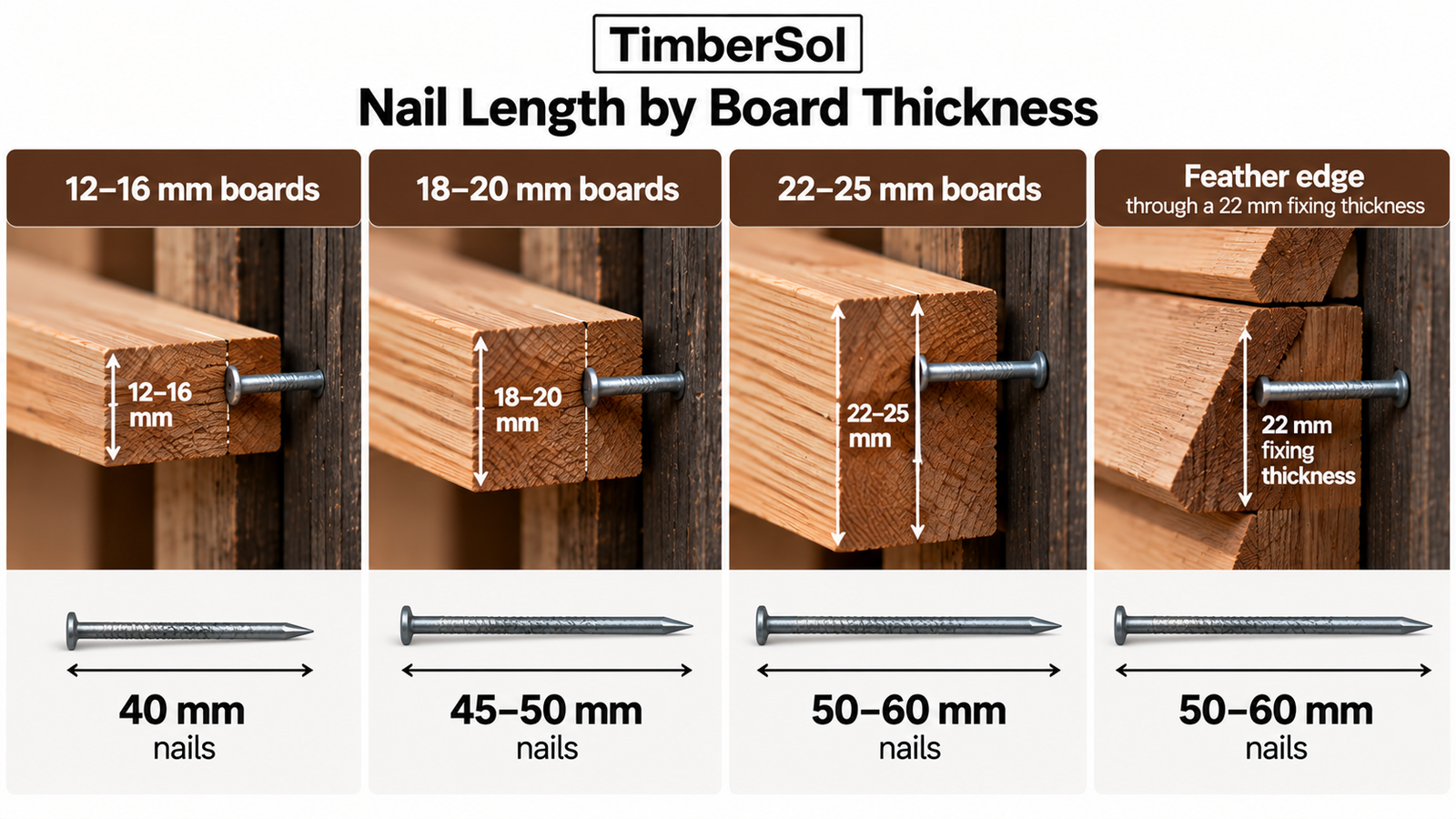
Nail Length by Board Thickness
Applying the traditional 2.5× rule and the thickness-plus-24 mm guidance gives approximate working lengths rather than fixed standards:
- 12–16 mm boards: 40 mm nails
- 18–20 mm boards: 45–50 mm nails
- 22–25 mm boards: 50–60 mm nails
- Feather edge through a 22 mm fixing thickness: 50–60 mm nails
Board width also affects the number of fixings. The TDCA specifies one central fixing for boards under 100 mm wide and two fixings, positioned about 25% in from each edge, for boards 100 mm wide and above. Manufacturer-specific guidance may differ for products such as Accoya and ThermoWood.
The board calculator estimates board quantities, so fixings can be budgeted alongside at approximately 40 screws per m² for TimberSol face-fixed cladding; add at least 10% wastage.
Where to Nail Cladding Boards Without Splitting
Keep fixings at least 20 mm from board ends and pre-drill where necessary to reduce the risk of splitting. In board-on-board cladding, never fix the top board through the board underneath, as seasonal movement between the boards can cause splitting.
On tongue and groove and loglap profiles, avoid fixing through the tongue itself. Where the profile is designed for secret fixing, fix through the thicker section above the tongue so the next board conceals the fixing. Follow the profile manufacturer’s fixing position for shiplap.
Battens run at a maximum of 600 mm centres, reduced to 400 mm for diagonal boards or high-moisture-content boards such as green oak. Vertical cladding generally needs counter-battens to maintain drainage and ventilation; the cladding installation guide covers the full build-up. TimberSol’s 3.2 × 40 mm stainless steel secret fixings can be used with its Secret Fix profile to keep fixings concealed.
Nail Gun Gauge and Collated Cladding Nails
Collated stainless steel ring shank nails can be used for cladding where their dimensions meet the cladding specification and they are compatible with the nailer. The TTF/TDCA Timber Cladding Handbook recommends a minimum nail shank diameter of 2.3 mm, so typical 16-gauge nails at about 1.6 mm do not meet this recommendation.
Clipped D-head nails pack more tightly in the magazine but provide a smaller bearing area than full-round-head nails, which can reduce resistance to pull-through.
Drive fixings flush rather than countersunk. An overdriven head can crush wood fibres, damage coatings and create a recess where water can collect, so test the driving depth on offcuts first.
For external charred cladding, TimberSol recommends stainless steel screws rather than nail guns: softwood boards move with the seasons and can loosen nails over time, so nail guns are better suited to internal, sheltered installations.
Best Nails for Cladding: FAQ
What Nails Should I Use to Fix Shiplap Cladding?
Stainless steel annular ring shank nails are commonly used for shiplap cladding. Nail length should suit the board thickness and fixing detail, with roughly 40–50 mm suitable for many 16–20 mm boards. Follow the profile manufacturer’s guidance for the fixing position, particularly where the profile is designed for secret fixing.
Use one fixing per batten on boards under 100 mm wide and two fixings on boards 100 mm wide and above. In board-on-board cladding, do not fix the top board through the board below, as both boards need to move independently.
What Are the Best Nails for Feather Edge or Shed Cladding?
Galvanised or stainless steel ring shank nails can be used for treated softwood feather edge, with the nail length selected to suit the board thickness and required penetration into the batten. Drive one nail per batten through the thicker part of the board without fixing through the board beneath, so each board can move independently.
Stainless steel is generally the safer choice for cedar or larch sheds, as unsuitable steel fixings can cause black staining. For garden rooms and offices, where appearance matters, treat the boards like house cladding.
Can You Nail Charred (Yakisugi) Timber Cladding?
You can, but TimberSol recommends stainless steel screws for external charred cladding: A2 (304) inland and marine-grade A4 (316) near the coast. Softwood boards move with the seasons and can loosen nails over time, and hammering can damage the brushed char surface. The timber beneath the char can still react with unsuitable steel fixings, so use stainless steel whichever fixing you choose.
Re-seal cut ends with matching charred timber coatings, follow the installation FAQs for the recommended expansion gap, and start with charred cladding samples to test fixings on the actual board.
The right fixing is one matched to the timber, the exposure and the board profile, and for charred cladding that generally means stainless steel nails or screws installed carefully. At TimberSol, boards are charred, brushed and pre-oiled at our Boston, Lincolnshire workshop, so correct fixing remains important on site. Our A2 stainless steel fixings for cladding are designed for this material, with a black finish that blends into the char and a slash point designed to reduce splitting.
A charred cladding sample lets you test the surface, the shade and your chosen fixing on the actual board before committing to a full order. When the project is ready, our team is available by phone or email to discuss fixing centres, coastal grades and quantities.
