
Siberian vs British vs European Larch Cladding: Key Differences, Costs and Which to Choose

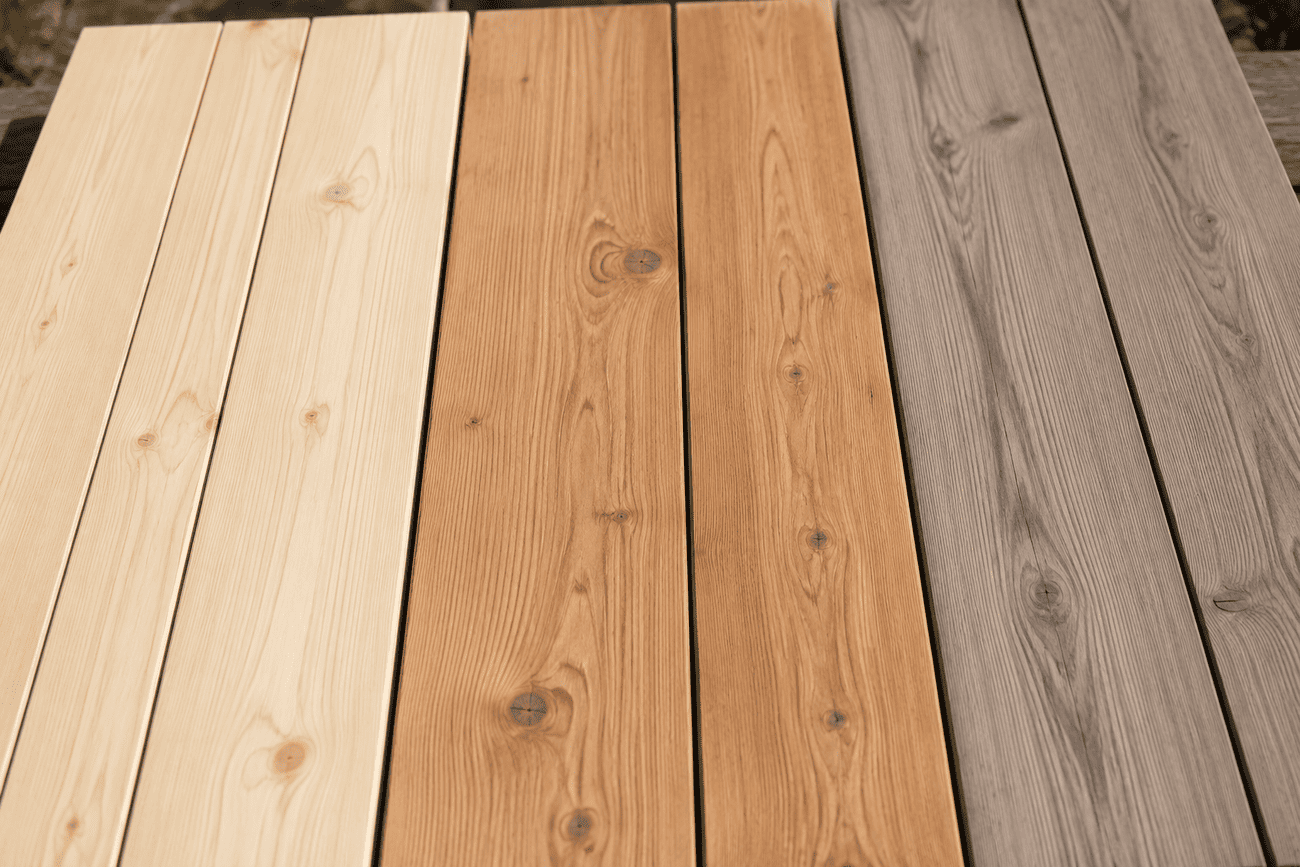
Choosing between Siberian, British and European larch cladding comes down to grain, knot frequency, density and supply because all three share the same EN 350 durability class for heartwood. The label on the invoice matters less than most buyers assume, and the differences that do matter rarely appear on a spec sheet.
There is also a complication that the trade often glosses over. Most “British larch” is actually Japanese or hybrid larch, while genuine Siberian larch has become scarce since the UK imposed sanctions on Russian wood products in 2022. Consequently, the real-world choice looks quite different from the one most comparison guides describe.
The sections below set out how the three larches compare in terms of appearance, stability, cost and UK availability, backed by Forest Research data and TDUK installation guidance, so you can specify the right board with confidence.
Siberian vs British vs European Larch Cladding: What’s the Difference?
The three larches differ mainly in density, knot frequency, colour and availability, not in official durability. EN 350 places the heartwood of all three larches in the same moderately to slightly durable band (Class 3–4), with sapwood classified as not durable (Class 5).
One correction first: “British larch” is mostly not European larch. According to Forest Research (McLean et al., 2024), of the 126,000 ha of larch in Great Britain in 2012, roughly 57% was Japanese larch, 30% was hybrid larch and only 13% was true European larch. The real choice is therefore between Siberian larch, British-grown Japanese or hybrid larch, and continental imports, often from Austria.
| Siberian | British (Japanese/hybrid) | European/Austrian | |
| Colour | Pale straw to golden | Pinkish-brown | Golden to reddish-brown |
| Knots | Fewest and smallest | Frequent and darker | Moderate |
| Density (kg/m³) | Higher end of EN 350 range | ~515 average | Mid-to-high |
| EN 350 class | 3–4 heartwood | 3–4 heartwood | 3–4 heartwood |
| Price band | Premium | Cheapest | Mid-range |
| UK availability | Restricted since 2022 | Variable | Steady imports |
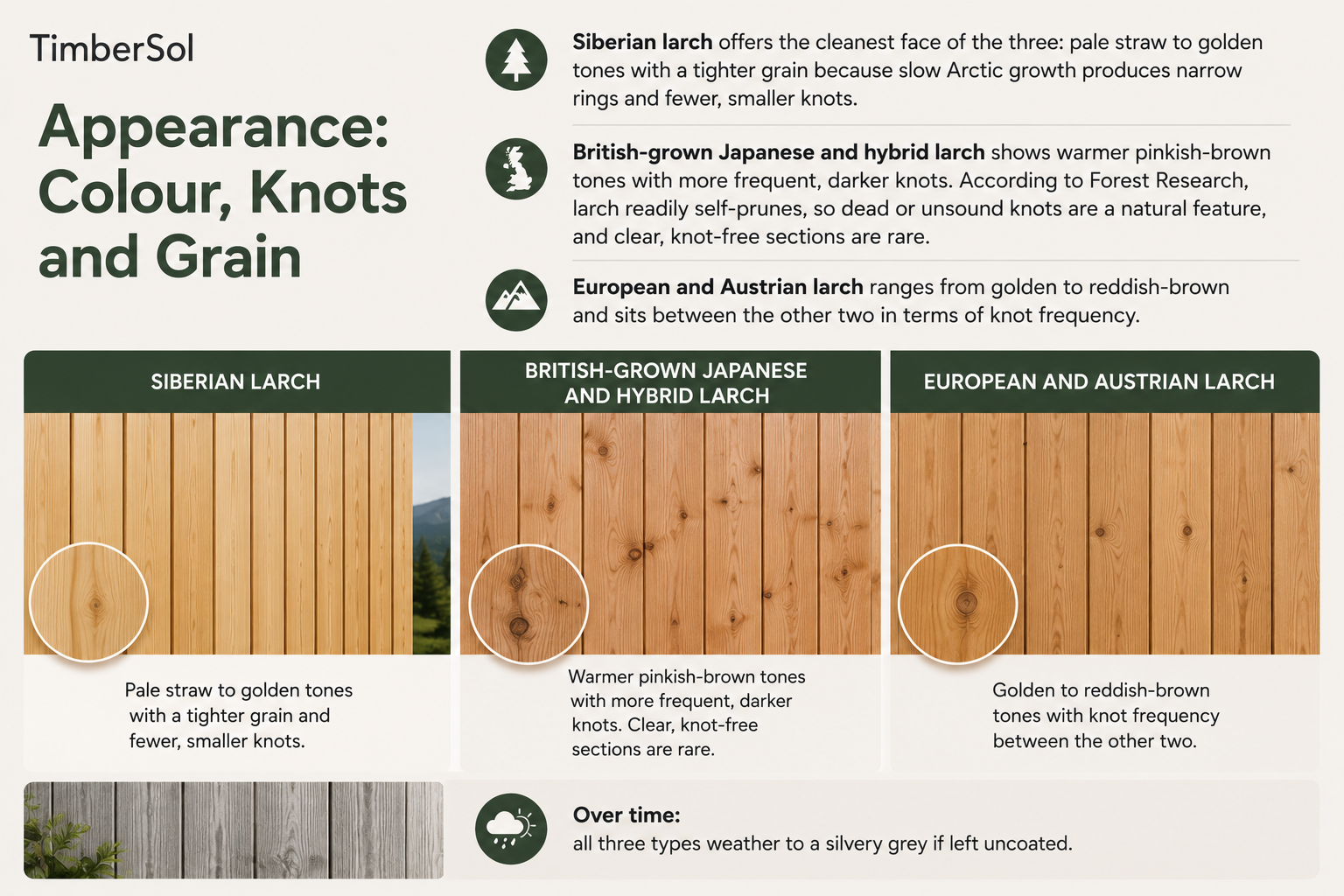
Appearance: Colour, Knots and Grain
Siberian larch offers the cleanest face of the three: pale straw to golden tones with a tighter grain because slow Arctic growth produces narrow rings and fewer, smaller knots.
British-grown Japanese and hybrid larch shows warmer pinkish-brown tones with more frequent, darker knots. According to Forest Research, larch readily self-prunes, so dead or unsound knots are a natural feature, and clear, knot-free sections are rare.
European and Austrian larch ranges from golden to reddish-brown and sits between the other two in terms of knot frequency.
However, their appearance converges over time: all three types weather to a silvery grey if left uncoated.
Density, Stability and Grading
According to Forest Research, the currently harvested home-grown larch resource averages around 515 kg/m³, with a coefficient of variation of roughly 11%. Siberian larch is listed in EN 350 as having similar durability but higher density, while UK-grown larch sits at the lower end of the range.
But denser is not automatically better. One Belgian dataset (Charron et al., 2003) suggests that the densest larch tested also shrank the most in every transverse direction, and movement is what opens joints and loosens fixings on a facade.
Grading matters more than species when it comes to price. Siberian larch is sold as Unsorted (I–III) or Sawfalling; British larch typically comes as Sawfalling or character grade, hence its lower cost.
Siberian Larch Cladding: Why It Set the Benchmark and Why It’s Hard to Buy
Siberian larch earned its reputation honestly. Forest Research notes that the UK cladding market was long served by imported Siberian larch, which was considered less knotty than home-grown alternatives, with its heartwood shown to have greater natural durability than that of other larch species (Jebrane et al., 2014). The same species is also used for Siberian larch decking, though cladding remains its primary UK use.
But supply has fundamentally changed. In March 2022, FSC suspended all trading certificates in Russia and Belarus, so no new Russian material can carry an FSC claim anywhere in the world. Separately, UK import sanctions covering Russian wood products were announced in April 2022.
These are two distinct barriers: sanctions govern what may legally enter the UK, while the FSC decision governs what may carry a certification claim. A board can clear one and fail the other.
Consequently, new Siberian larch in the UK is largely pre-sanction stock or material with a questionable chain of custody. Ask suppliers about the paperwork, not just the species name. Austrian imports and British-grown larch are the closest readily available alternatives.
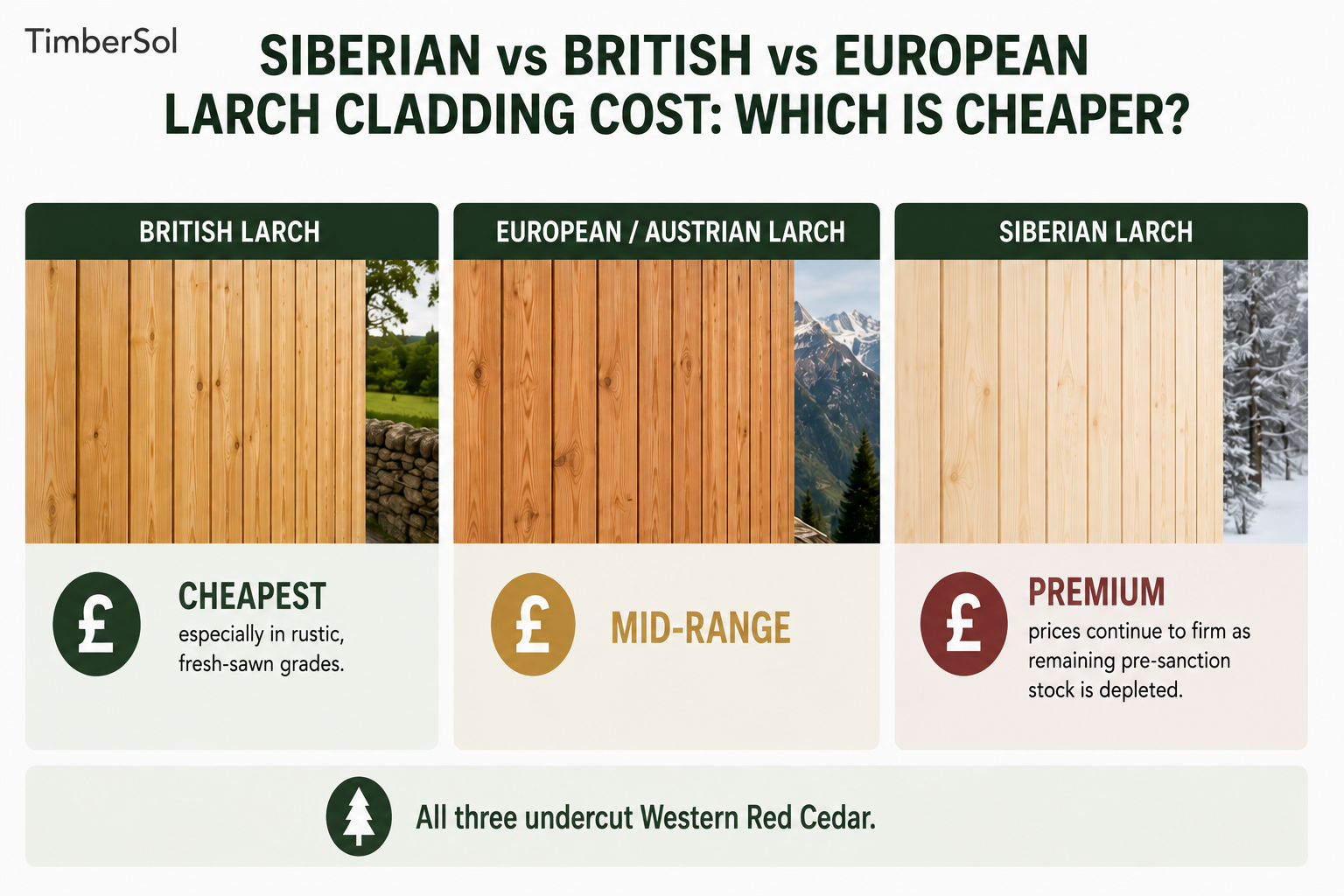
Siberian vs British vs European Larch Cladding Cost: Which Is Cheaper?
British larch is typically the cheapest of the three, especially in rustic, fresh-sawn grades. European and Austrian larch sit in the mid-range, while Siberian larch commands a premium. Siberian prices continue to firm as remaining pre-sanction stock is depleted. All three, however, undercut Western Red Cedar.
Grade drives price more than species does. Unsorted versus Sawfalling is the single biggest cost variable, followed by profile machining (shiplap or shadow gap), kiln drying, import and haulage costs, and any factory coatings or treatments.
British larch pricing carries a supply twist. According to Forest Research, Phytophthora ramorum sanitation felling has pushed short-term volumes onto the market, while the standing resource shrank from 126,000 hectares in 2012 to 100,000 in 2022. Consequently, British larch pricing and lead times are genuinely unpredictable, so check availability rather than assuming it.
For context on finished boards, TimberSol’s charred larch cladding is priced at £63/m² excl. VAT across all brushed and deep-char finishes. That figure shows where factory-finished boards sit relative to raw sawn larch.
Which Larch Cladding Should You Choose for Your Project?
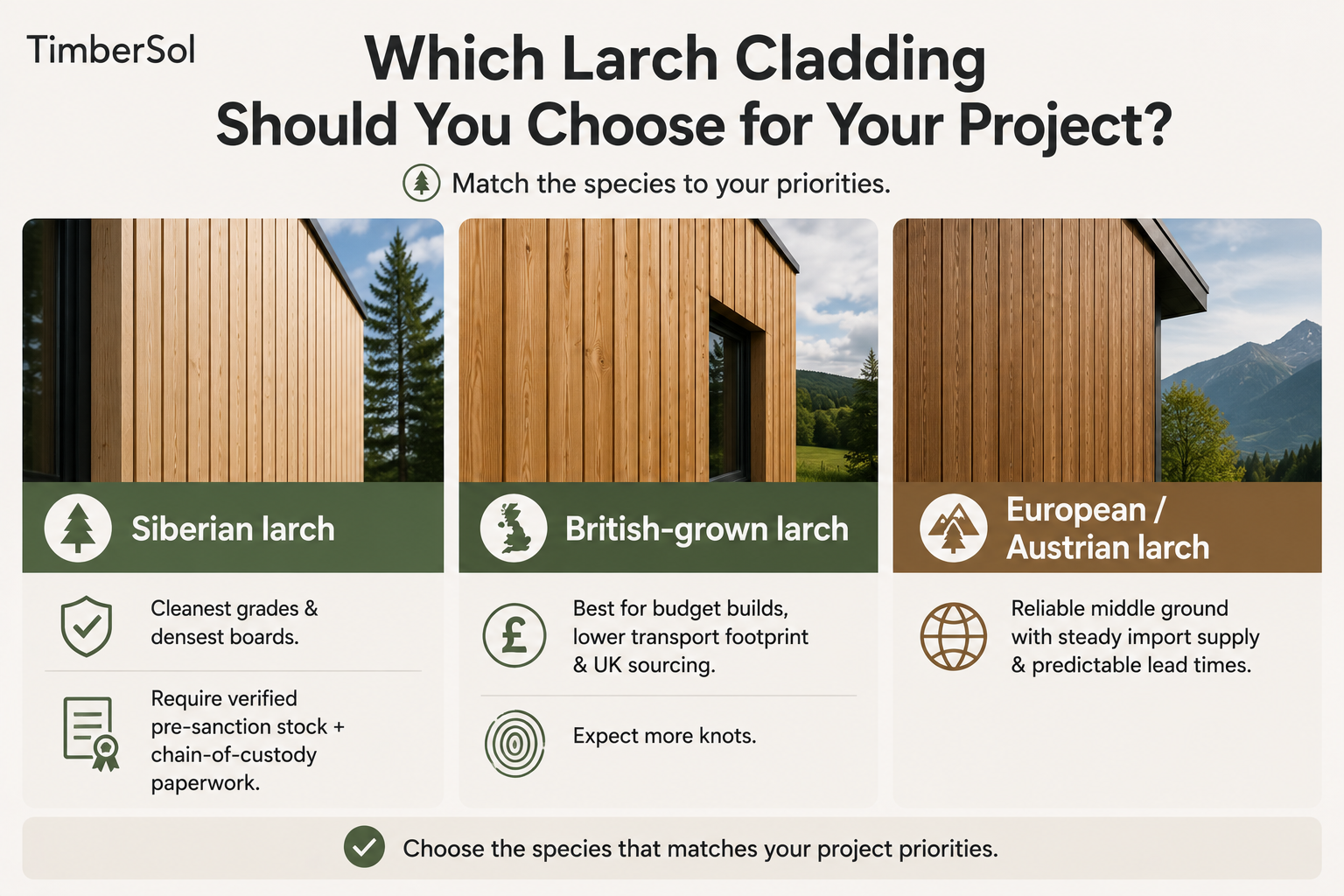
Match the species to your priorities:
- Siberian larch: choose it for the cleanest grades and densest boards, but only if the supplier can verify pre-sanction stock and provide chain-of-custody paperwork.
- British-grown larch: best for budget builds, a low transport footprint and home-grown sourcing, provided you accept more knots.
- European/Austrian larch: a reliable middle ground with steady import supply and predictable lead times.
Whichever you pick, installation determines lifespan more than species. TDUK guidance specifies a minimum 150 mm ground clearance, a ventilated cavity with a gap of at least 6 mm and insect mesh at the top and bottom, Use Class 3 treated battens, and non-ferrous fixings. NHBC has reported cladding failures caused by poor drainage, film-forming coatings and incorrect fixings across all species.
There is also a fourth route. Charred larch adds a protective carbon layer and oil finish to FSC-certified boards, giving a consistent modern look that avoids patchy silvering. TimberSol’s black larch cladding, for example, is Class 3 under BS EN 350, has a density of roughly 570 kg/m³ and is kiln-dried to 16–18%.
Before committing, order a charred cladding sample and compare the finish and shade in natural daylight.
Siberian vs British vs European Larch Cladding: FAQ
Can You Still Get Siberian Larch in the UK?
Only in limited quantities. UK import sanctions on Russian wood products, announced in April 2022, and the FSC’s suspension of Russian trading certificates mean that the remaining supply is largely pre-sanction stock. Whatever a supplier offers, ask for chain-of-custody documentation before ordering. Austrian and European imports, along with British-grown larch, are the closest readily available alternatives.
How Long Does Larch Cladding Last?
Correctly specified and ventilated larch cladding is commonly expected to last 30+ years, though no lifespan is guaranteed. Larch heartwood sits in Class 3–4 under EN 350, and Forest Research notes that it has the highest durability of the commercial home-grown softwoods. However, the sapwood is not durable, so it must be excluded or treated before the boards are installed on a wall. Because installation quality determines real-world lifespan, drainage and ventilation matter as much as species.
Is Siberian Larch Cladding Expensive?
Moderately. Siberian larch sits at the affordable end of premium cladding timbers: cheaper than Western Red Cedar but pricier than British-grown larch. Grade matters most, since Unsorted boards cost significantly more than Sawfalling material. Meanwhile, constrained post-sanction supply keeps Siberian prices firm and rising as the remaining UK stock is depleted.
What Are the Common Problems with Larch Cladding?
The main issues are resin bleed in the first 12–18 months, loose or dead knots, seasonal movement, surface checking and uneven silvering if left uncoated. Dead knots are more frequent in British larch since larch readily self-prunes. All three types are affected, but TDUK guidance helps manage the risks through non-ferrous screw fixings and simple overlapping profiles that accommodate moisture movement.
Whichever larch you settle on, charring takes the material a step further. At TimberSol, we char larch to create a protective carbon layer that improves its resistance to moisture, insects and decay, then brush and oil each board to produce a refined, low-maintenance finish. The result retains larch’s natural strengths while avoiding its familiar weathering quirks.
If you’re weighing up options for a façade, extension or garden building, ordering a sample is the easiest place to start. Browse our range of charred larch cladding in shades ranging from deep black to soft greys, and our team is on hand to help you match the right board, profile and finish to your project.
