
Accoya vs Thermowood: Durability, Price, and Which Wood Is Best for Your Project

Accoya and Thermowood are often grouped into the same category of high-performance modified timber, but they achieve their durability in very different ways. One relies on acetylation, a wood-modification process that dramatically improves stability and lifespan, while the other uses heat and steam to enhance durability without the use of chemical additives. This distinction influences everything from cost and strength to long-term maintenance requirements.
Both materials outperform conventional softwoods and have become popular choices for cladding, decking and exterior joinery. However, the best option depends on your project’s priorities. Are you looking for maximum lifespan and dimensional stability, or a more budget-friendly timber that still offers excellent durability and weather resistance?
In this guide, we’ll compare Accoya and Thermowood side by side, examining durability, lifespan, price, maintenance requirements and real-world performance to help you decide which modified timber offers the best value for your project.
What Are Accoya and Thermowood? Two Modified Woods Explained
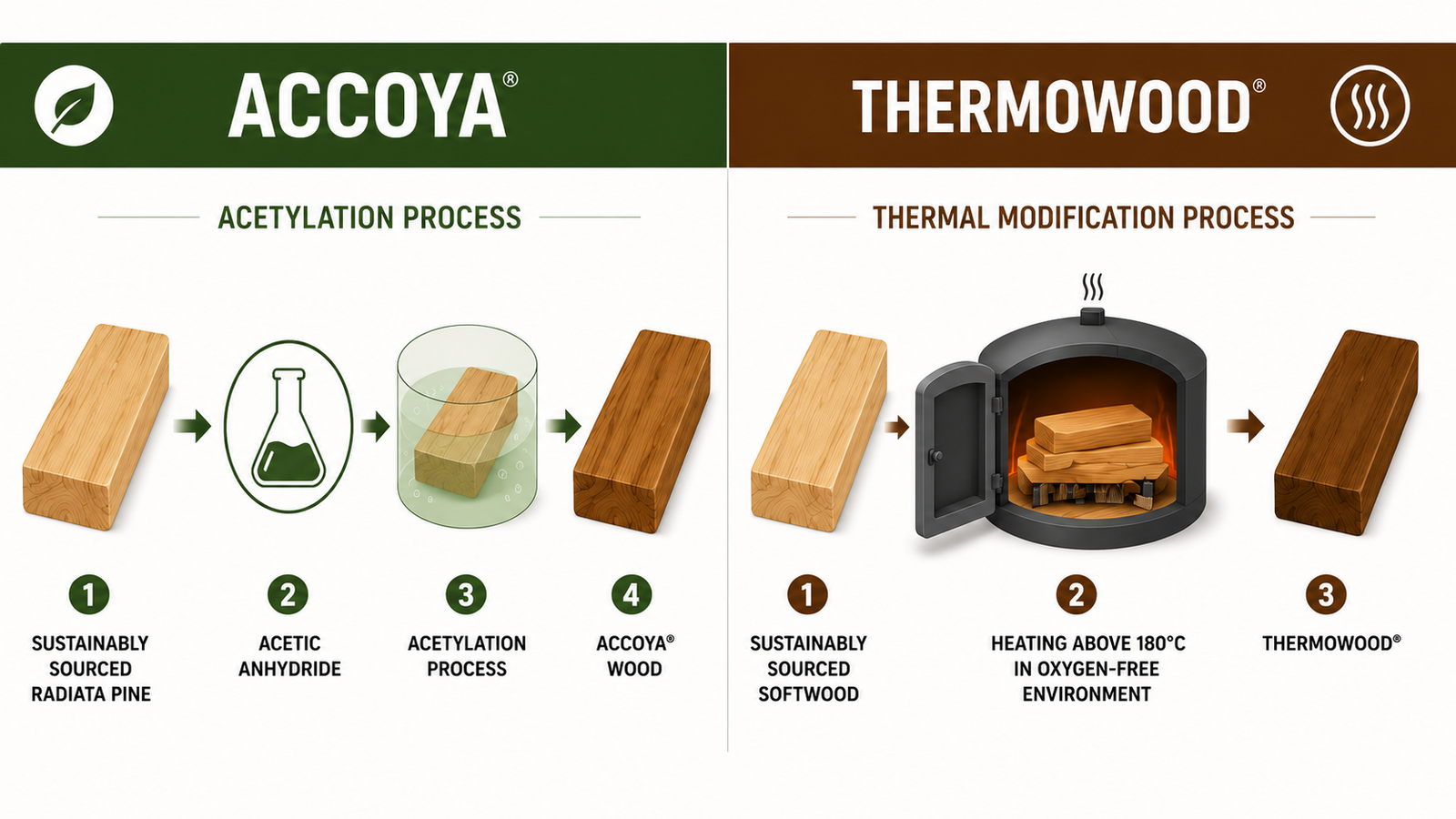
The core difference is simple: Accoya is modified through acetylation, while Thermowood is heat-modified using only heat and steam. This distinction explains almost every subsequent difference in strength, cost, durability and appearance.
Accoya is made from fast-growing, FSC-certified radiata pine. During acetylation, the wood’s free hydroxyl groups, which normally absorb and release water, are converted into acetyl groups derived from acetic anhydride, a compound closely related to the chemistry of vinegar.
As a result, the timber can no longer readily absorb moisture, which significantly improves its dimensional stability and resistance to decay. It contains no added biocides and is classified as non-toxic.
Thermowood takes a different approach. The timber is heated to temperatures above 180°C in an oxygen-free environment, with no chemicals added at any stage.
This high-temperature process alters the lignin, cellulose and hemicellulose within the wood, reducing moisture absorption and degrading the hemicellulose that supports the growth of decay fungi. As a result, the timber becomes more dimensionally stable and more resistant to decay than untreated softwood.
Both are softwood-based modified timbers widely used for cladding, decking and joinery. Both can also be charred to create a Yakisugi (Shou Sugi Ban) finish, which adds a protective carbon layer and a distinctive dark surface.
TimberSol offers both species in a charred finish, allowing you to compare the same aesthetic across two different modification methods before making a decision.
Accoya vs Thermowood: Head-to-Head Comparison Table
Both timbers achieve the highest durability classifications under BS EN 350, yet they do so through different modification processes. These differences become clear when their key properties are compared side by side.
| Property | Accoya | Thermowood |
| Base species | Radiata pine (FSC-certified) | Spruce or pine (softwood) |
| Modification | Acetylation | Heat + steam above 180 °C |
| Durability class | Class 1 (BRE assessed) | Class 1–3 (depending on treatment process) |
| Lifespan / warranty | 60-year service life; 50-year above-ground warranty | 25+ years (thermo-spruce); 15+ years (thermo-pine), CATAS tested |
| Dimensional stability | Stable at board widths up to 200 mm (BM TRADA) | Shrinkage and swelling reduced by 50–90% |
| Bending strength | Retained, hardness slightly improved | Reduced by up to ~30% |
| Colour / aging | Greys if uncoated; durability unaffected | Rich brown, fading to silver-grey |
| FSC certification | Yes | Depends on supplier |
Thermal modification can elevate a non-durable Class 5 softwood to Class 1–3, as heat degrades the hemicellulose that supports the growth of decay fungi. Accoya has achieved a documented Class 1 rating in a BRE assessment, meeting the requirements for a 60-year service life under BS 8417.
In terms of dimensional stability, thermal modification reduces movement by roughly 50–90%, while Accoya has proven stable enough in BM TRADA testing to support wider board widths than larch or thermally modified pine.
The key takeaway is that both materials achieve the highest durability classes, but Accoya retains its strength, whereas Thermowood sacrifices some strength as a result of the thermal modification process.
Strength and Dimensional Stability Differences
This is where the two timbers genuinely diverge. Thermal modification can reduce bending strength by up to around 30%, with greater reductions occurring at higher treatment temperatures, as the process degrades hemicellulose. As a result, heavily modified Thermowood may become more brittle and less suitable for load-bearing applications.
Acetylation avoids this trade-off. As the process modifies the wood chemically rather than thermally, Accoya retains its bending strength and may even achieve a slight increase in hardness, making it a more suitable choice for applications where strength and dimensional stability are critical.
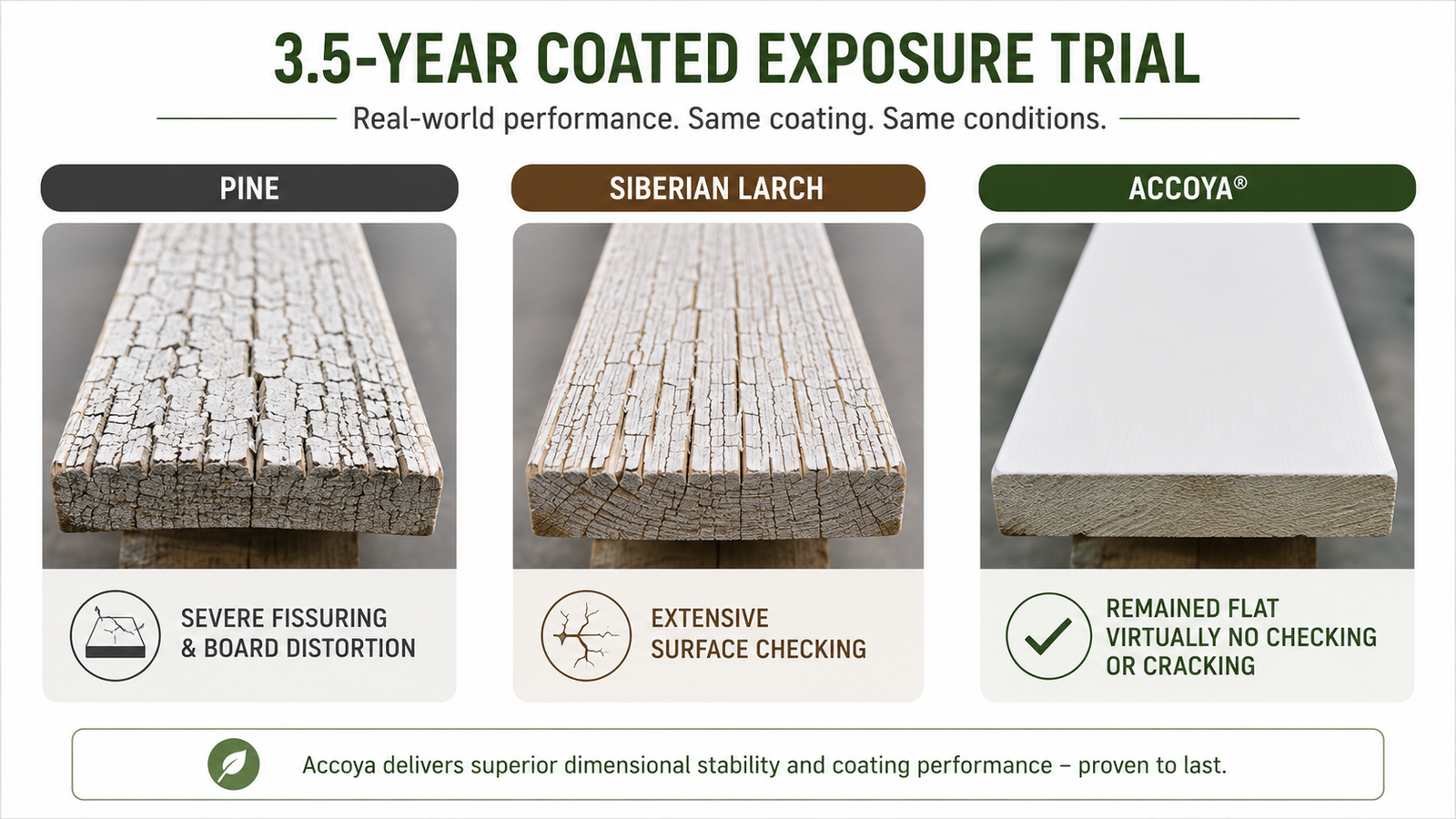
Stability tells a similar story. In a 3.5-year coated exposure trial conducted by BM TRADA in Buckinghamshire and begun in February 2007, pine showed severe fissuring and board distortion, while Siberian larch developed extensive surface checking. By contrast, Accoya remained flat with virtually no checking or cracking, helping to explain why it can accommodate wider board profiles than thermally modified pine.
Accoya vs Thermowood Price and Cheaper Alternatives
Accoya is the premium option, commonly quoted at around £100–£150/m² depending on the profile, while Thermowood sits below it as a mid-priced modified timber, cheaper than Accoya but more expensive than untreated softwood. These figures are indicative UK trade prices for 2026 rather than a fixed standard, so always confirm costs with a current quotation for your chosen profile.
The price gap narrows once the whole-life cost is taken into account. Accoya’s higher upfront cost is offset by fewer replacements and re-treatments over a documented 50–60-year service life, meaning the cost per year of service can be competitive with cheaper timbers that require replacement sooner.
For buyers working to a tighter budget, several more affordable alternatives are available, each with its own trade-off:
- Thermowood: lower cost, but a shorter lifespan and increased brittleness due to reduced bending strength.
- Tricoya: acetylated MDF that brings Accoya-style stability to board and panel applications, making it ideal for fascias and signage rather than structural uses.
- Pressure-treated softwood: the lowest-cost entry point, offering the shortest lifespan and relying on biocide treatment to compensate for the timber’s natural susceptibility to decay.
Charring suits both species and helps create a stable, dark finish, which is where comparing real boards can be particularly valuable. You can compare the two directly through our charred Accoya cladding and charred Thermowood cladding ranges.
Ordering a sample is a simple, low-commitment first step before requesting a tailored quotation.
Disadvantages of Accoya and Thermowood
Accoya’s main drawback is cost rather than performance. Its premium price reflects the patented acetylation process and brand positioning, placing it well above most modified timbers in terms of upfront cost. For shorter-term projects, its documented 60-year service life may exceed practical requirements, making value for money the key consideration rather than any technical limitation.
Otherwise, Accoya remains low-maintenance, dimensionally stable and strong, which is precisely what the premium price is intended to deliver.
Thermowood carries genuine performance trade-offs. Bending strength can decrease by up to around 30% because high temperatures degrade hemicellulose, making the timber more brittle. This can limit its suitability for structural applications and increase the risk of splitting around fixings, so careful installation and pre-drilling are important.
Colour is the other trade-off. Thermowood begins with a rich, dark brown appearance but fades to a silver-grey patina under UV exposure unless a UV-protective finish is reapplied regularly.
Accoya also weathers to a silver-grey patina if left uncoated. However, this colour change does not affect its durability or dimensional stability, and because the boards move very little, any coating applied is subjected to less stress. As a result, repainting and re-staining intervals are typically much longer than those of conventional softwoods.
Charring offers a practical way to achieve a stable, dark finish on either species. The controlled surface char of a charred timber finish retains its colour far better than an oiled dark stain, helping to avoid the fading associated with uncoated Thermowood. It also adds a protective carbon layer that improves resistance to moisture and insects.
Which Is Best for Decking, Cladding, or Windows?
There is no single winner. The right choice depends on the intended application, budget, level of exposure and how much maintenance you are willing to undertake over the lifetime of the project.
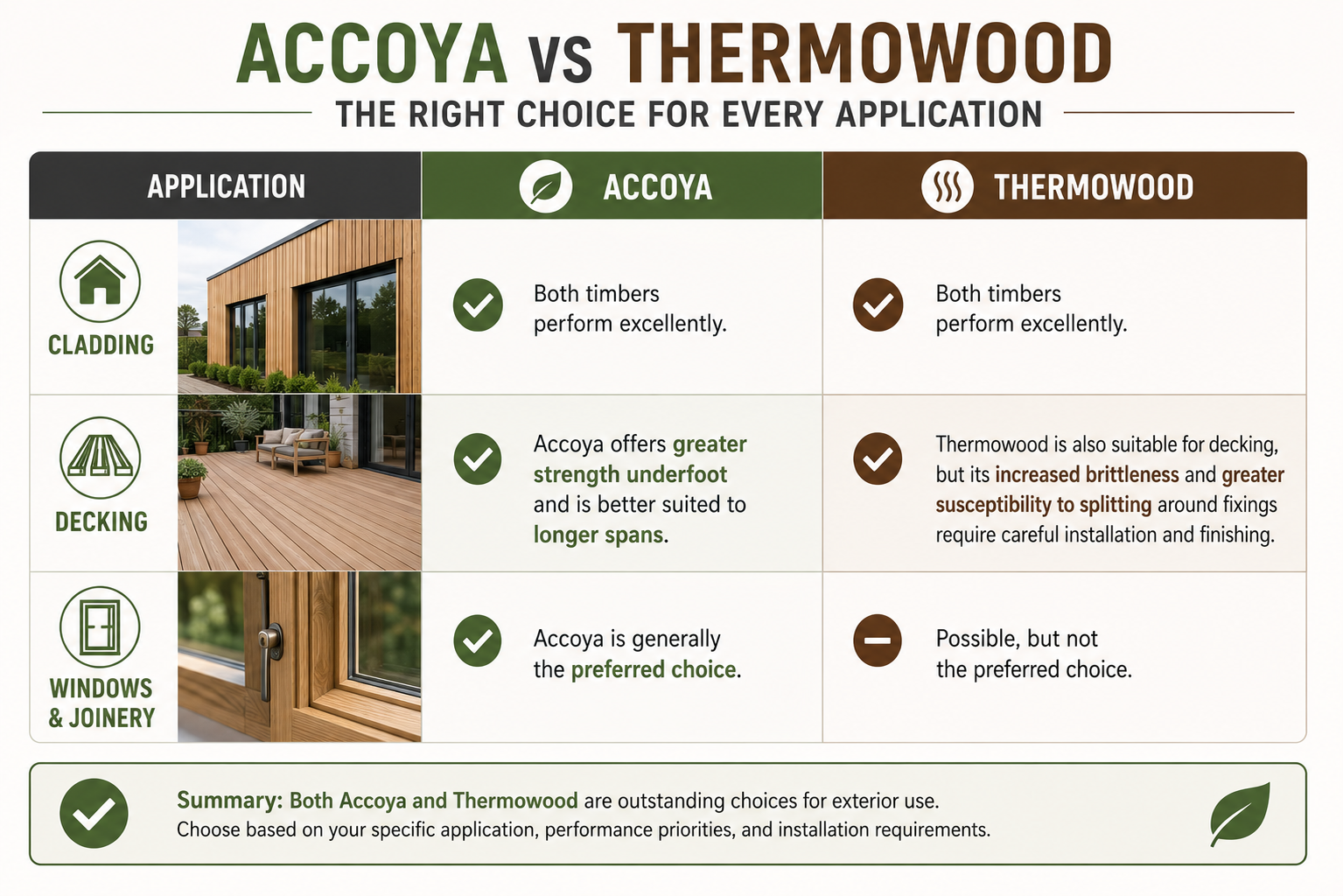
For cladding, both timbers perform excellently. Accoya suits high-specification, low-maintenance façades where a long service life and wider boards are important, as its stability allows board widths of up to 200 mm. Thermowood offers strong value for residential charred cladding projects where owners are willing to reapply oil periodically.
For decking, Accoya offers greater strength underfoot and is better suited to longer spans because acetylation preserves its bending strength. Thermowood is also suitable for decking, but its increased brittleness and greater susceptibility to splitting around fixings require careful installation and finishing.
For windows and joinery, Accoya is generally the preferred choice. Tight-tolerance frames require a timber that resists movement and retains its strength, qualities that acetylation is designed to provide. Thermowood, with its reduced bending strength, is typically better suited to non-structural cladding and surface applications.
Both also carry strong environmental credentials, which matters to many self-builders and architects. Thermowood relies solely on heat and steam, with no chemicals added during the modification process. Accoya is made from FSC-certified radiata pine, is non-toxic and 100% biodegradable, and holds Cradle to Cradle Certified® Gold status, with Platinum certification for Material Health.
So weigh the needs of the project carefully: choose Accoya for demanding, long-life applications, and Thermowood where budget considerations and periodic refinishing make sense.
Accoya vs Thermowood: FAQ
What Are the Disadvantages of Accoya Wood?
The main drawbacks are its premium price and brand-driven cost rather than any performance limitations. The patented acetylation process and strong market positioning place Accoya well above most modified timbers in terms of upfront cost.
For many projects, its 60-year service life and 50-year above-ground warranty exceed practical requirements, making value for money the key consideration. Beyond that, Accoya remains low-maintenance, dimensionally stable and strong, with coatings that last longer because the boards move very little in service.
What Is a Cheaper Alternative to Accoya?
Thermowood is the leading lower-cost alternative, with Tricoya serving board and panel applications and quality pressure-treated softwood providing a budget-friendly option. Each reduces upfront cost, but with associated trade-offs.
Thermowood costs less, yet offers a shorter lifespan, greater brittleness and faster colour fading. Tricoya is an acetylated MDF product suited to flat-panel applications, while pressure-treated softwood is the lowest-cost option but also the shortest-lived, relying on biocides rather than wood modification.
How Long Does Thermowood Last Compared to Accoya?
Thermowood typically lasts more than 25 years above ground in the case of thermo-spruce, and around 15 years for thermo-pine, while Accoya has a documented service life of 60 years. Accoya is backed by a 50-year above-ground warranty and a 25-year warranty for use in ground contact or freshwater applications.
These figures apply to above-ground applications, so real-world service life depends on exposure conditions, finishing and ongoing maintenance. Correct installation and periodic re-coating can extend the service life of both timbers.
Is Accoya a Hardwood or Softwood, and Is It Sustainable?
Accoya is technically a softwood, made from radiata pine, but after acetylation it performs similarly to a durable hardwood, achieving Class 1 durability under BS EN 350. This performance is driven by the acetylation process rather than the species itself.
It is also a genuinely sustainable choice: FSC-certified, non-toxic, 100% biodegradable and Cradle to Cradle Certified® Gold. Charring either species using the Yakisugi technique adds a stable, dark finish, and at TimberSol, both charred Accoya cladding and charred Thermowood cladding are available with samples to order.
Whether you choose Accoya or Thermowood, both modified timbers gain an additional layer of protection and a striking finish when charred. At TimberSol, we apply the traditional Japanese Yakisugi technique to both species, creating a protective carbon layer that improves resistance to moisture, insects and decay before brushing and oiling each board to achieve a refined, low-maintenance finish.
If you’re weighing durability against budget for your cladding, decking or fencing project, our team can help you match the right species and shade to your requirements. Order a sample of our charred Thermowood cladding, request a quotation, and see how a craft-led finish can elevate the timber you’ve chosen.
