
Best Wood for Shou Sugi Ban: Which Species to Char (and Which to Avoid)

For Shou Sugi Ban, larch is a common choice for UK exterior projects, while Accoya or thermowood can be suitable where boards face full weather exposure. Western Red Cedar can also be used where a finish closer to traditional Japanese yakisugi is desired. Spruce and Douglas fir also char well, but each differs in cost, durability and texture.
Choosing the wrong species is a common mistake in charred timber. Resinous pine can flare under the torch, dense hardwoods may char flat rather than cracking into the classic alligator pattern, and pressure-treated boards can release toxic fumes. Because charring typically modifies only the outer few millimetres of the board, the base timber still plays a major role in how long the cladding, fence or deck lasts.
The comparison below ranks each species on how it takes a char, how it weathers and what it costs in the UK, using EN 350 durability classes and published weathering trials rather than supplier claims. It also covers which woods to rule out, how long a charred surface can realistically last, and whether to burn your own boards or buy them pre-charred and oiled.
Which Wood Types Are Best for Shou Sugi Ban?
Straight-grained softwoods with strong earlywood/latewood contrast generally char well, while Accoya or thermowood can be suitable for full weather exposure. Porous earlywood burns faster than dense latewood, so pronounced growth rings can produce the raised alligator texture; dense, even-grained wood tends to char flatter.
The char layer itself stays relatively shallow, which is why the base timber’s durability class still plays a major role in performance.
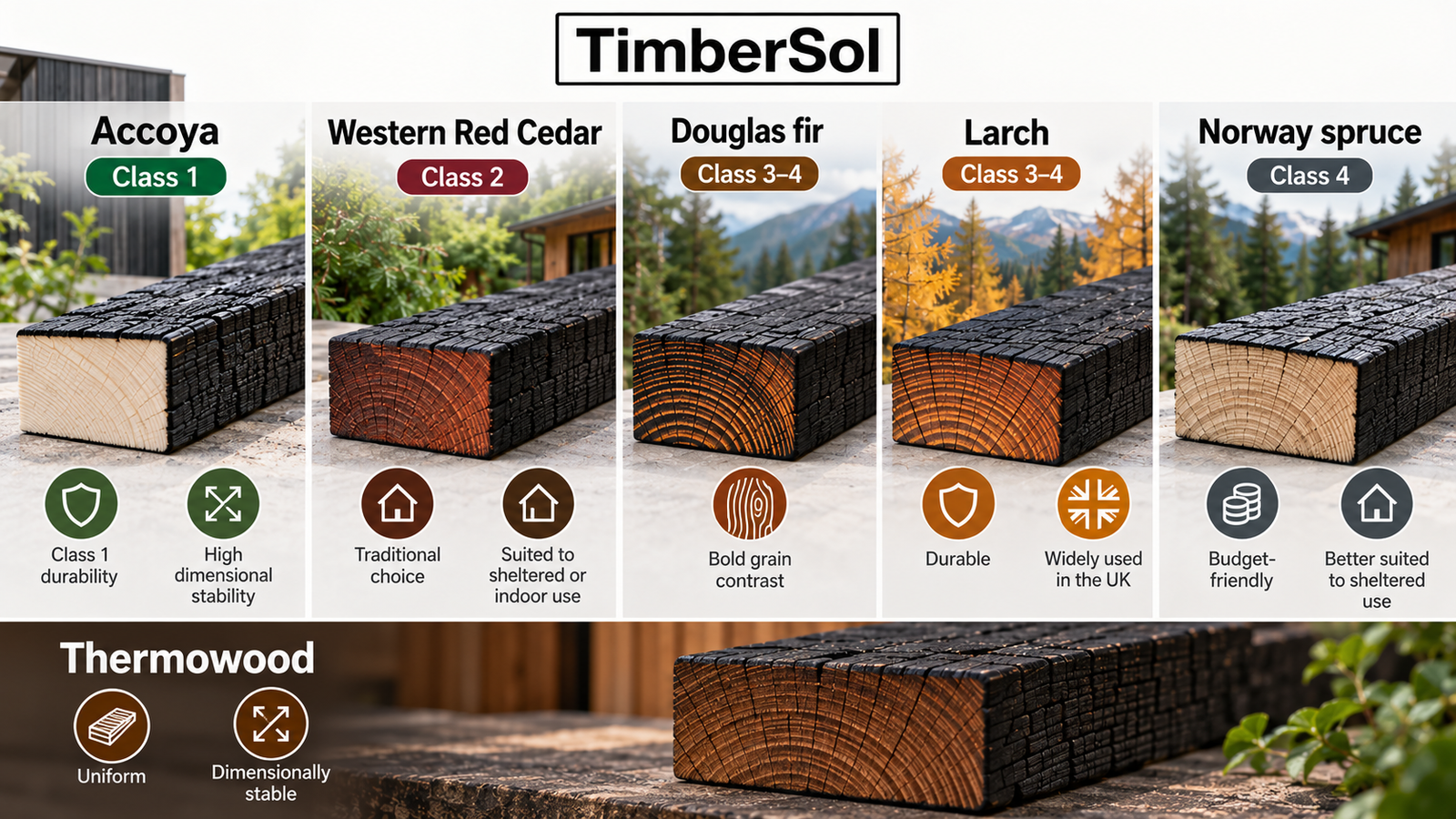
- Cedar: traditional choice, suited to sheltered or indoor use
- Larch: durable, widely used in the UK
- Douglas fir: bold grain contrast
- Spruce: budget-friendly, better suited to sheltered use
- Accoya: Class 1 durability, high dimensional stability
- Thermowood: uniform, dimensionally stable
Yakisugi (焼杉) means charred sugi; Shou Sugi Ban is a Western term for the same technique (see yakisugi technique explained).
Cedar (Sugi and Western Red Cedar): The Traditional Choice
Sugi is Cryptomeria japonica, a Japanese conifer rather than a true cedar. Western Red Cedar is a Western alternative: both are relatively light and low-density woods that can char quickly and evenly under a propane torch or in the traditional three-board chimney.
That softness helps explain the disagreement between sources. DIY and interior guides may rate cedar highly for its easy alligator texture, while some cladding manufacturers consider it too soft for fully exposed elevations, as the char layer can abrade faster.
The verdict: well suited to interiors, furniture and sheltered façades, with potentially more frequent oiling on exposed walls.
Western Red Cedar heartwood typically rates EN 350 durability class 2, among the better natural durability ratings for cladding softwoods. However, it is generally more expensive in the UK, so larch, Douglas fir and modified timbers are also widely used.
Accoya:A Dimensionally Stable Wood for Charring
Acetylation treats radiata pine with acetic anhydride, modifying the moisture-attracting hydroxyl groups in the cell wall. The timber then swells and shrinks far less, and becomes more resistant to fungal decay.
That low movement helps wide charred boards resist cupping and can reduce cracking at joints. Accoya holds EN 350 durability class 1 and comes with long manufacturer warranties for above-ground use.
In USDA Forest Products Laboratory cone calorimeter tests, uncoated acetylated charred samples released less total heat than controls, although this does not constitute a formal fire classification.
Charred Accoya cladding is suitable for exposed façades and coastal sites. Stock fluctuates, so it is quote-only with a 50 m² minimum.
Thermally Modified Pine (Thermowood)
Thermal modification heats pine to roughly 180–212°C in a low-oxygen environment. The heat degrades hemicelluloses, which lowers equilibrium moisture content and reduces swelling and shrinkage.
The treated timber is relatively uniform and low in resin, so it can char evenly and brush back to a linear grain with warm brown undertones behind the black. That consistency can suit large façades.
However, modification reduces bending strength, making thermowood better suited to cladding than structural applications; pre-drill fixings near board ends. It sits mid-range at £59/m² excl. VAT in Black, in 120 and 145 mm widths and 3.0–4.2 m lengths.
Larch, Douglas Fir and Spruce: Natural Softwoods for Charring
Larch, widely used for charred timber in the UK, typically rates EN 350 class 3–4. It is generally harder than spruce and can absorb less water, which can help the char layer last longer; pronounced growth rings give charred larch cladding a bold alligator pattern.
Douglas fir (class 3 North American, 3–4 European) is generally more durable than many pines but less durable than Western Red Cedar. Its orange-pink latewood gives charred Douglas fir high contrast, supplied in 145 mm width only.
Spruce (£46/m² excl. VAT in Black) is generally class 4 and can cup more than charred fir, while flame-charred spruce has shown good weathering performance after a year in Finland. Oil charred spruce cladding for fencing, garden rooms and sheltered walls; knots can char unevenly.
Where EN 350 gives a range, design to the less durable class. Sapwood is generally not durable.
Best Wood for Shou Sugi Ban Siding vs Interiors, Fencing and Furniture
Exterior cladding benefits from an abrasion-resistant char layer, low movement on wide boards, a ventilated cavity and sealed end grain, as the guide to charred timber cladding details. Accoya and thermowood can be well suited to exposed façades, followed by larch and Douglas fir, with cedar and oiled spruce better suited to more sheltered elevations.
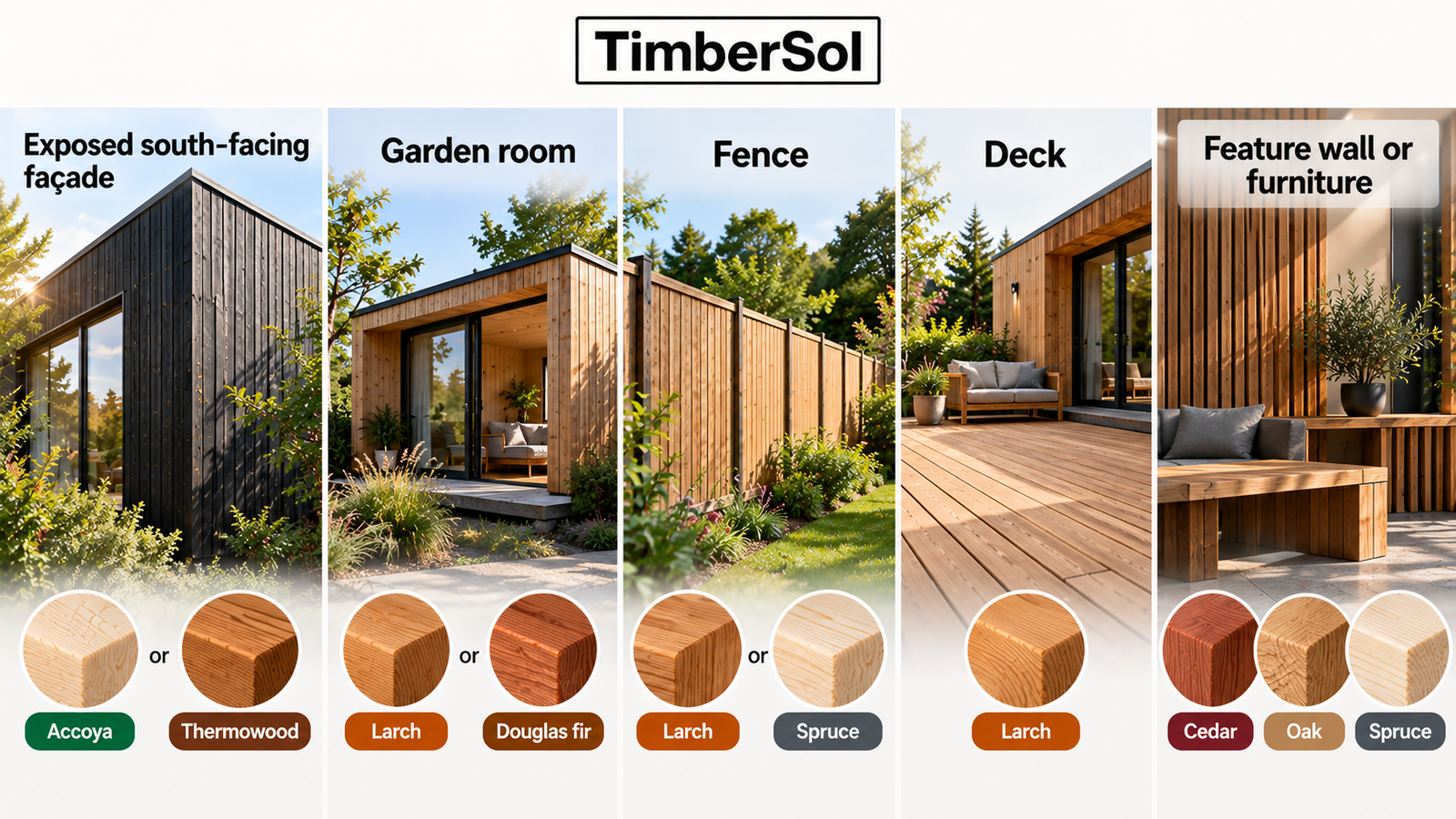
- Exposed south-facing façade: Accoya or thermowood
- Garden room: larch or Douglas fir
- Fence: larch or spruce
- Deck: larch
- Feature wall or furniture: cedar, oak or spruce
Exposure can shift those preferences. In the Ljubljana weathering study, the char layer was removed during two years of natural weathering even on coated samples, so on highly exposed walls the base species and maintenance schedule can matter more than initial char depth.
Fencing can be more forgiving. Larch and spruce are common choices where boards are narrower, replacement cost is lower and appearance may be secondary. Deep Carbon-style char is generally unsuitable underfoot, so decking can use brushed and oiled charred-effect timber such as oak or larch.
Indoors there is no direct weathering, and appearance is often the main consideration. Soft cedar, pine and dense hardwoods such as oak and maple can all work; brushed oak gives a smoother grain rather than an alligator texture. Properly brushed and oiled boards generally do not transfer soot in normal use.
Best Wood for Shou Sugi Ban in the UK: Cost, Availability and Where to Buy
Common shou sugi ban wood options in the UK include European larch, Douglas fir, Norway spruce and thermowood in cladding profiles. Western Red Cedar is imported and generally more expensive, while Accoya is available through selected merchants. US readers can also find Western Red Cedar, Southern Yellow Pine, Douglas fir and cypress.
Pre-charred prices per m² excl. VAT in Black give a benchmark: spruce £46, thermowood £59, Douglas fir £61, larch £63 and Accoya £147 (quote only, 50 m² minimum; other timbers 10 m²). Accoya costs more and offers class 1-equivalent durability and a manufacturer warranty. Larch sits around the mid-point on price while offering good hardness and a pronounced texture.
Torching your own boards can suit furniture, feature walls and small fences. A full façade, however, benefits from consistent char depth, kiln-dried stock, factory-applied oil coating and planned lead times (5–10 days in stock, 21–28 days made to order). TimberSol chars, brushes and oils its boards in-house in Boston, Lincolnshire.
Board calculators may exclude wastage, so allow around 10%; shadow gap and shiplap profiles can cover less than their nominal board width due to the joint or overlap. The siding cost breakdown explains budgeting further.
Start small. A charred cladding sample costs £2.49 excl. VAT, with samples available across five timbers and 10 finishes, so you can compare how different species and finishes look before committing.
Which Woods Are NOT Suitable for Shou Sugi Ban?
Do not burn pressure-treated lumber, painted or stained reclaimed boards, or engineered panels such as plywood, OSB and MDF. For exterior applications, also generally avoid resinous pine, sapwood-heavy boards and dense, even-grained hardwoods where a pronounced char texture is required.
The safety exclusions come down to chemistry. CCA-treated timber contains chromium, copper and arsenic, while newer ACQ and copper azole treatments contain copper and other biocidal compounds; heating can release hazardous fumes and leave contaminated ash. Engineered panels can delaminate, while their formaldehyde-based or other binders may release hazardous emissions under a torch.
Do not burn:
- Pressure-treated timber (CCA, ACQ, copper azole)
- Painted or varnished reclaimed wood (possible lead paint or solvent-based coatings)
- Plywood and OSB
- MDF and other fibreboards
- Any board with an unknown treatment history
Performance failures are less dangerous but can still be costly. Untreated pine can flare at resin pockets and scorch unevenly; in a Finnish outdoor trial, thick pine boards cracked extensively regardless of the charring method, and laboratory tests showed that charred pine sapwood absorbed more water rather than less. Untreated spruce sapwood (EN 350 class 4) is generally a poor choice for highly exposed south-facing cladding. Beech and maple can char more slowly and produce a flatter texture, so they are generally better suited to interior applications.
Charring is not a fire treatment.
In SBI tests on 32 mm spruce, an intact char layer reduced fire growth by about 35%, yet the boards remained Euroclass D; brushing increased the fire growth index and smoke production. Consequently, untreated charred timber does not meet the A2-s1,d0 or A1 requirement for external walls of relevant buildings over 18 m in England. The Japanese wood burning technique post explains what the process actually changes.
How Long Does Shou Sugi Ban Last, and Do You Need to Seal It?
Service life depends mainly on the base species, exposure and maintenance, rather than the char itself. Exterior charred timber can benefit from oiling and periodic re-oiling to help retain colour and slow char loss.
The USDA Forest Products Laboratory (Hasburgh et al., 2021) found no systematic durability or fire-performance improvements across the commercial charred wood products tested. Similarly, a 2022 Finnish decay study found mass losses of up to 32% in contact-charred spruce, compared with 56% in unmodified spruce. Charring can reduce decay in some conditions, but its effect depends on the wood, charring method and exposure.
Lifespan by Wood Species
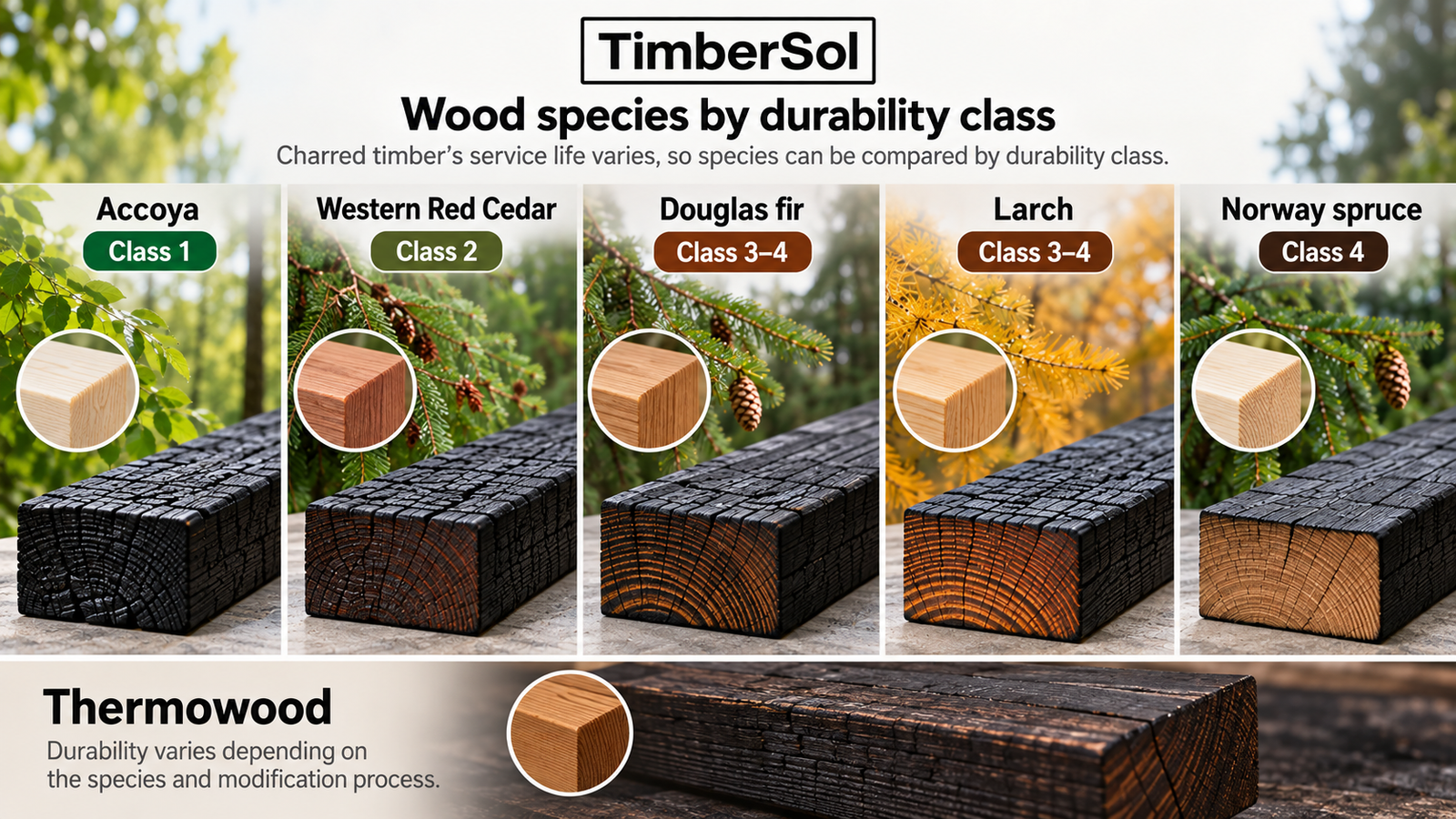
Charred timber’s service life varies, so species can be compared by durability class: Accoya class 1-equivalent, Western Red Cedar 2, Douglas fir 3–4, larch 3–4 and Norway spruce 4. Thermowood durability varies depending on the species and modification process.
In practice:
- Class 1–2: suitable for more exposed applications
- Class 3: suitable with appropriate detailing and a ventilated cavity
- Class 4: better suited to sheltered applications
Poor detailing can shorten service life regardless of species: trapped water behind boards, exposed end grain, unsuitable fixings, wide boards that can cup and crack the char, sapwood, and high UV exposure. The Ljubljana study found that charred boards changed colour far less than sanded ones (ΔE* up to about 9 versus 60) even as the char eroded, suggesting that colour can outlast the original char texture.
Specify boards around 20 mm thick, up to about 145 mm wide for less dimensionally stable species, stainless-steel fixings and a ventilated cavity of about 20–25 mm.
Sealing and Oiling After Charring
Unbrushed char gives a deep black finish but can shed soot, so it is better suited to low-contact applications. Brushed char plus penetrating oil (linseed, tung, hardwax or hybrid) can reduce soot transfer while allowing vapour movement. Film-forming varnish can peel as timber moves, so it is generally better suited to indoor applications.
Clear oil can deepen the black and reveal brown grain undertones; pigmented greys, teak or mahogany tones can tint the grain and contain UV blockers that help slow fading.
Recoat as needed, typically more often on south-facing than north-facing elevations, following the coating manufacturer’s guidance. Factory-coated boards generally need cut ends and drilled holes treated: re-char cut ends where required, brush off loose soot, oil exposed ends, then allow them to dry before fixing.
TimberSol’s Hi-Tech Hybrid Oil (£26/1 L, £71/3 L excl. VAT) is available in matching touch-up shades for factory-coated boards; see the coatings.
Best Wood for Shou Sugi Ban: FAQ
What kind of wood do you use for shou sugi ban?
Traditionally, Japanese sugi (Cryptomeria japonica) is used; in the UK and Europe, larch, Douglas fir, spruce and thermowood are common choices. Western Red Cedar is a Western alternative to sugi, while Accoya can be suitable for demanding exposed cladding. As a rule of thumb, light, porous, straight-grained softwoods with strong growth-ring contrast generally char evenly and can give the classic alligator texture.
Can you shou sugi ban pressure-treated wood?
No. Heating CCA-, ACQ- or copper azole-treated timber can release hazardous fumes and leave contaminated ash. Use untreated larch, Douglas fir, spruce or a modified timber instead. The same precaution applies to painted, varnished or stained reclaimed boards.
Can you shou sugi ban any wood?
Most solid, untreated woods can take a char, but density, grain structure and resin content affect the result. Softwoods with clear earlywood/latewood contrast can produce the alligator texture, whereas dense hardwoods tend to char more slowly and produce a flatter texture. Exclude plywood, OSB, MDF and treated or coated timber, and torch resinous pine cautiously.
Is pine a good wood for shou sugi ban?
Pine can work for interior projects and furniture and is generally affordable and widely available, but untreated pine is less suitable for exposed exterior applications. Resin pockets can flare during torching, thick pine boards cracked extensively in a Finnish weathering trial, and untreated pine sapwood has low natural durability. Thermowood and Accoya can both be pine-based, while thermal modification and acetylation improve dimensional stability and durability, making them more suitable for charred cladding.
Does shou sugi ban work on hardwoods like oak or maple?
Yes, with caveats. Oak and maple can require longer, more even torching and tend to produce a smoother, tighter texture rather than deep alligator cracking. Charred, brushed oak can suit furniture, interior feature walls and charred-effect decking. Hardwoods can also be used for exterior cladding, but their suitability depends on the species, detailing and exposure, and they can cost more per m².
Is shou sugi ban wood fireproof?
No. SBI tests on charred spruce kept the boards at Euroclass D, while brushed char showed poorer fire performance than intact char, and USDA Forest Products Laboratory testing found no systematic fire-performance improvement across the commercial charred wood products tested. Ask the supplier for the product’s fire classification, and specify appropriately classified cladding where Building Regulations require it, such as A2-s1,d0 or A1 materials for external walls of relevant buildings over 18 m in England.
Should I char my own boards or buy pre-charred shou sugi ban wood?
Charring your own boards can suit furniture, feature walls and small fences, where variation may be acceptable. A full façade, fence run or deck can benefit from pre-charred boards, as factory processing can provide more consistent char depth, oil coating, custom profiles and planned lead times. Browse charred cladding by species, order a sample, then request a quote.
Whichever species you settle on, the base timber still plays a major role, since the wood beneath the char layer is largely unchanged. At TimberSol we char, brush and oil our timber in-house in Boston, Lincolnshire, including spruce, thermowood, Douglas fir, larch and Accoya, each offering different charring characteristics and weathering performance.
A practical way to judge a species is to hold a board in your hand and see the char texture and shade in daylight. Order a sample in any of the ten finishes, and if you are planning a full façade, fence run or deck, get in touch for a quote and advice on which timber suits your site.
