
What Is the Best Cladding for a House? Materials Compared by Cost, Durability and Maintenance

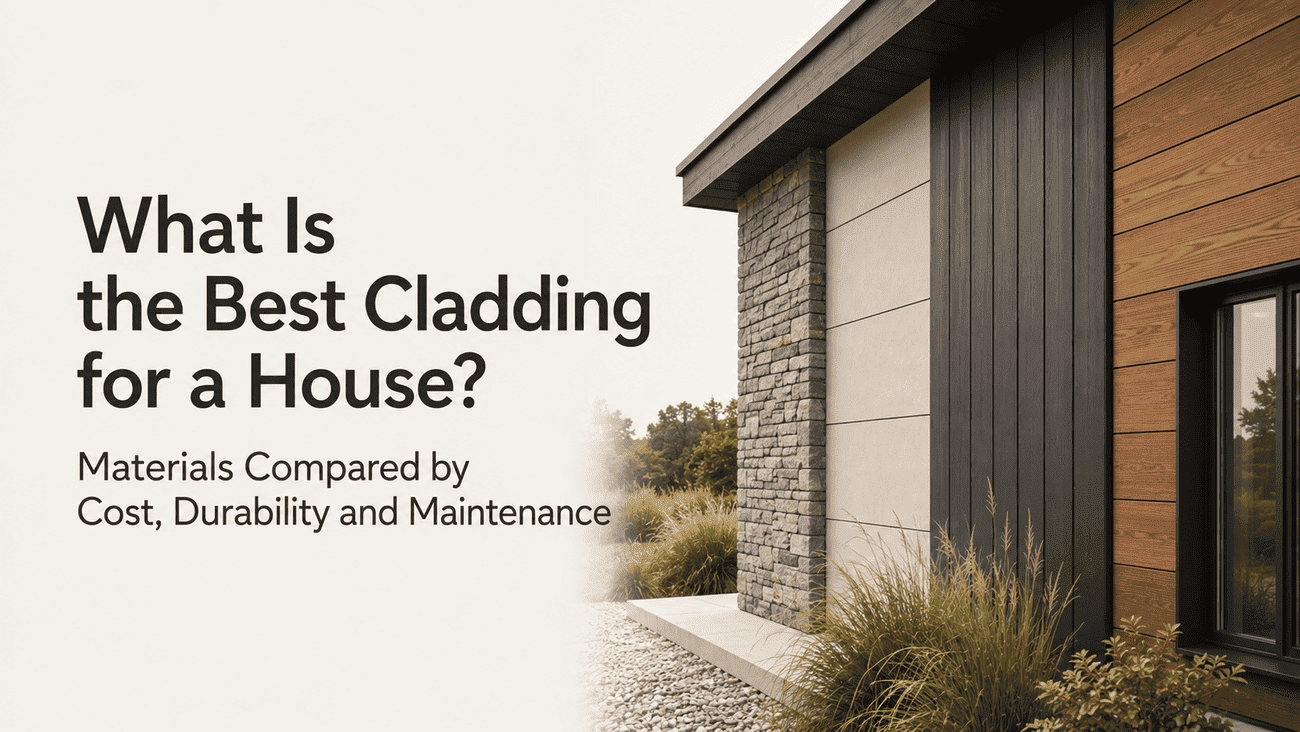
The best cladding for a house is not necessarily the most expensive or the one with the longest warranty. It is the material that offers the right balance of cost, durability, maintenance, and performance for the conditions your home will face over the coming decades. A product that performs exceptionally well on a sheltered suburban property may be far less suitable for a coastal or heavily exposed location.
Today’s homeowners can choose from a wide range of cladding materials, including timber, fibre cement, composite, uPVC, metal, and stone. Each offers distinct advantages, but each also comes with trade-offs that affect appearance, service life, maintenance requirements, and overall value. Understanding these differences before you invest can save you considerable time, money, and maintenance over the years.
This guide compares the most popular house cladding materials, explains how they perform in terms of durability, maintenance, and cost, and highlights which options are best suited to different types of homes and environments. Whether you’re renovating an existing property or planning a new build, it will give you the information you need to choose the right cladding system with confidence.
What Is the Best Cladding for a House? Quick Verdict
For most UK homes, the best all-round cladding is durable, low-maintenance timber, either thermally modified or charred, with fibre cement as the strongest low-maintenance alternative and uPVC as the most affordable option. However, the best choice ultimately depends on your budget, the site’s level of exposure, and the appearance you want to achieve.
By application, the recommendations are straightforward:
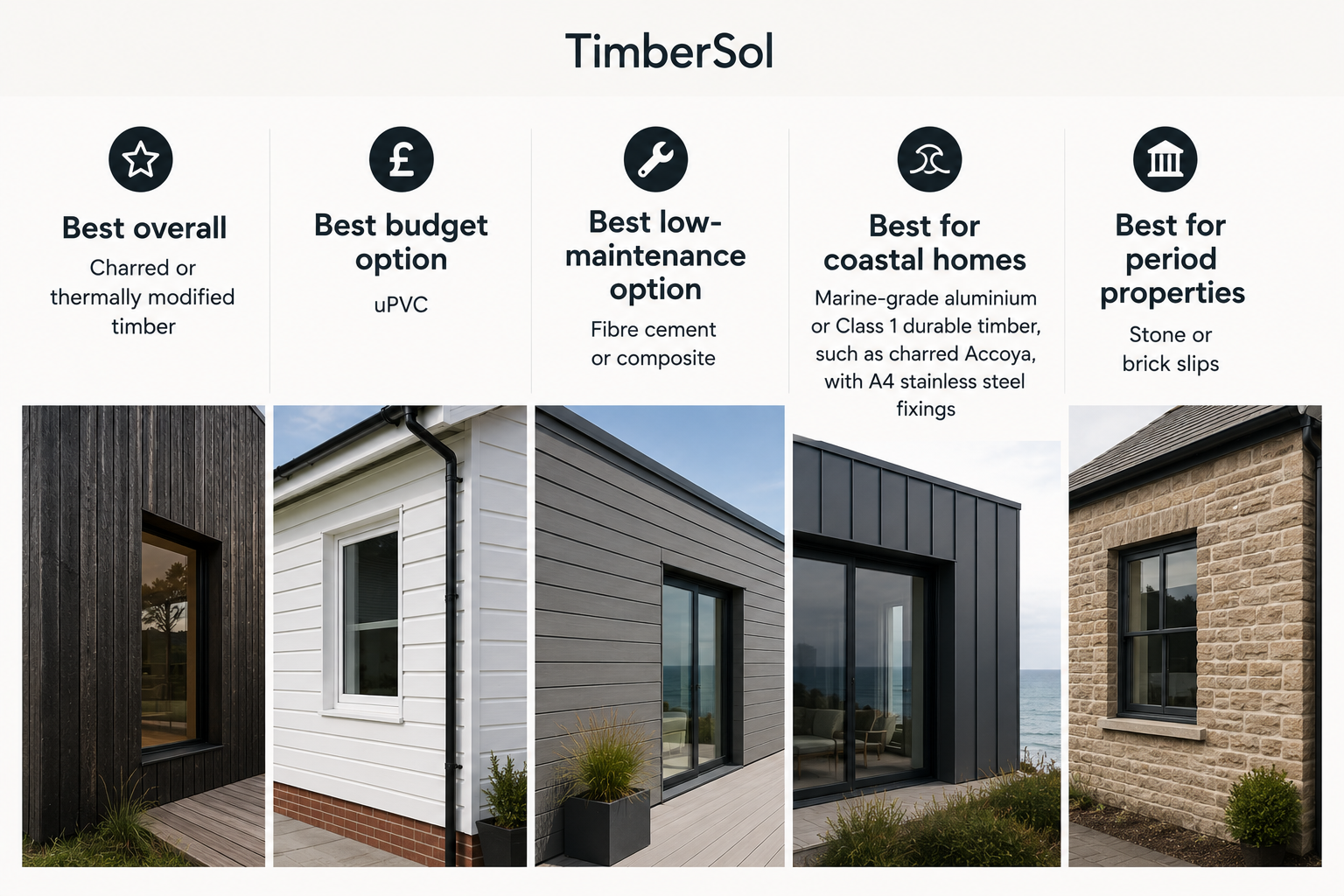
- Best overall: Charred or thermally modified timber
- Best budget option: uPVC
- Best low-maintenance option: Fibre cement or composite
- Best for coastal homes: Marine-grade aluminium or Class 1 durable timber, such as charred Accoya, with A4 stainless steel fixings
- Best for period properties: Stone or brick slips
The quickest objective comparison is the EN 350 durability class, as recommended by the TDCA: Class 1 indicates a service life of over 60 years, while Class 5 indicates less than 15 years. Any cladding option should also exceed the industry’s 30-year benchmark for pressure-treated timber cladding.
Sustainability points in the same direction. According to Búryová & Sedlák (Coatings, 2021), an uncoated thermally modified timber façade had the lowest environmental impact over a 30-year service life because it does not require repainting. By comparison, untreated timber finished with natural oil requires recoating every two years, while alkyd paint typically needs renewing every eight to ten years. The same study also highlights the trade-off: thermal modification generates up to 66.5% more greenhouse gas emissions during production, so the environmental benefit comes from avoiding repeated repainting rather than from the material itself.
Types of House Cladding Materials Compared
Six mainstream cladding materials dominate the UK market, and the right choice depends on three key factors: cost, service life, and maintenance requirements.
| Material | Typical Cost | Typical Service Life | Maintenance |
| Timber (charred / modified) | £46–£147/m² (TimberSol, excl. VAT) | EN 350 Class 2 ≈60 yrs, Class 3 ≈30 yrs; modified timber declared 30 yrs uncoated | Low to high, finish-dependent |
| uPVC | Entry level | Manufacturer’s warranty — verify per system | Very low — occasional cleaning |
| Aluminium | Mid to premium | Up to 30-yr transferable warranty (VitraDual) | Low |
| Zinc / copper | Premium | Rolled zinc: over 100 years (VMZINC) | Low |
| Fibre cement | Mid-range | Estimated 50 yrs to specification; 10-yr warranty (Cedral) | Very low |
| Composite | Mid-range | 10 yrs uncapped / 15 yrs capped (Cladco) | Very low |
| Brick slips / stone | Premium | Service life equivalent to brick masonry (BBA 17/5475) | Minimal |
The cost bands indicate relative market positioning rather than quoted prices. TimberSol’s figures are the only verified list prices included. Service life estimates are based on manufacturer declarations or EN 350 durability classes, and all assume correct installation and detailing.
For a more detailed comparison, see our guide to the different types of cladding.
Timber and Wood Cladding: Natural Character, Species-Dependent Lifespan
Species choice sets the lifespan. Under EN 350 durability data in the COFORD tables, western red cedar rates as Class 2 (around 60 years, with sapwood excluded), Douglas fir Class 3 (around 30 years), larch Class 3–4, and Norway spruce Class 4, which requires preservative treatment for extended service life.
Modern processes push softwoods up that ladder: thermal modification (ThermoWood), acetylation (Accoya), and Yakisugi charring, where a carbon layer improves resistance to moisture, insects, and decay. See charred timber cladding for examples across species.
The maintenance gap is stark: untreated softwood needs re-oiling roughly every two years, whereas thermally modified boards can have a 30-year uncoated service life. Board width matters too: the TDCA recommends 75–150 mm, with tongue-and-groove boards no wider than 125 mm unless a very stable timber is used. TimberSol’s charred range runs from £46/m² (spruce) to £147/m² (Accoya), excl. VAT.
uPVC and Vinyl Cladding: The Cheapest Low-Maintenance Option
uPVC is the cheapest mainstream external wall cladding and needs only occasional washing. That combination suits budget renovations and rental properties where upkeep costs matter most.
However, the trade-offs are real: brittleness and fading due to UV exposure, and little added property value compared with timber, stone, or fibre cement. Check the published reaction-to-fire classification of any specific board against Approved Document B before specifying it close to a boundary. Low-grade boards on south-facing or coastal façades degrade the fastest, as covered in the “avoid” section below.
Metal and Aluminium Cladding for Modern Exteriors
Aluminium systems carry long warranties: Valcan’s VitraDual, for example, offers up to 30 years, transferable upon application. Zinc goes considerably further—VMZINC puts the life expectancy of rolled zinc at over a hundred years, based on a corrosion rate of roughly 1 µm per year, and cites a Liverpool library sample that still contained uncorroded zinc after 130 years of exposure. Powder-coated aluminium offers a broad choice of colours for contemporary builds.
Metals also reach the top Euroclass ratings—VitraDual aluminium is classified A1 to BS EN 13501-1—which matters for taller buildings covered by Building Regulations, Regulation 7. The trade-offs are higher cost, denting risk on thin profiles, and the need for marine-grade systems near the sea.
Stone and Brick Cladding: Traditional and Durable
Brick slip systems are certified to last as long as the masonry they imitate. BBA Certificate 17/5475 for Pro-Clad brick slip facings states that they “will retain their adhesion and have a service life equivalent to that of other similar brick masonry”, with the backing panel rated A1 to BS EN 13501-1, and maintenance is minimal. Both stone and brick slips cost more to buy and install than boarded systems and add greater structural weight.
They suit period properties, conservation-sensitive streetscapes, and ground-floor feature sections paired with timber above—a popular mixed-cladding look. In conservation areas, matching the existing masonry may be a planning requirement rather than just a style choice.
Fibre Cement Cladding: The Durable All-Rounder
Fibre cement is the strongest maintenance-free performer: rot-proof, insect-proof, and colour-stable for decades, at a mid-range price. Cedral, one of the main UK ranges, is classified A2-s1,d0 to EN 13501-1:2018 and quotes an estimated 50-year lifespan when installed to its specification, backed by a ten-year warranty. Made from cement, sand, and cellulose fibres, the boards resist the wet UK climate without re-coating, unlike painted timber.
The trade-offs are practical. Heavier boards demand careful handling, cutting requires silica dust precautions, and the finish looks more uniform than natural timber grain.
Composite Cladding: Pros, Cons and Disadvantages
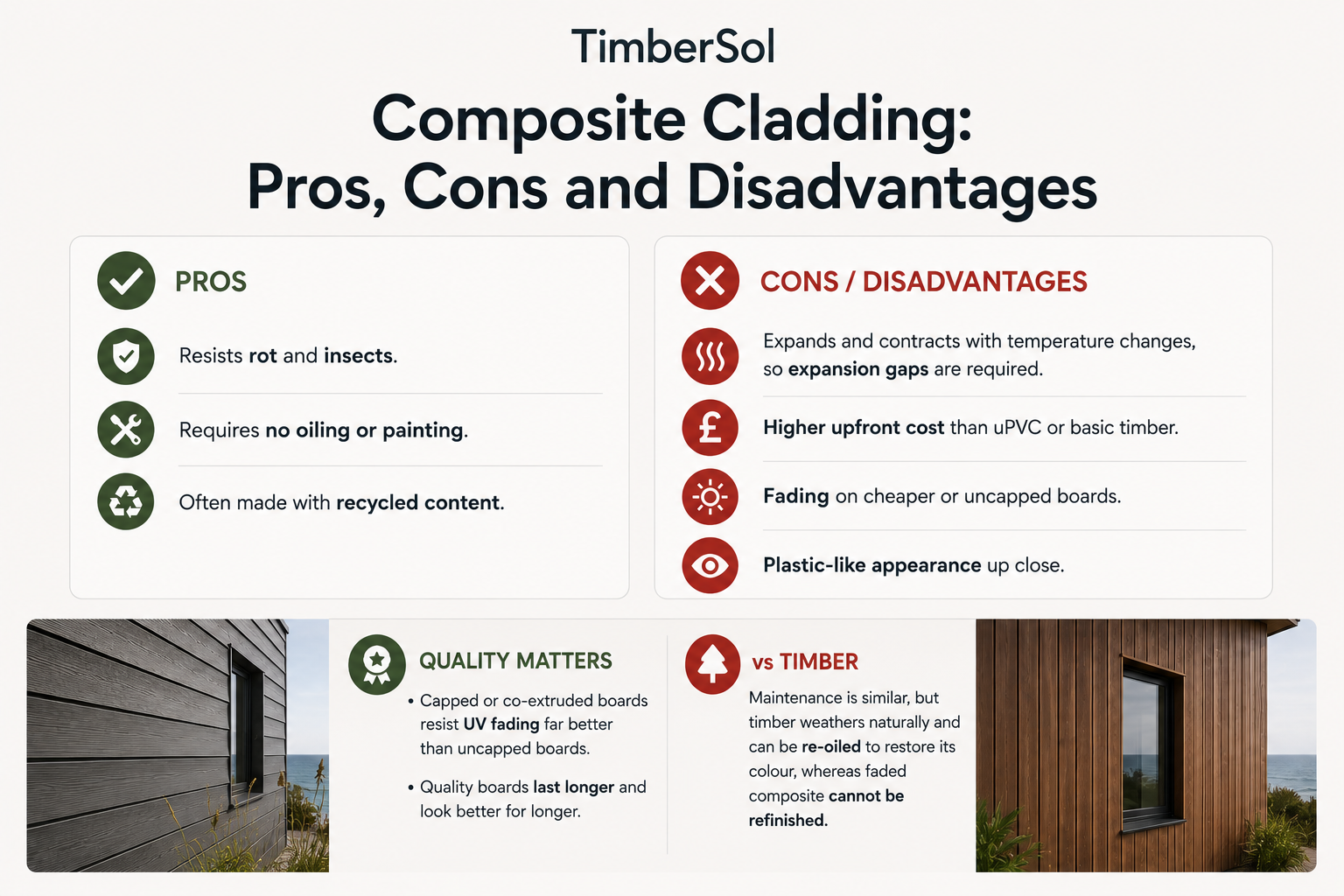
The main disadvantages of composite cladding are heat expansion and contraction, a higher upfront cost than uPVC or basic timber, fading on cheaper boards, and a plastic-like appearance up close. Boards expand and contract with temperature changes, so installers must leave expansion gaps to prevent buckling.
That said, the strengths are genuine. Wood-plastic composite, often made with recycled content, resists rot and insects and requires no oiling or painting, which is why it is a popular choice for low-maintenance buyers.
Quality varies widely, however. Capped or co-extruded boards resist UV fading far better than uncapped budget boards. Cladco, for instance, rates its uncapped Signature range as showing “slight fading over time”, with a 10-year warranty, compared with “minimal to no fading” and a 15-year warranty for its polymer-capped ProClad range.
Against charred or thermally modified timber, the comparison is close in terms of maintenance. However, timber weathers naturally and can be re-oiled to restore its colour, whereas faded composite cannot be refinished.
Which Cladding Should You Avoid?
Avoid three things: combustible cladding that falls short of the required fire classification, untreated softwood in wet or exposed locations, and bargain uPVC on south-facing or coastal façades, where UV exposure degrades it the fastest.
On fire, untreated timber achieves Euroclass D-s2,d0 at a minimum thickness of 18 mm. Where Approved Document B requires C-s3,d2 or better, the TDCA advises factory-applied, certified flame-retardant treatment. Our explainer on fire rating classes covers the details.
One point competitors often get wrong: the combustible materials ban under Regulation 7(2) of the Building Regulations 2010 requires A1/A2 materials only on “relevant buildings” with a storey over 18 m containing dwellings. It does not apply to ordinary houses.
Installation failures matter just as much. Avoid coated or plated fixings, which corrode and stain (specify A2/A4 stainless steel), cavities under 25 mm, in line with COFORD guidance, and boards finishing less than 200 mm above ground. Moisture content deserves the same attention: the TDCA recommends a moisture content of around 16% at installation, BS 1186-3 specifies a range of 13–19%, and in service it needs to stay below 20%—which is exactly what the ventilated cavity is designed to achieve. Finally, untreated Norway spruce (Class 4, which COFORD says requires preservative treatment for any extended service life) is a false economy.
Best Cladding for Coastal Houses and Exposed Locations
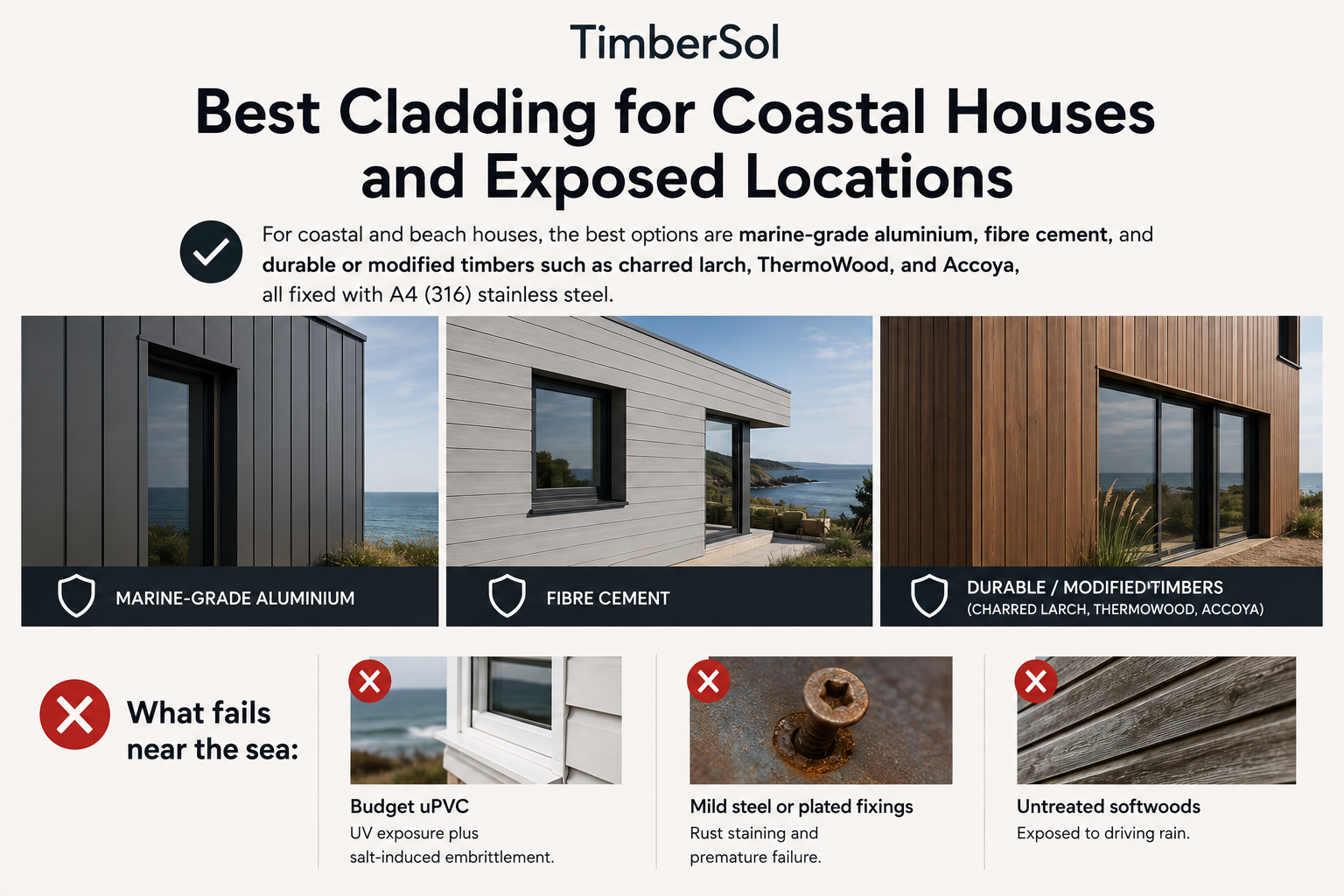
For coastal and beach houses, the best options are marine-grade aluminium, fibre cement, and durable or modified timbers such as charred larch, ThermoWood, and Accoya, all fixed with A4 (316) stainless steel.
Salt air changes the calculation because airborne chlorides corrode standard steel fixings and cause pitting in lower-grade metals. Timber industry fixing guidance specifies A2 (304) stainless steel for general external use, but A4 (316) stainless steel for coastal, high-exposure, or polluted sites.
What fails near the sea: budget uPVC (UV exposure plus salt-induced embrittlement), mild steel or plated fixings (rust staining and premature failure), and untreated softwoods exposed to driving rain.
Charred and thermally modified boards suit exposed locations because reduced moisture uptake limits swelling and cupping in wind-driven rain. Charred Accoya cladding offers the highest durability, with charred ThermoWood as the mid-priced alternative.
Best Cladding for a House: FAQ
How Much Does House Cladding Cost in the UK?
Material costs vary widely by supplier, specification, and region, so treat any single headline figure with caution. The most reliable way to compare is by band: uPVC sits at the entry level, fibre cement and composite are mid-range, and stone, brick slips, and premium modified timbers are at the top. TimberSol’s own charred range runs from £46 per m² for spruce to £147 per m² for Accoya, excluding VAT, on a 10 m² minimum order. Installation adds to the total cost depending on the region and wall area. For a fuller breakdown, see this guide to house cladding costs.
Do I Need Planning Permission to Clad My House?
Usually not: re-cladding a normal house generally falls under permitted development. However, on Article 2(3) land (conservation areas, National Parks, AONBs), Class A.2(a) of the GPDO 2015 removes those rights for cladding in stone, render, timber, plastic, or tiles. Check with your local planning authority and confirm Building Regulations compliance regardless.
What Is the Best Cladding for a Summer House or Garden Room?
Charred or treated timber suits a natural, design-led garden room, while composite or uPVC offers the lowest maintenance. Outbuilding cladding can match the main house or deliberately contrast with it, for example, black charred larch against brick. Since a garden room often needs only 15–25 m² of cladding, premium boards become far more affordable at this scale.
How Do I Avoid Ordering the Wrong Amount of Cladding?
Under-ordering is the most common and costly error because made-to-order boards carry a 3–4 week lead time, turning a shortfall into a project delay. Three practical rules help:
- Shadow gap and shiplap profiles lose roughly 15 mm of coverage per board due to the overlap.
- Match board lengths to wall height; 3.0 m boards on a 2.5 m wall waste 500 mm per board.
- Add a minimum 10% wastage allowance to the calculated area.
TimberSol boards are 20 mm thick and available in 95, 120, and 145 mm widths and 3.0–4.2 m lengths, with a 10 m² minimum order.
Also confirm the colour and texture with a physical sample before committing, since made-to-order charred boards cannot be returned if you change your mind. Budget for the fixings, too: roughly 40 screws per m², so a £30 box of 250 covers about 6 m²—around £5/m² on top of the boards.
The best cladding for your house is the one you have seen, touched, and priced before committing, which is why we make that first step easy. At TimberSol, we char larch, spruce, ThermoWood, Accoya, and Douglas fir to order and finish European oak in charred-effect tones, with prices from £46 to £147 per m² and expert guidance for self-builders, architects, and the trade alike.
Start with a £2.49 sample—a 220 mm board, shipped free, charred and brushed using the same process as our full boards, so the colour and texture you approve are exactly what arrive on site. Order your samples today, run your measurements through our board calculator, and we’ll help you take your project from shortlist to finished façade.
