
Understanding the UK Class 0 Fire Rating

When specifying materials for a building project in the UK, the term Class 0 fire rating comes up frequently. While it is widely referenced in regulations and product descriptions, its meaning is often misunderstood, making it important to understand exactly what a Class 0 fire rating represents and how it applies in practice.
Class 0 was the highest national classification for surface linings under the former British Standard BS 476. It indicated that a material demonstrated a very high level of fire performance, specifically by limiting flame spread across the surface and restricting heat release during a fire.
It’s important to understand that Class 0 was not a single standalone test. The classification was achieved only by passing two separate fire performance tests, each assessing a different aspect of a material’s behaviour in a fire.
This article explains what the Class 0 fire rating meant, how the two-part BS 476 testing system operated, and why the classification became central to UK building safety, particularly for escape routes. It also clarifies why Class 0 was removed from regulations and replaced by the Euroclass fire rating system, outlining how modern materials – such as charred timber cladding – can achieve Euroclass B performance under current standards.
Decoding the Class 0 Fire Rating
A useful way to understand the Class 0 fire rating is to compare it to passing a driving test. You can’t earn a licence by passing the theory exam alone – you must also pass the practical driving test. In the same way, achieving Class 0 required strong performance in both required fire tests; excelling in just one was not sufficient.
The same principle applied to materials seeking a Class 0 designation. To achieve it, products had to meet the strict performance requirements of two separate tests under British Standard BS 476, with both results taken together to determine overall fire performance.
This dual-test system formed a cornerstone of UK fire safety regulations for many years. It provided architects and builders with a clear – though now outdated – benchmark for predicting how materials would behave during the critical early stages of a fire.
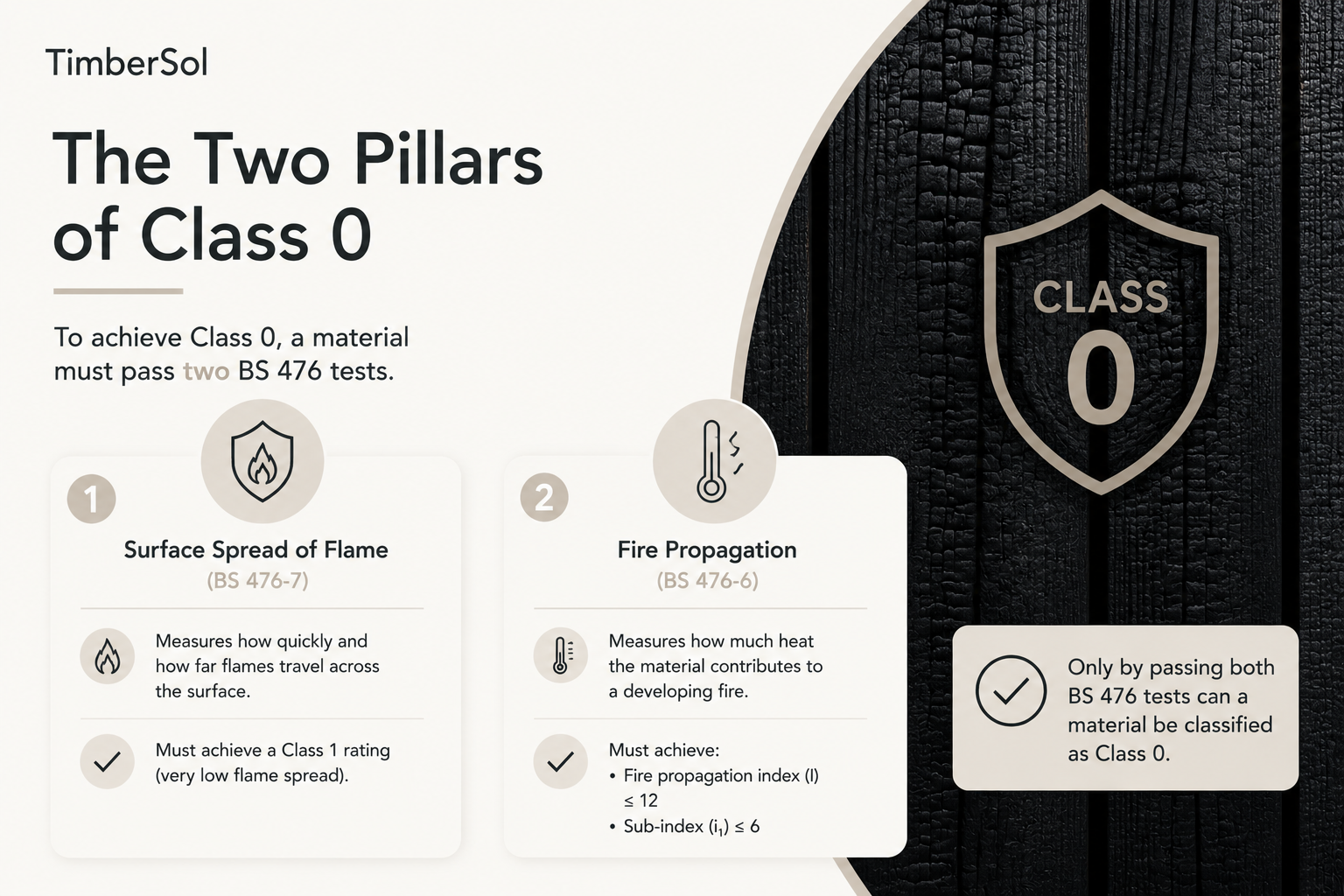
The Two Pillars of Class 0
So, what were these two tests?
First, the material had to achieve a Class 1 rating under BS 476-7, the Surface Spread of Flame test. This test measures how quickly and how far flames can travel across a material’s surface. A Class 1 result indicated very low flame spread, meaning fire propagation across the surface was tightly controlled.
After passing the first test, the material had to meet the requirements of the Fire Propagation test (BS 476-6). This more demanding assessment measured how much heat the material contributed to a developing fire. To qualify, the material needed to achieve a fire propagation index (I) of no more than 12 and a sub-index (i₁) of no more than 6, confirming limited heat release during the early stages of fire growth.
Only by successfully passing both BS 476 tests could a material be officially classified as Class 0.
A material that only passed the flame spread test would be Class 1, but it would not be Class 0. This distinction was critical, because Class 0 signified a higher level of fire performance, confirming that the material limited both flame spread and heat release, not just surface fire travel.
Let’s break that down into a quick summary.
Class 0 Fire Rating At a Glance
The table below provides a concise overview of the key components of the Class 0 fire rating under BS 476.
| Component | Description | Standard |
|---|---|---|
| Surface Spread of Flame | The first test, measuring how flames travel across a surface. Material must achieve a Class 1 rating. | BS 476-7 |
| Fire Propagation | The second, more demanding test, measuring heat contribution. Material must meet specific index values. | BS 476-6 |
| Overall Classification | Achieved only when a material passes both tests. | Class 0 |
This two-part structure ensured that materials not only resisted flame spread but also limited their contribution to fire growth, preventing them from adding significant heat or fuel to an existing fire.
Its Historical Importance in Building Safety
For decades, the Class 0 fire rating served as a critical benchmark in UK building safety, particularly for materials used in high-risk and high-traffic areas.
Until 2019, UK Building Regulations – specifically Approved Document B – required that surface linings on walls and ceilings in circulation spaces such as corridors, stairwells, and entrance halls achieved a Class 0 rating. This requirement played a vital role in protecting escape routes.
As a result, Class 0 strongly influenced material specification across a wide range of projects, from internal wall linings to products such as timber external cladding, including spruce cladding, oak cladding, and douglas fir wood cladding. Compliance was non-negotiable: materials used along escape routes had to demonstrate limited flame spread and low heat contribution, reducing the risk of rapid fire growth and maintaining safer evacuation conditions.
How Materials Were Tested for a Class 0 Rating
Materials were tested for a Class 0 rating by passing a strict two-part fire performance assessment under British Standard BS 476, proving both limited flame spread and low fire contribution.
Under the former UK standard BS 476, achieving a Class 0 rating was not a simple tick-box exercise. A material had to demonstrate strong performance in two separate fire tests, showing not only resistance to flame spread but also that it would not actively fuel a fire once ignition occurred.
The first requirement was the BS 476 Part 7 Surface Spread of Flame test. This assessed how far and how quickly flames would travel across the material’s surface when ignited at one end. To progress, the material had to achieve a Class 1 rating, indicating minimal flame spread.
Passing this test alone was not sufficient. It was only the first stage in proving that the material met the demanding criteria required for a full Class 0 fire rating.
The Fire Propagation Test
The real test of performance came with the BS 476 Part 6 – Fire Propagation test. This assessment went beyond surface behaviour and examined how much heat the material contributed to a developing fire. In simple terms, it evaluated whether the product would act as fuel and accelerate fire growth, turning a small, manageable fire into a serious hazard.
To pass this test and remain eligible for a Class 0 classification, the material had to meet two strict criteria:
- The fire propagation index (I) had to be 12 or less.
- The initial sub-index (i₁) – measuring heat release during the first critical three minutes – had to be 6 or less.
Only materials that passed both tests – achieving Class 1 in BS 476-7 and meeting the strict fire propagation limits in BS 476-6 – could be awarded the Class 0 classification. Failure in either test meant the material did not qualify.
To better understand how different materials perform, explore our guide to various fire-resistant ratings.
The Historical Role of Class 0 in UK Building Safety
For decades, the Class 0 fire rating was more than a technical benchmark – it formed the backbone of UK fire safety regulation. It acted as a trusted gatekeeper, determining which materials were suitable for use in the most critical areas of a building. Its influence was deeply embedded in official guidance, particularly within Approved Document B.
Approved Document B, which sets out the practical requirements for meeting fire safety regulations, relied heavily on Class 0 as the default standard for surface linings on walls and ceilings, especially in circulation spaces. The underlying principle was simple but vital: protect the routes people rely on to escape safely during a fire.
The Guardian of Escape Routes
Hallways, stairwells, and lobbies in residential and commercial buildings are more than circulation spaces – in a fire, they become critical escape routes. The purpose of the Class 0 fire rating was to ensure that surfaces within these areas would not accelerate fire spread, buying vital time for occupants to evacuate safely.
By demanding very low flame spread and minimal heat contribution, the regulation aimed to keep escape routes functional during an emergency. For many years, this was regarded as a robust and dependable safety benchmark, strongly influencing material selection across the construction industry.
The principle was clear: a fire originating in one part of a building should not be able to race along the walls or ceilings of an escape corridor and trap people inside. Class 0 existed specifically to prevent this scenario.
A Standard Under Scrutiny
However, this long-standing reliance on Class 0 ultimately revealed serious weaknesses. The Grenfell Tower fire in 2017 marked a turning point, exposing a critical flaw in how the Class 0 fire rating had been applied to external cladding systems. Prior to the tragedy, UK regulations permitted the outer surface of cladding on high-rise residential buildings – including finishes such asblack charred wood cladding – to achieve only a Class 0 rating. As Dr Bob Moore warned nearly two decades earlier, assessing surface performance alone was dangerously insufficient when combined with combustible core materials. Learn more about the regulatory background and its consequences.
The disaster triggered a comprehensive re-evaluation of the UK’s fire safety framework. It became clear that a test developed for internal wall and ceiling linings under BS 476 was not suitable for predicting the real-world fire behaviour of complex, multi-layer cladding systems. This context is essential for understanding both historic building practices and the regulatory shift away from Class 0 toward the Euroclass fire rating system. For a deeper look at the foundational rules that shaped UK fire safety, have a look at a comprehensive guide to British Standards in fire safety.
Why Modern Standards Moved Beyond Class 0
Modern fire safety standards moved beyond Class 0 because it assessed only surface flame behaviour, failed to account for combustible cores, and did not reflect real-world fire conditions.
For many years, Class 0 was treated as the benchmark for UK fire safety. However, advances in fire science exposed critical limitations in the BS 476 testing framework that made the classification unreliable for modern construction materials.
The primary issue was scope. BS 476 tests focused almost entirely on surface performance, ignoring how materials behave beneath the surface. This created a serious blind spot for composite products such as modern cladding panels. A material could achieve a Class 0 rating with a thin, non-combustible outer layer while concealing a highly flammable core.This limitation also applies to adjacent external elements such as black charred wood decking and charred black wood fencing, where system interaction and proximity to buildings significantly influence real-world fire behaviour In a real fire, once flames penetrated the surface, that core could ignite and significantly accelerate fire spread.
The test scale was another major weakness. BS 476 relied on small, laboratory-controlled samples that did not replicate the heat, flame spread, or structural interactions present in full-scale building fires. As a result, materials that passed Class 0 testing could perform catastrophically under real fire conditions, prompting regulators to adopt more comprehensive, system-based fire testing standards.
The Arrival of the Euroclass System
It became clear that a more rigorous, holistic method was needed to assess fire performance. This led to the adoption of the European Reaction to Fire classification system, commonly known as the Euroclass system, defined under EN 13501-1.
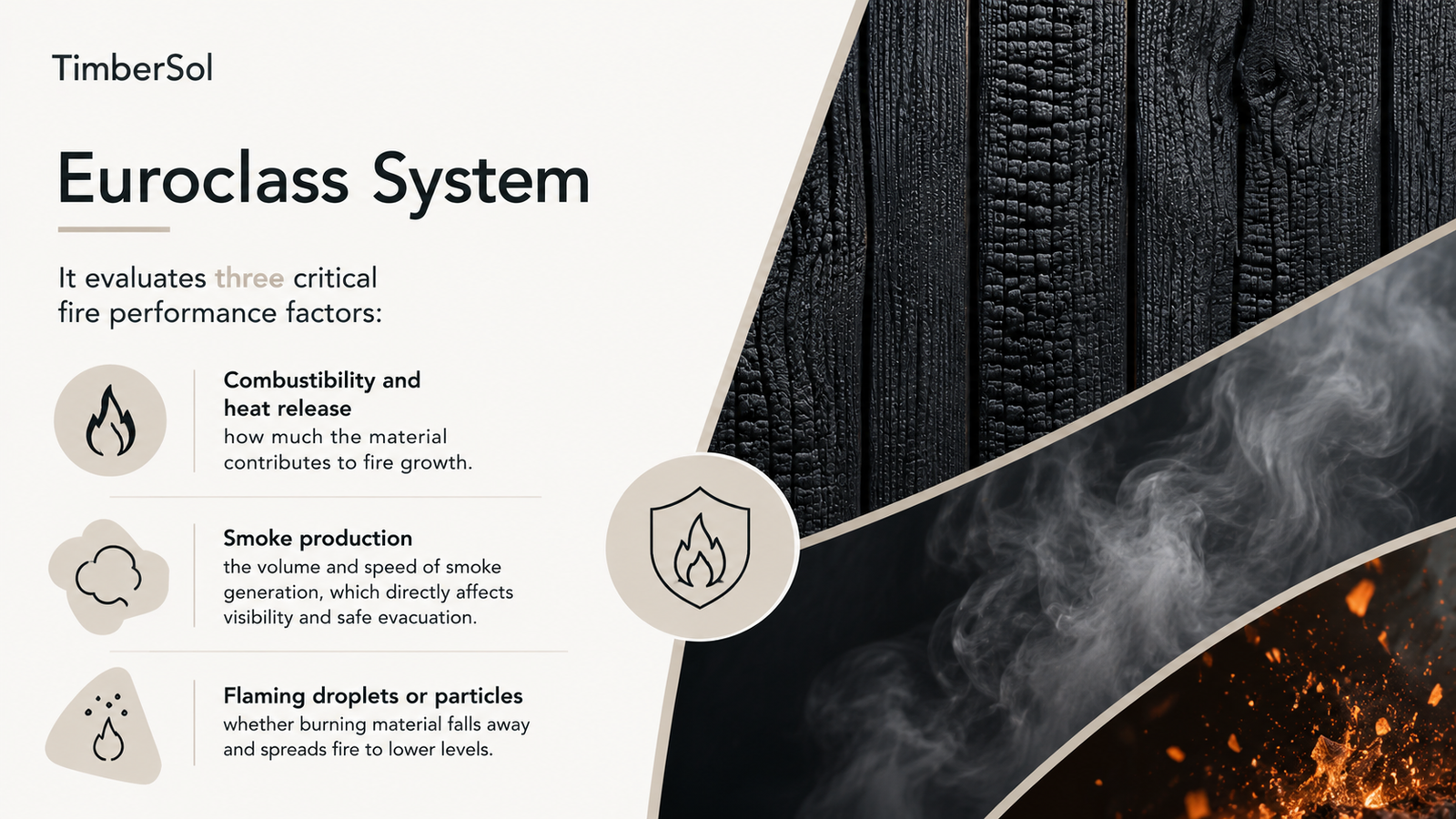
Unlike the former Class 0 rating, the Euroclass system provides a far more realistic picture of how materials behave in a real fire. Instead of focusing only on surface flame spread, it evaluates three critical fire performance factors:
- Combustibility and heat release – how much the material contributes to fire growth.
- Smoke production – the volume and speed of smoke generation, which directly affects visibility and safe evacuation.
- Flaming droplets or particles – whether burning material falls away and spreads fire to lower levels.
This shift represents a fundamental change in fire-safety thinking. Where Class 0 focused on the question, “How does the surface react?”, the Euroclass system asks, “How does the entire product behave in a realistic fire, and what additional hazards – such as smoke or flaming droplets – does it introduce?”
This multi-faceted approach provides a far more reliable and trustworthy assessment of a material’s real-world fire performance and safety.
Comparison of Class 0 (BS 476) vs Euroclass B (EN 13501-1)
To clearly understand the difference, it helps to compare the two systems directly. The table below shows how the former UK Class 0 standard and the current European Euroclass system differ in the way they assess fire performance and overall safety.
| Assessment Factor | Class 0 (BS 476) | Euroclass B (EN 13501-1) |
|---|---|---|
| Primary Test Focus | Surface spread of flame | Overall combustibility, heat release, and contribution to fire growth |
| Smoke Assessment | Not directly measured as part of the Class 0 test | Measured and classified (s1, s2, or s3) |
| Flaming Droplets | Not directly measured as part of the Class 0 test | Measured and classified (d0, d1, or d2) |
| Test Scale & Realism | Small-scale lab tests with limited realism | Includes the Single Burning Item (SBI) test, simulating a fire in the corner of a room |
| Overall Assessment | A pass/fail rating based on surface performance | A comprehensive classification (e.g., B-s1, d0) describing total product behaviour |
As shown, Euroclass B delivers a far more detailed and practical assessment of fire performance than the former Class 0 rating. This evolution in testing standards explains why, by 2019, all references to Class 0 were officially removed from Approved Document B in the UK. Current building regulations now rely exclusively on the Euroclass fire rating system, which provides a more robust and realistic evaluation of material behaviour in real fire scenarios.
As a result, a clear understanding of current building code compliance is now essential to ensure that materials and systems meet today’s stringent fire safety requirements.
Fire Ratings for Charred Timber Cladding Like Yakisugi
As the construction industry moves beyond the outdated Class 0 fire rating, architects and specifiers now focus on the Euroclass B standard, raising important questions about how sustainable materials – such as charred cladding – perform under modern fire regulations. This is especially relevant for traditional techniques like Yakisugi (shou sugi ban).
Modern charred timber cladding systems – such as charred accoya cladding, charred larch cladding, charred douglas fir cladding, and charred thermowood cladding – are increasingly specified for projects requiring verified Euroclass fire performance rather than legacy Class 0 claims.
At first glance, fire-resistant burnt wood may seem contradictory. However, the science behind charred timber fire performance explains why it can achieve strong Euroclass ratings. During the charring process, intense heat forms a dense, carbonised surface layer. This char layer acts as a natural protective barrier, insulating the unburnt timber beneath and significantly slowing ignition
Much like a thick log that smoulders slowly compared to a thin twig that ignites instantly, this carbonised layer reduces flame spread and heat transfer. As a result, charred timber cladding can demonstrate controlled fire behaviour, making it compatible with Euroclass B requirements when correctly specified and tested.
Can Yakisugi Meet Modern Fire Standards?
The short answer is that it can, but not automatically. Achieving compliance with modern fire regulations depends on a controlled combination of factors that must be addressed from the outset.
Reaching high Euroclass fire ratings with charred timber is a technical process rather than a purely aesthetic one. Several key variables directly influence performance, and each must be carefully specified and executed to ensure safety and regulatory compliance.
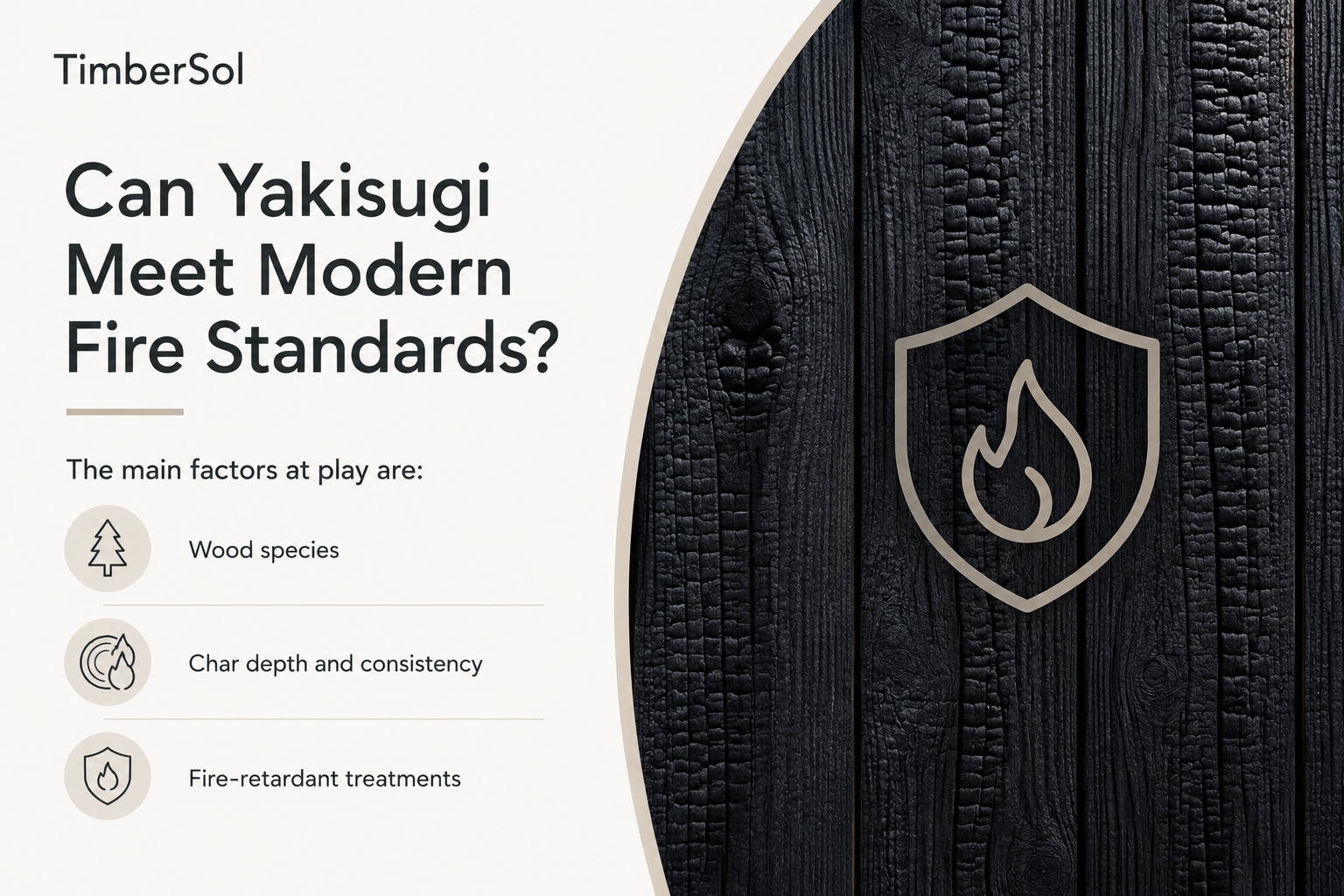
The main factors at play are:
- Wood species – Timber density and natural resin content affect how the wood chars and how it behaves in fire. Species such as larch and Accoya typically deliver stronger, more predictable performance.
- Char depth and consistency – A deep, uniform char layer provides the best insulation and resistance to flame spread. Thin or uneven charring creates weak points that reduce overall fire performance.
- Fire-retardant treatments – In many applications, achieving higher Euroclass ratings requires the use of clear, non-toxic fire-retardant treatments. These are absorbed into the timber and work alongside the char layer to significantly enhance fire resistance.
By tightly controlling these variables – selecting the correct timber species, achieving a deep, uniform char layer, and applying a certified fire-retardant treatment – Yakisugi (charred timber) cladding can achieve a Euroclass B-s1, d0 rating. This classification confirms that the material contributes only limited fuel to a fire, produces very low levels of smoke, and does not generate flaming droplets.
Specifying Charred Timber Safely
Choosing a finish you like is only part of the process. It is absolutely critical to work with a supplier who can provide official test reports and certification for the exact product being specified. General claims about “fire-resistant charred wood” are not sufficient – fire performance is directly linked to the specific timber species, charring depth, production method, and fire-retardant treatment used.
This level of verification ensures charred timber cladding can be specified with full confidence, meeting modern Euroclass fire standards rather than relying on the outdated Class 0 rating. For a deeper understanding of this material, explore our complete guide to charred timber cladding, which provides detailed insights to help you specify the right solution for your project.
Your Questions About the Class 0 Fire Rating, Answered
Even though UK building regulations have moved on, the Class 0 fire rating still appears in specifications and product descriptions, often causing confusion for architects, builders, and homeowners alike. Below is a clear, no-nonsense FAQ that addresses the most common questions and helps separate outdated terminology from current fire safety requirements.
Is a Class 0 Fire Rating Still a Thing?
In short, no. The Class 0 fire rating is no longer recognised in UK building regulations for new construction or major refurbishments. Since 2019, Approved Document B has fully adopted the European Euroclass fire classification system, known as Euroclasses.
While older documentation or product specifications may still reference Class 0, it is now obsolete for compliance purposes. All new projects must meet current standards using Euroclass ratings, such as Euroclass B.
What’s the Difference Between Class 0 and Euroclass B?
The simplest way to understand the difference is to compare a basic pass/fail result with a detailed performance report. Class 0 was a single, legacy benchmark that focused mainly on how flames spread across a material’s surface. It offered limited insight and did not reflect real fire behaviour.
Euroclass B, by contrast, provides a multi-dimensional assessment of how a material performs in a realistic fire scenario.
A typical Euroclass B rating, like B-s1, d0, breaks down performance into three crucial parts:
- B: The material makes a very limited contribution to fire growth.
- s1: It produces very low levels of smoke, supporting safer evacuation.
- d0: It produces no flaming droplets, reducing the risk of fire spreading to lower levels.
This level of detail provides a far more realistic, reliable, and safety-led assessment of how a material will behave in a real-world fire scenario than the old Class 0 system ever could.
So, What Should I Be Specifying Instead of Class 0?
For any application where fire safety is critical – such as external cladding, escape routes, or public buildings – you must specify materials with a current Euroclass fire rating. In most projects, the benchmark requirement is Euroclass B-s1, d0.
Crucially, you must obtain official fire test certificates from the supplier for the exact product system being used. Verbal assurances or generic website claims are not sufficient. Compliance depends on documented evidence proving the material achieves the stated Euroclass rating. Relying on the obsolete Class 0 fire rating will not meet modern building control requirements and risks non-compliance at sign-off.
At TimberSol, fire safety is treated as a core specification requirement, not an afterthought. Our Yakisugi charred timber cladding is rigorously tested to meet modern Euroclass fire standards, and selected treated systems can achieve a certified Euroclass B rating. This ensures you can specify and install a visually striking, sustainable material with full confidence in its compliance, performance, and long-term safety for contemporary building projects.
Ready to learn more? Explore our range of high-performance charred timber solutions at https://timbersol-backup.elnoirstudio.com.
