
The Best Cladding for Sheds: Materials Compared, Costs & What to Avoid

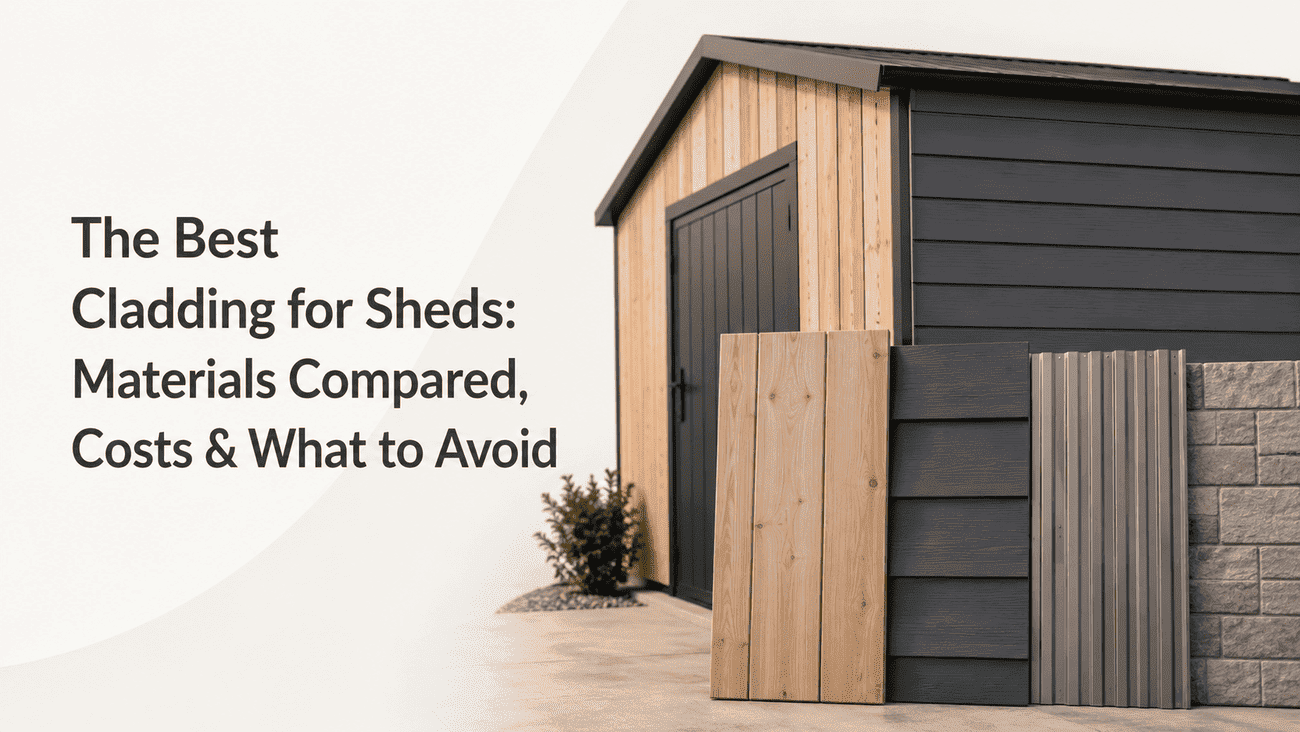
Most people don’t choose the wrong shed cladding because they ignore the research. They choose it because the information available focuses on profiles, prices, and appearances, while the factor that matters most is often overlooked: how well the material will stand up to years of outdoor exposure. Two sheds can look almost identical when they’re first built, yet perform very differently over the next 10 or 20 years depending on the material beneath the finish.
Timber, uPVC, steel, and composite all have their strengths, but they’re designed for different priorities. Some offer the lowest upfront cost, others reduce maintenance, while naturally durable timber can provide decades of reliable performance with far less ongoing treatment. Understanding durability classes, maintenance requirements, and the differences between cladding profiles is often far more valuable than simply comparing materials by name.
This guide compares the most popular shed cladding options, including timber, uPVC, metal, and composite; explains the difference between shiplap and tongue-and-groove cladding; examines the true cost of each option over time; and highlights the materials worth avoiding. By the end, you’ll know which cladding offers the best balance of lifespan, maintenance, and value for your project.
Types of Shed Cladding Materials: Timber, uPVC, Metal and Composite Compared
The best wall covering for most UK sheds is pressure-treated or naturally durable timber in a shiplap or tongue-and-groove profile because it balances weather protection, cost, and appearance better than any alternative. uPVC suits owners who want minimal maintenance, while box-profile metal makes sense for utilitarian workshops.
| Material | Typical lifespan | Maintenance | Relative cost | Best for |
| Untreated softwood | ~5–10 years | High; regular preservative treatment | Lowest | Short-term storage |
| Treated or naturally durable timber | 15–30+ years | Low to moderate | Low–mid | Most garden sheds |
| uPVC/plastic | 25+ years | Minimal, wash down | Mid–high | Low-maintenance sheds |
| Steel/metal | 25+ years | Minimal | Low per m² | Workshops, secure storage |
| Composite | 25+ years | Minimal | Highest | Premium garden buildings |
Timber remains the default choice because it provides natural insulation, takes fixings easily, and can be repaired board by board. uPVC never rots and never needs painting, but it costs more upfront and looks less natural. Recycled plastic boards offer a more environmentally conscious alternative for utility sheds.
Steel box-profile sheets are tough and inexpensive per square metre. However, uninsulated metal walls are prone to condensation, making them better suited to workshops than to storing tools or fabrics.
Composite blends wood fibre and polymer to create a low-maintenance finish at a premium price.
There is also a premium timber option: charred timber (Yakisugi). Controlled surface charring forms a protective carbon layer that improves resistance to moisture, insects, and decay, and each board is then brushed and oil-finished. Browse timber cladding options to compare charred and uncharred boards side by side.
Best Timber for Shed Cladding: Durability Classes Explained
Timber species fall into two categories: those durable enough to withstand the weather without treatment, and those that depend on a preservative treatment programme for longevity. BS EN 350 is the objective standard that distinguishes between the two.
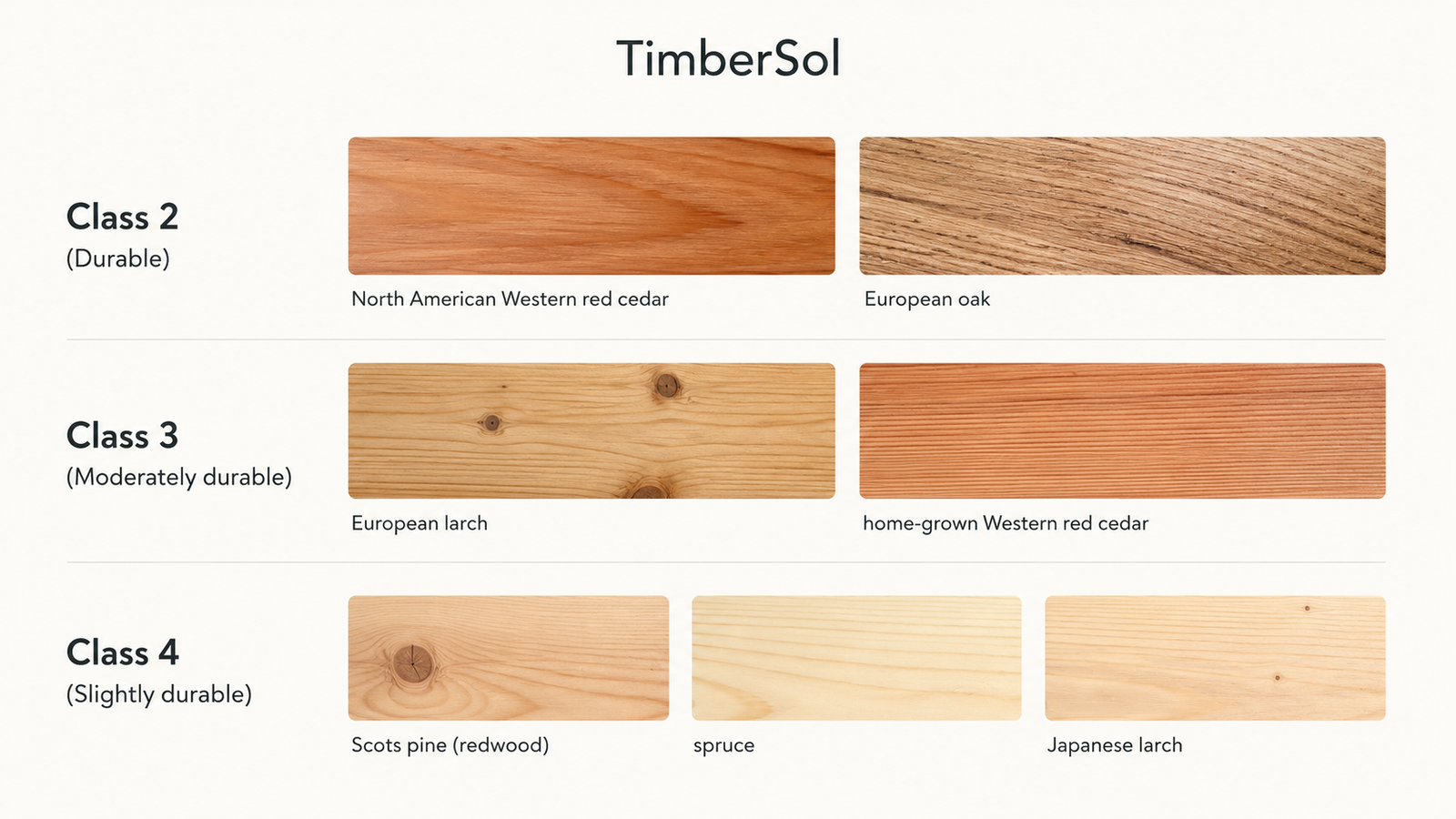
BS EN 350 rates heartwood decay resistance from Class 1 (Very durable) to Class 5 (Not durable). According to GreenSpec, untreated exterior cladding should be Class 2 (Durable) or Class 3 (Moderately durable); Class 4 and Class 5 timbers require treatment. Sapwood is never classified as durable, regardless of the species.
The following examples illustrate the durability classes:
- Class 2 (Durable): North American Western red cedar, European oak
- Class 3 (Moderately durable): European larch, home-grown Western red cedar
- Class 4 (Slightly durable): Scots pine (redwood), spruce, Japanese larch
Notice where standard budget shed cladding sits. Class 4 softwood must be regularly re-treated, or it will rot.
Larch is the sweet spot for sheds. Siberian larch achieves Class 3, so it performs well above ground without treatment, and its density of roughly 628 kg/m³ at around 18% moisture content, combined with its tight growth rings, gives it good dimensional stability. The practical choice is simple: buy Class 3 larch once, or keep re-treating cheap softwood.
Charring adds a further protective carbon layer to a species’ natural durability. That makes charred larch cladding the durable choice, while charred spruce cladding is the value option, with the charring and oil helping to compensate for the lower natural durability of the base species.
Shiplap vs Tongue-and-Groove Cladding: Which Is Best for Sheds?
Shiplap is the safer choice for exposed UK sheds because its angled, lipped overlap actively channels rainwater away from each board. Tongue-and-groove cladding provides a tighter, flatter interlocked finish with better draught resistance, making it better suited to garden rooms and workshops where a well-sealed finish matters more.
The difference is physical. Shiplap’s overlapping profile sheds water away before it can collect in the joint. Tongue-and-groove boards lock together, helping them stay aligned as the timber expands and contracts with the seasons.
Overlap (featheredge) cladding is the third, budget option: the cheapest per square metre, with a rustic appearance, but more prone to gaps as the boards shrink.
That said, profile matters less than species and treatment when it comes to lifespan. Class 3 larch in any profile outlasts untreated softwood shiplap. For a contemporary look, shadow-gap profiles are increasingly popular in garden offices.
What’s the Cheapest Way to Clad a Shed Without Sacrificing Durability?
15 mm pressure-treated (tanalised) spruce or pine tongue-and-groove cladding is widely regarded as the cheapest option that won’t fail, followed by featheredge overlap boards. Both cost less per square metre than uPVC, composite, or box-profile steel.
Ranked roughly by upfront cost, the order is: featheredge overlap, followed by 15 mm treated tongue-and-groove softwood, then box-profile metal sheets, plastic panels, and composite at the top.
But there’s a running-cost catch. Treated spruce and pine remain Class 4 species, so they need to be re-treated regularly to stay sound. The cheapest boards on day one carry ongoing preservative and maintenance costs that Class 3 larch avoids.
Tradespeople also rely on a few practical tactics to stretch a budget:
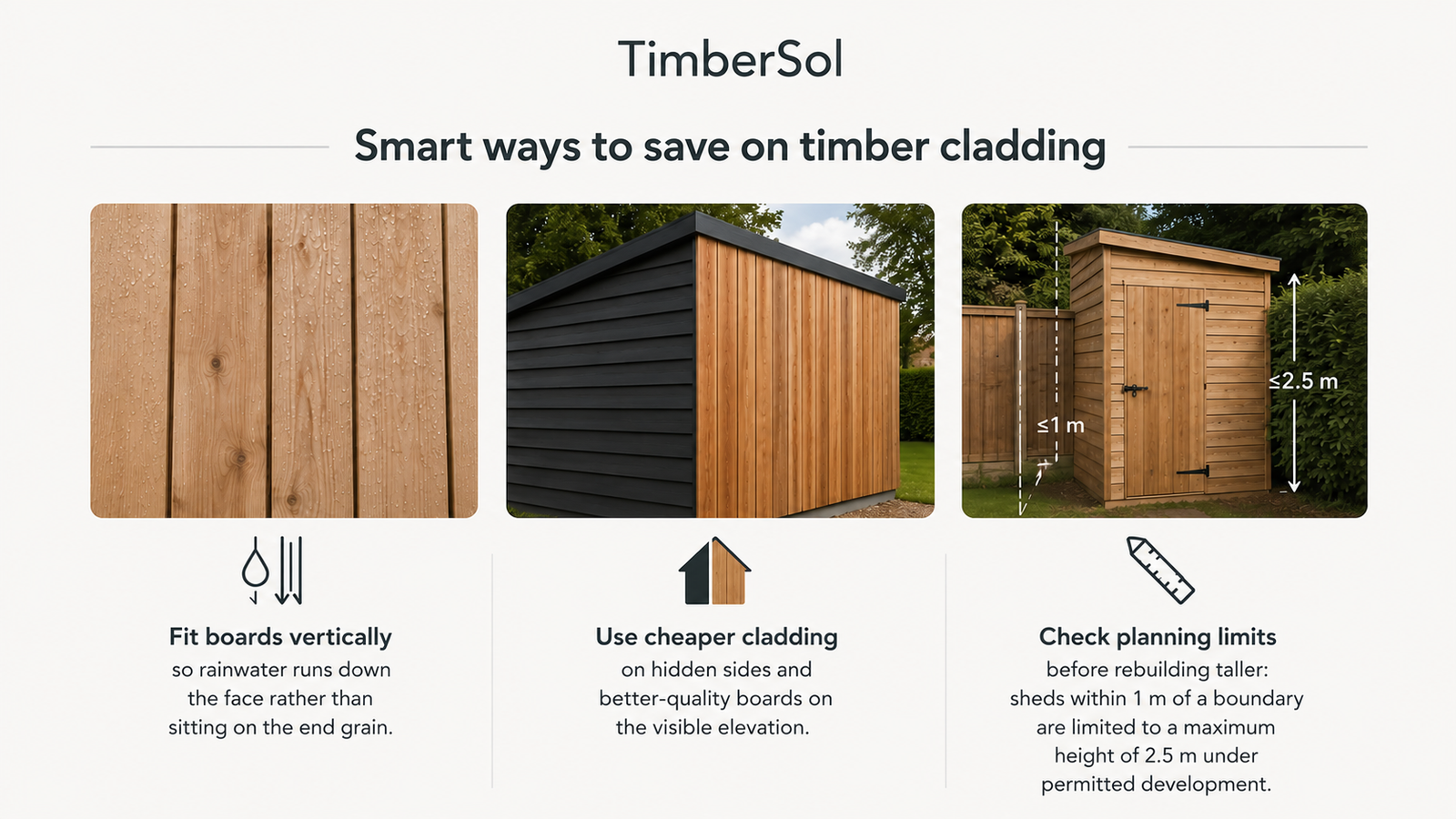
- Fit boards vertically so rainwater runs down the face rather than sitting on the end grain.
- Use cheaper cladding on hidden sides and better-quality boards on the visible elevation.
- Check planning limits before rebuilding taller: sheds within 1 m of a boundary are limited to a maximum height of 2.5 m under permitted development.
Finally, measure accurately before ordering because offcut waste quietly inflates the real price per m². A board calculator works out the exact quantities from your wall dimensions.
Which Shed Cladding Should You Avoid?
Even on a tight budget, avoid OSB, interior-grade or untreated plywood, and thin untreated featherboard on exterior shed walls. Tradespeople consistently warn that OSB can delaminate outdoors within months once moisture penetrates the strands.
The failure modes explain why. OSB and cheap plywood rely on adhesives that break down when repeatedly wetted, so the sheets swell and delaminate. Untreated Class 4–5 softwood rots first at fixing points and points of ground contact, where water lingers. Thin boards also cup and warp because they cannot buffer seasonal moisture swings.
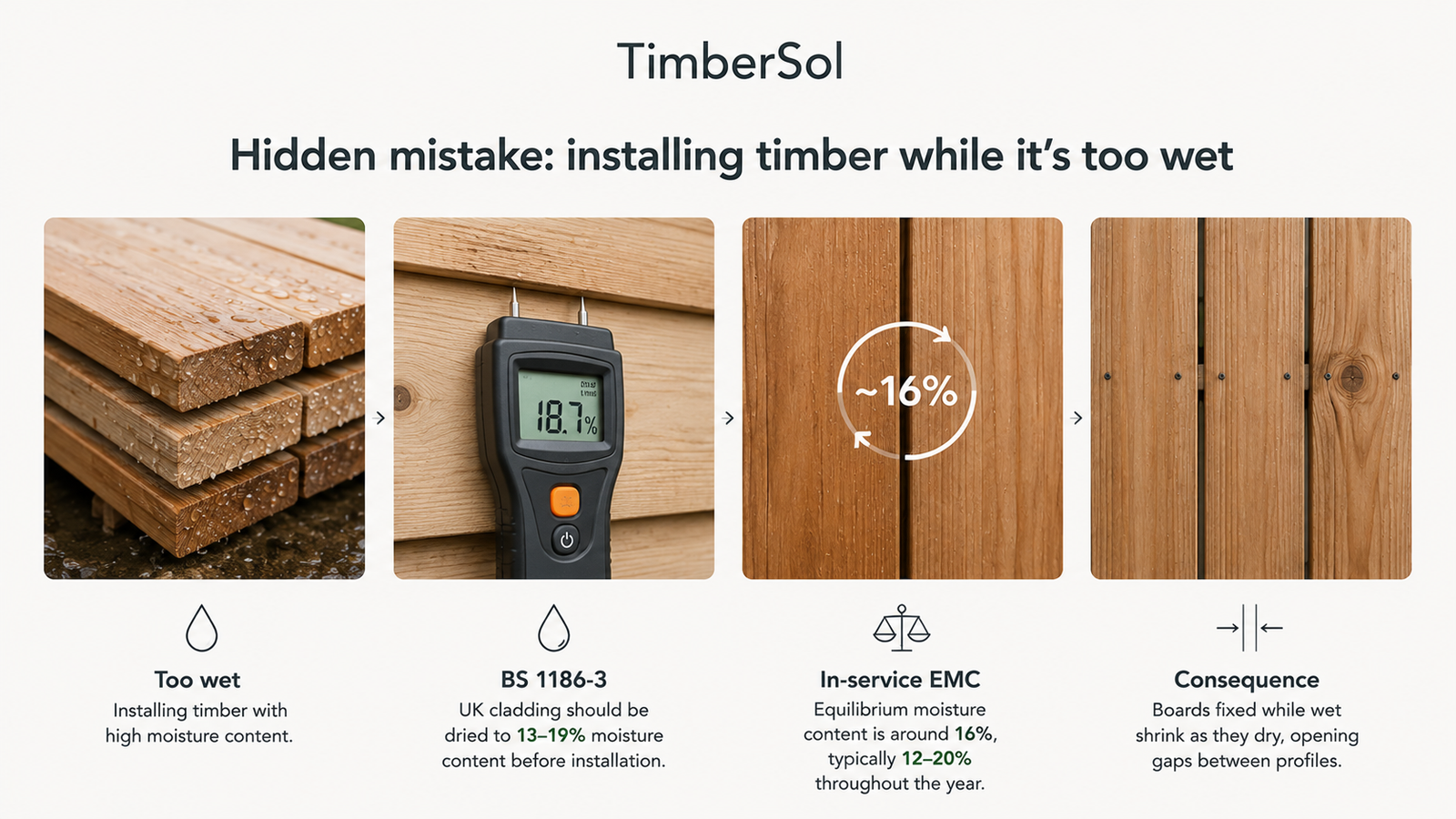
There is also a hidden installation mistake: fixing timber while it is too wet. According to BS 1186-3, UK cladding should be dried to 13–19% moisture content before installation, since the in-service equilibrium moisture content is around 16%, typically ranging from 12–20% throughout the year. Boards fixed while wet shrink as they dry, opening gaps between profiles.
WBP or exterior-grade plywood can serve as a temporary covering or backing layer. However, it should never be used as the finished weather face.
Best Cladding for Sheds: FAQ
Quick answers to the questions shed owners most often ask before ordering cladding, from lifespan and thickness to samples.
How Long Does Shed Cladding Last?
Untreated softwood lasts roughly 5–10 years, pressure-treated or naturally durable Class 2–3 timber lasts 15–30+ years, and uPVC or steel lasts 25+ years with minimal upkeep.
Lifespan depends most on durability class or treatment, a ventilation gap behind the boards, correct moisture content at installation, and periodic re-finishing, such as re-oiling charred timber.
What Thickness Should Shed Cladding Be?
Aim for 12 mm as the practical minimum on a basic garden shed, 15–18 mm for better durability, rigidity, and security, and 18 mm+ for workshops and garden offices.
Thicker boards buffer moisture swings more evenly, so they resist warping and cupping. They also absorb impacts better and provide marginal insulation to heated spaces.
Is Plastic or UPVC Cladding Good for Sheds?
Yes, if low maintenance is the priority: uPVC never rots, never needs painting, and washes down easily. The trade-offs are a higher upfront cost than budget timber, a less natural appearance, and more awkward single-panel repairs.
Recycled plastic cladding is also worth considering, offering durable, environmentally conscious performance on utility sheds.
What’s the Best Internal Cladding for a Shed or Garden Office?
OSB3 is the practical choice for workshop interiors: cheap, strong for fixings, and reliable indoors where it stays dry. For finished garden rooms, tongue-and-groove boards or plywood provide a cleaner surface.
In heated spaces, internal lining works alongside insulation and vapour control to help prevent condensation. See our guide to cladding a garden room for that upgraded scenario.
Can I See and Feel Cladding Before Committing?
Yes, and you should. Board texture, colour, and finish are difficult to judge from photos alone, so ordering physical samples helps avoid expensive surprises.
TimberSol offers charred cladding samples for each wood type and shade, making it straightforward to compare species and finishes before placing a larger order.
Whichever class of timber you choose, the goal is the same: cladding that keeps your shed dry without demanding a lifetime of re-treatment. At TimberSol, we char durable species like larch and spruce to build in that protection from day one, with a brushed, oiled finish that looks sharp on everything from a simple tool store to a full garden office.
If you have measured up and want to know what your project would cost in charred timber, you can request a quote, and we’ll help you specify the right species, profile, and shade for the job.
