
Spruce vs Larch Cladding: Durability, Cost and Which One to Choose

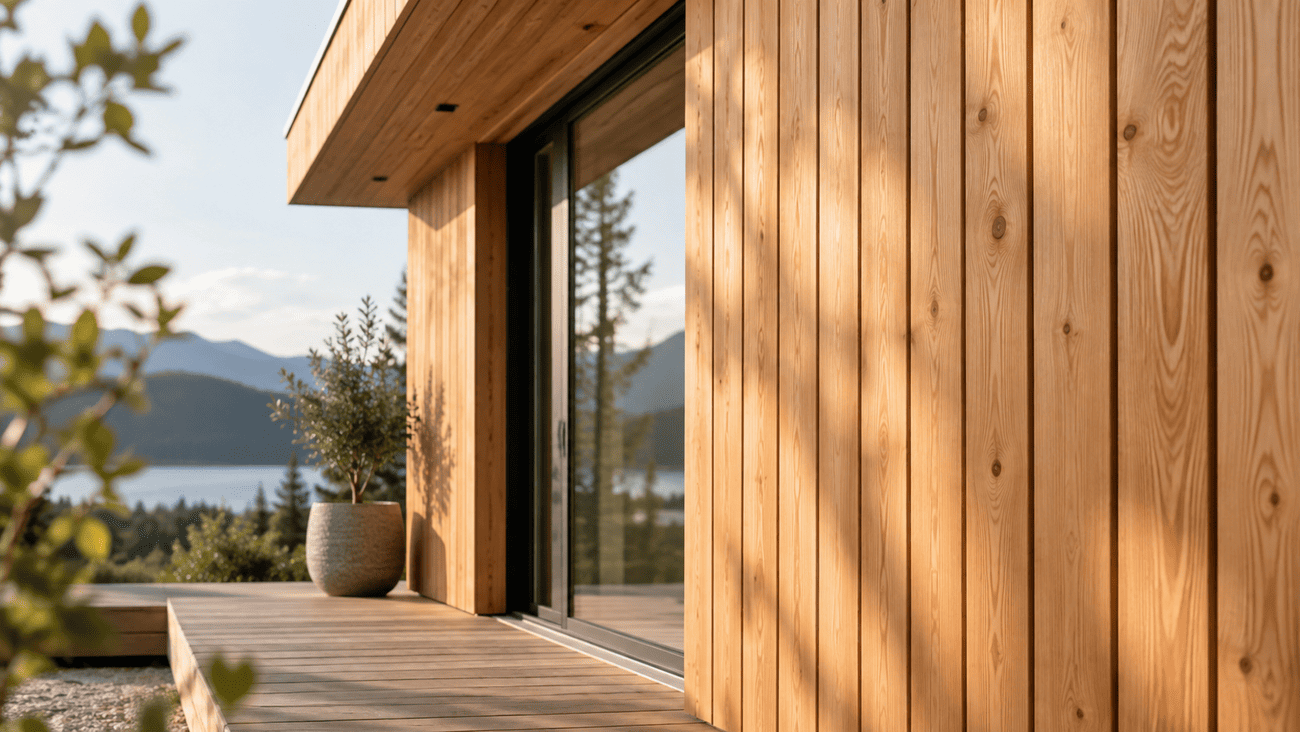
Spruce vs larch cladding is decided less by appearance than by specification: larch heartwood earns its place on an exposed UK façade without a coating, whereas spruce achieves a comparable service life only when pressure-treated and finished on every face.
At the merchant, the two softwoods look interchangeable. Both appear on COFORD’s list of species considered suitable for cladding in practice, both weather to grey, and both are milled into the same shiplap and shadow-gap profiles. Yet EN 350 places them a full durability class apart, and that distinction can mean a 15- rather than 30-year desired service life for untreated heartwood, depending on exposure conditions.
The comparison below uses Forest Research density and strength data, COFORD detailing rules, and 2026 UK prices per m² to show where larch justifies its premium and where treated spruce is the smarter buy. It also answers a question many self-builders now ask: does charring a board to achieve a Yakisugi finish change which species you should choose?
Spruce vs Larch Cladding: What Are They and How Do They Differ at a Glance?
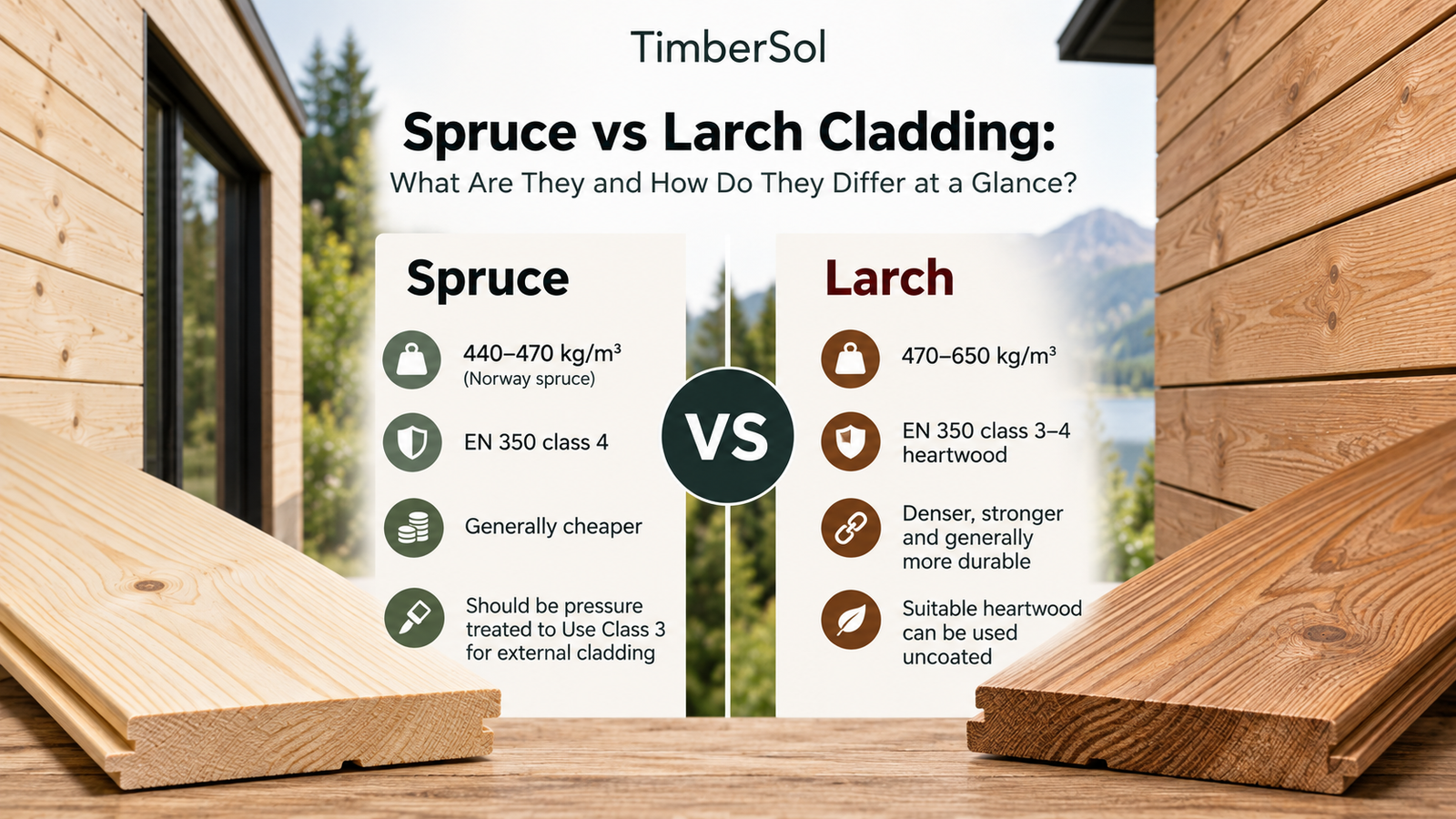
Larch is the denser, stronger and generally more durable softwood: EN 350 class 3–4 heartwood at 470–650 kg/m³, and suitable heartwood can be used uncoated. Spruce is lighter (Norway spruce 440–470 kg/m³), class 4 and generally cheaper, but spruce cladding should be pressure treated to Use Class 3 for external cladding (COFORD, Wood Technology Ireland No. 13, 2021).
Since both pass the suitability test, the real question is how much protection, maintenance and money each demands.
Provenance matters too. Nordic Norway spruce or UK-grown Sitka can be set against Siberian larch, whose heartwood has shown greater natural durability than European larch in long-term testing, or against generally knottier European and British-grown larch, so the gap can widen or narrow with origin.
Budget and a pale, coated contemporary look point to spruce. Exposed elevations, low maintenance and longevity point to larch.
Spruce vs Larch Cladding: Full Head-to-Head Comparison
| Property | Spruce | Larch |
| EN 350 heartwood durability class | Norway spruce 4 (4–5); use DC4 | 3–4; use DC4 unless durability is otherwise verified |
| Density at 12% MC | Norway spruce 440–470 kg/m³; UK-grown spruce typically 380–410 kg/m³ | 470–650 kg/m³; UK-grown larch typically 480–530 kg/m³ |
| Bending strength (UK-grown) | 30–33 N/mm² | 37–44 N/mm² |
| Green-to-12% shrinkage (T / R) | Sitka 5.0% / 3.0% | European 4.5% / 3%; Japanese 3% / 2% |
| Treatment requirement | Pressure treat to Use Class 3 | Durable heartwood may be used untreated; heartwood is difficult to treat |
| Untreated service life (COFORD Table 2) | DC4: 15 years in Use Class 3.1 | DC3: 30 years in Use Class 3.1 |
| Euroclass without testing | D-s2,d0 where EN 14915 CWFT conditions are met | D-s2,d0 where EN 14915 CWFT conditions are met |
Figures come from Forest Research (Moore, 2011; McLean et al., 2024) and COFORD; the three sections below explain what each row means on a real wall.
Appearance, Colour and Weathering
Fresh Nordic spruce is pale cream to near-white, with small, tight knots in slow-grown grades. Larch heartwood runs from reddish-brown to yellow, with a clearly lighter white or pale-yellow sapwood band (McLean et al., 2024).
Larch tends to self-prune, so dead knots are a common feature and clear sections are rare. Siberian larch generally carries fewer knots than home-grown larch, and Unsorted grades carry fewer defects than Sawfalling.
Both species grey as UV exposure degrades surface lignin. Uncoated larch weathers towards a silver-grey appearance, although the colour may develop unevenly depending on exposure. Spruce also greys as it weathers, and coating failure can produce uneven weathering.
Charring gives either species a defined colour from day one, as with black larch cladding.
Durability Class, Density and Lifespan Outdoors
Larch heartwood at class 3–4 can suit external cladding when specified to BS 8605 and Timber Development UK guidance, with sapwood excluded. Larch sapwood has no natural durability, but because it forms a relatively thin 2–5 cm band, it can be excluded or treated (McLean et al., 2024).
COFORD applies the lowest durability class where a range is given, so larch rated 3–4 is assumed DC4 unless its durability is otherwise verified, and timber with sapwood present is treated as DC5. Sapwood exclusion can therefore matter as much as species choice.
On COFORD Table 2 (based on the WPA manual and BS 8417), untreated DC4 heartwood has a 15-year desired service life in sheltered Use Class 3.1, but does not meet the 15-year threshold in exposed Use Class 3.2; DC3 reaches 30 years in 3.1. Neither untreated spruce nor larch at these assumed durability classes reaches a 60-year desired service life.
UK-grown larch is generally stiffer and stronger than combined Sitka and Norway spruce. Yet the density distributions overlap, so an individual spruce board can still be denser than an individual UK-grown larch board; grade and provenance therefore matter.
Fungal decay is the main durability threat, with the risk increasing when timber remains above about 20% moisture content, which is why a drained and ventilated cavity is essential for both species. See larch cladding lifespan for realistic expectations.
Maintenance, Treatment and Workability
COFORD requires pine and spruce cladding to be pressure treated to Use Class 3, with battens treated to at least Use Class 2. Treated but uncoated boards can target a 30-year service life; with a maintained coating, a 60-year service life can be specified.
The species differ in how they respond to treatment. Sitka spruce is refractory, so preservative penetration is limited. Larch heartwood is impermeable and “extremely difficult to treat” (McLean et al., 2024). Pressure-treated spruce is therefore a standard option for external cladding; untreated larch relies on the natural durability of its heartwood.
Coatings go on all faces and edges before fixing, since face-only coating raises the risk of distortion and cracking, particularly on south-facing walls. Maintenance coatings allow matched re-oiling.
Larch is more prone to splitting when nailed and may require pre-drilling, while its higher density can wear tools faster, so screw-fixed shiplap or feather edge can suit it. Both species need austenitic stainless steel fixings, 16% (±3%) moisture content, a minimum 25 mm ventilated cavity, battens at no more than 600 mm centres, 150–200 mm ground clearance and T&G faces no wider than 125 mm. The cladding installation guide covers these details.
Cost Comparison: Is Spruce or Larch Cladding Cheaper per m² in the UK?
Spruce is generally the cheaper board to buy, but larch can be the cheaper wall to own over 30 years: pressure-treated spruce may require a coating regime, while sapwood-free larch can be fixed and left uncoated.
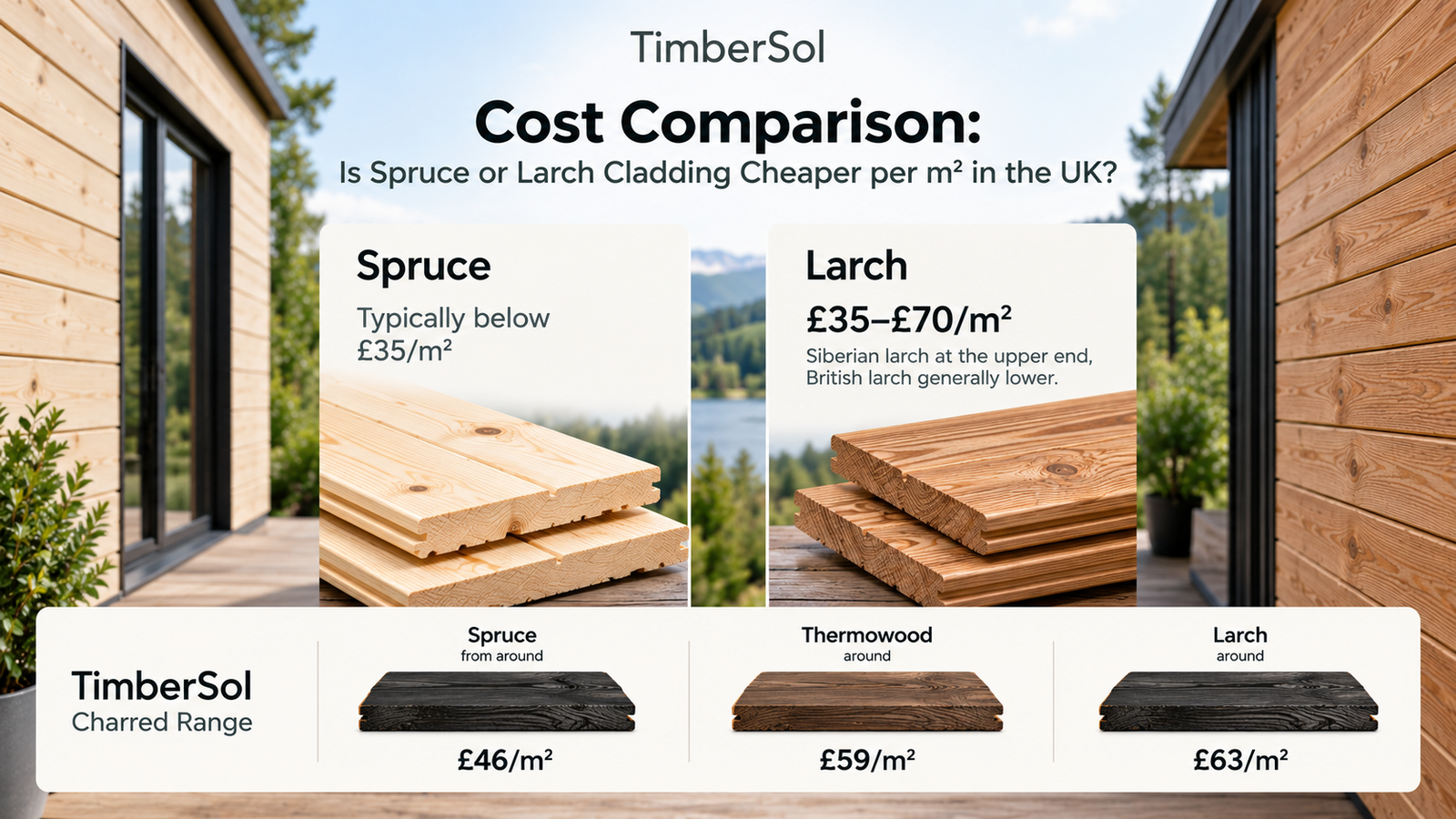
In 2026, UK suppliers quote plain larch at roughly £35–£70/m², with Siberian larch at the upper end and British larch generally lower; plain spruce typically sits below that range. TimberSol’s charred range follows a similar hierarchy: spruce from around £46/m², Thermowood around £59/m² and larch around £63/m².
Lifetime costs diverge afterwards. Film-forming finishes on spruce typically need recoating every 2–4 years in exposed applications, with each visit adding access costs. Larch’s spend is more front-loaded into material and pre-drilling labour.
Home-grown Sitka and British larch can also avoid Siberian import volatility on large elevations. Size the job with the board calculator so quotes include wastage.
Disadvantages of Spruce and Larch Cladding
Spruce’s main weakness is its class 4 heartwood, while sapwood is treated as class 5, so untreated boards do not meet COFORD’s 30-year requirement in Use Class 3.1. Spruce also absorbs moisture readily, and its refractory structure limits preservative penetration. UK-grown Sitka at around 390 kg/m³ sits on the Euroclass D-s2,d0 density threshold, so density needs to be considered where classification without further testing is relied upon.
Larch, meanwhile, brings frequent dead knots, especially in home-grown material, a risk of end splitting unless pre-drilled, resin bleed in sun, faster tool wear and cupping on wide boards. Siberian stock, screw fixings and modest face widths can mitigate most of these.
One myth needs correcting: larch does not necessarily move meaningfully less. Forest Research shrinkage data puts Sitka spruce (5.0% T / 3.0% R) and European larch (4.5% / 3%) within half a percentage point; Japanese larch (3% / 2%) shows the lowest shrinkage of the three.
Both remain softwoods dependent on good detailing. Neither tolerates a missing cavity, sapwood on the face or boards fixed at 22% moisture content.
Is Larch Better Than Spruce? Which Cladding Should You Choose?
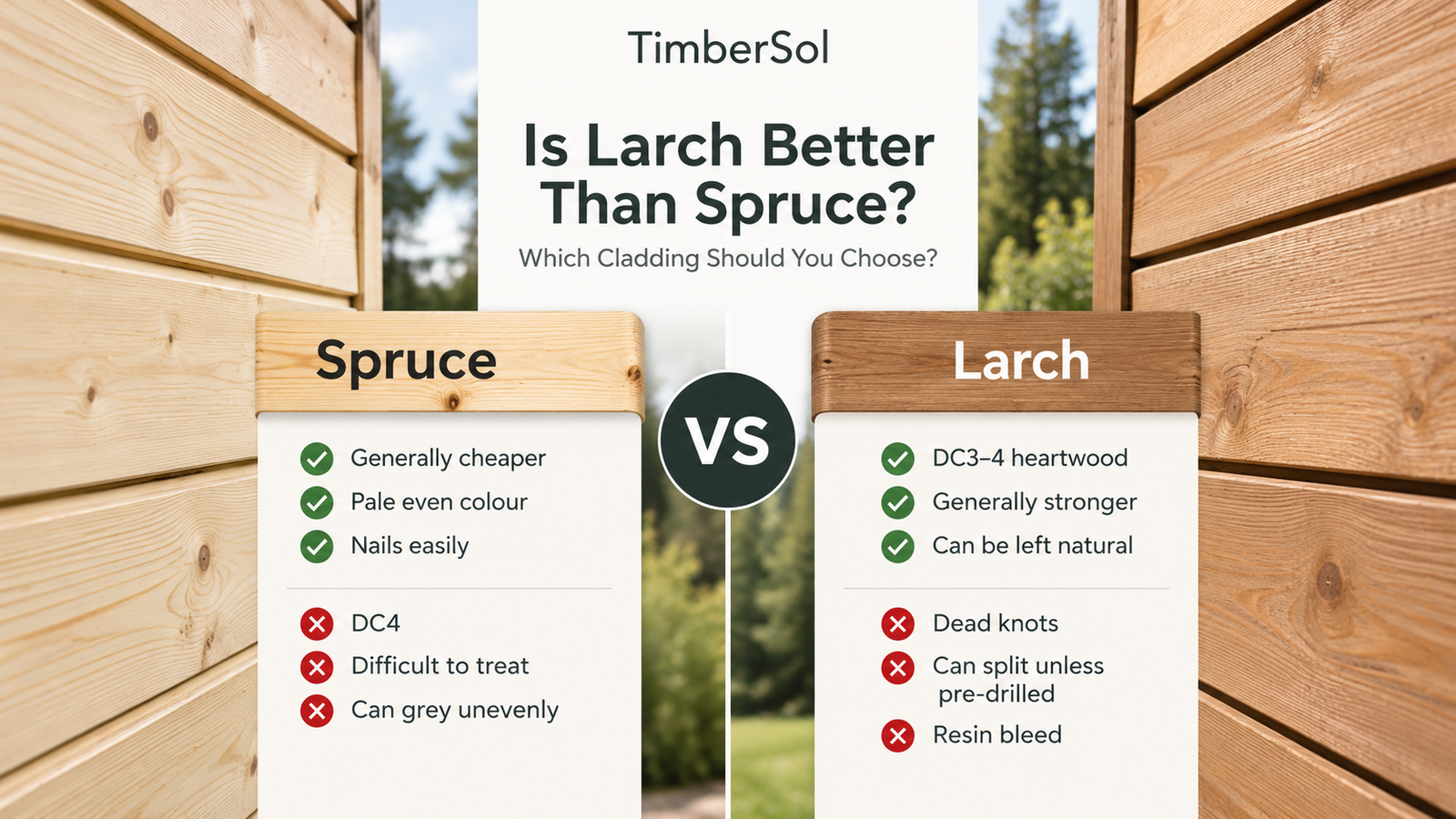
Larch can be better for exposed, south- or west-facing walls and uncoated finishes where greater natural durability is required. Spruce suits tight budgets, sheltered elevations and a pale, coated look, provided it is pressure treated to Use Class 3.
Spruce
- Pros: generally cheaper, pale even colour, nails easily
- Cons: DC4, difficult to treat, can grey unevenly
Larch
- Pros: DC3–4 heartwood, generally stronger, can be left natural
- Cons: dead knots, can split unless pre-drilled, resin bleed
Pine and Douglas fir offer alternative options; Western red cedar is naturally durable but softer and typically more expensive.
Weather a sample of each in your chosen shade before committing, since knots, grain and greying can vary considerably between boards.
Does Charring Change the Spruce vs Larch Answer?
No, the species underneath still does the durability work. Hasburgh et al. (2021, USDA Forest Products Laboratory) tested 28 shou sugi ban combinations and found that charring “did not systematically improve the flammability or durability”.
Charring does add hydrophobicity: Kymäläinen et al. (2018) recorded lower water sorption on charred spruce, although more severe charring can increase cupping risk.
Charred spruce therefore remains DC4 and still needs Use Class 3 treatment. Charring defines the initial colour and can simplify upkeep to periodic re-oiling, so charred larch cladding can lead where natural durability matters.
Spruce vs Larch Cladding: FAQ
Is spruce good for cladding?
Yes, with conditions. COFORD lists Norway and Sitka spruce as suitable for cladding, but at durability class 4 spruce should be pressure treated to Use Class 3. Where a protective coating is specified, it should be applied to all faces and edges, and the boards should be fixed over a minimum 25 mm ventilated cavity. Slow-grown Nordic stock can suit sheltered or fully coated contemporary façades; larch can be the safer choice for more exposed elevations.
Can spruce cladding be left untreated like larch?
Not generally in the UK. Larch heartwood can be left uncoated where its natural durability is sufficient for the required service life. Untreated DC4 spruce, however, reaches a 15-year desired service life in Use Class 3.1 under COFORD’s tables, but less than 15 years in Use Class 3.2. Pressure-treated spruce can target a 30-year desired service life uncoated, or up to 60 years with a maintained coating.
Is larch good for cladding in exposed or coastal UK locations?
Yes, provided sapwood is excluded, appropriate fixings are used, and a drained and ventilated cavity allows moisture to escape. Larch’s class 3–4 heartwood can suit exposed elevations without preservative treatment where its natural durability is sufficient for the required service life. In the same coastal conditions, spruce generally requires pressure treatment and may benefit from a protective coating. Fixings should be corrosion-resistant regardless of species.
Whichever way the comparison lands for your elevation, the species underneath still does the durability work: charred larch retains the natural durability of larch heartwood, while charred spruce remains class 4 spruce and generally requires Use Class 3 treatment for exterior cladding. At TimberSol, we char both, then brush and oil each board to a consistent finish, so the choice comes down to exposure, budget and the look you want.
The simplest way to judge that look is in hand, on your own wall, in your own light. Order a charred cladding sample in larch or spruce and your preferred shade, and for a full house or extension, our team can talk through sapwood, fixings and cavity detailing before you commit to a quote.
