
Fire Resistant Wood Siding A UK Homeowner’s Guide

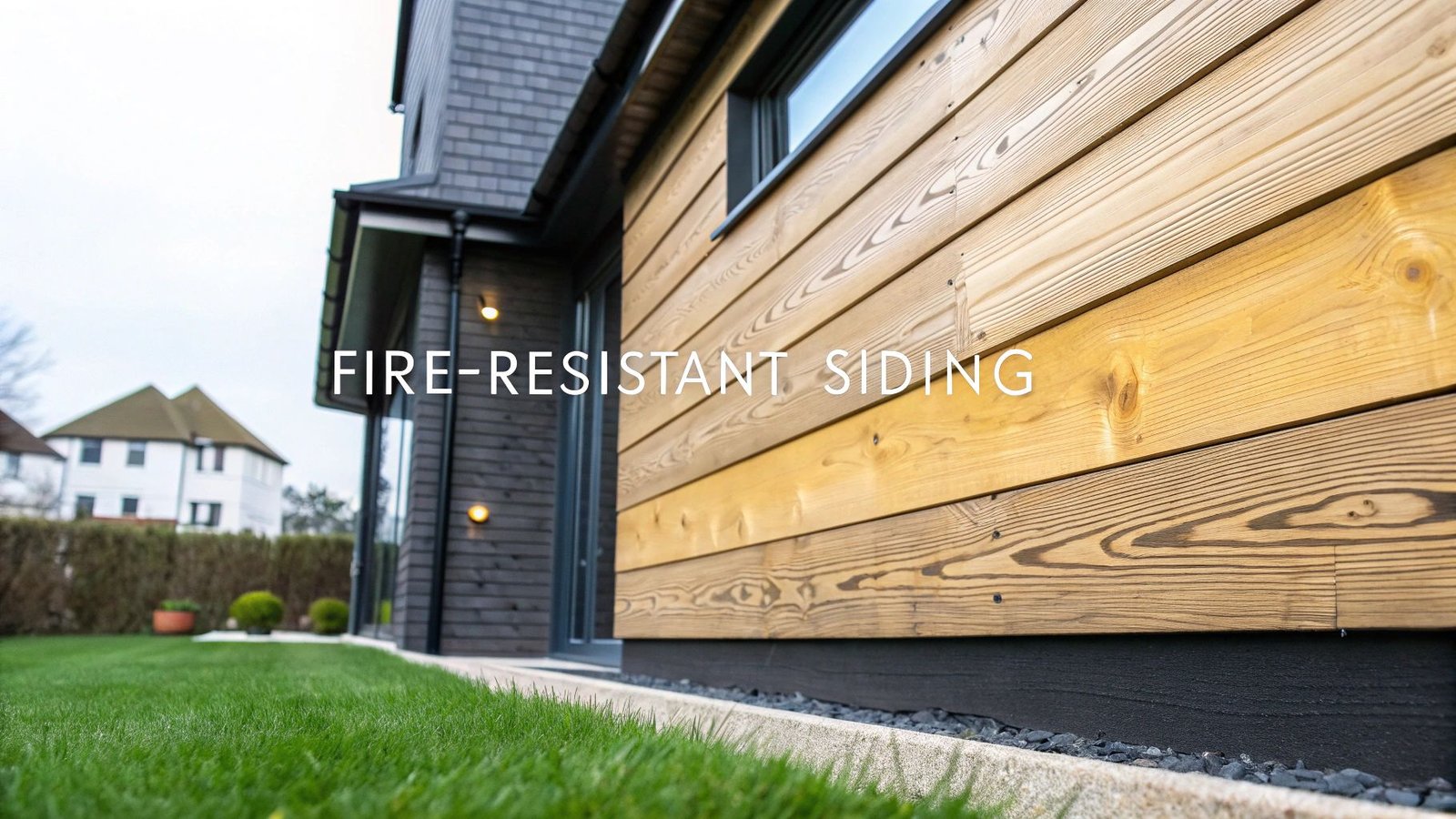
Fire-resistant wood siding is a type of timber cladding designed to slow ignition and reduce flame spread on a building’s exterior. It enhances fire safety through specialised treatments, the natural density of certain hardwoods, or protective finishes such as Yakisugi.
It’s important to be clear: “fire-resistant” does not mean fireproof. No wood product can completely resist fire. What fire-resistant siding does offer is valuable time—by slowing the spread of flames, it helps you and your family evacuate safely and allows emergency services to respond more effectively.
This article explores what fire-resistant wood siding is, how it works, and why it plays an important role in building safety in the UK. It also covers fire ratings, treated and natural timber options, Yakisugi charred wood, installation costs, maintenance requirements, and common questions around long-term performance.
Understanding Fire-Resistant Wood Siding
Natural wood brings warmth and character to a home’s exterior, but concerns about flammability are completely valid. Fire-resistant wood siding addresses this by bridging the gap between traditional aesthetics and modern safety requirements—allowing you to retain the look of timber without compromising on protection.
To put it simply, not all wood behaves the same in a fire. Lightweight, untreated materials can ignite quickly and contribute to flame spread. Fire-resistant wood siding, however, is designed to perform differently. Instead of igniting rapidly, it tends to char and smoulder when exposed to high heat, helping to slow the progression of fire.
How Does It Work?
There are two primary ways to achieve fire resistance in wood siding, both of which fundamentally alter how timber reacts to heat—shifting it from a potential fuel source to a more protective material.
The objective is the same in each case: to delay ignition and slow the rate of combustion.
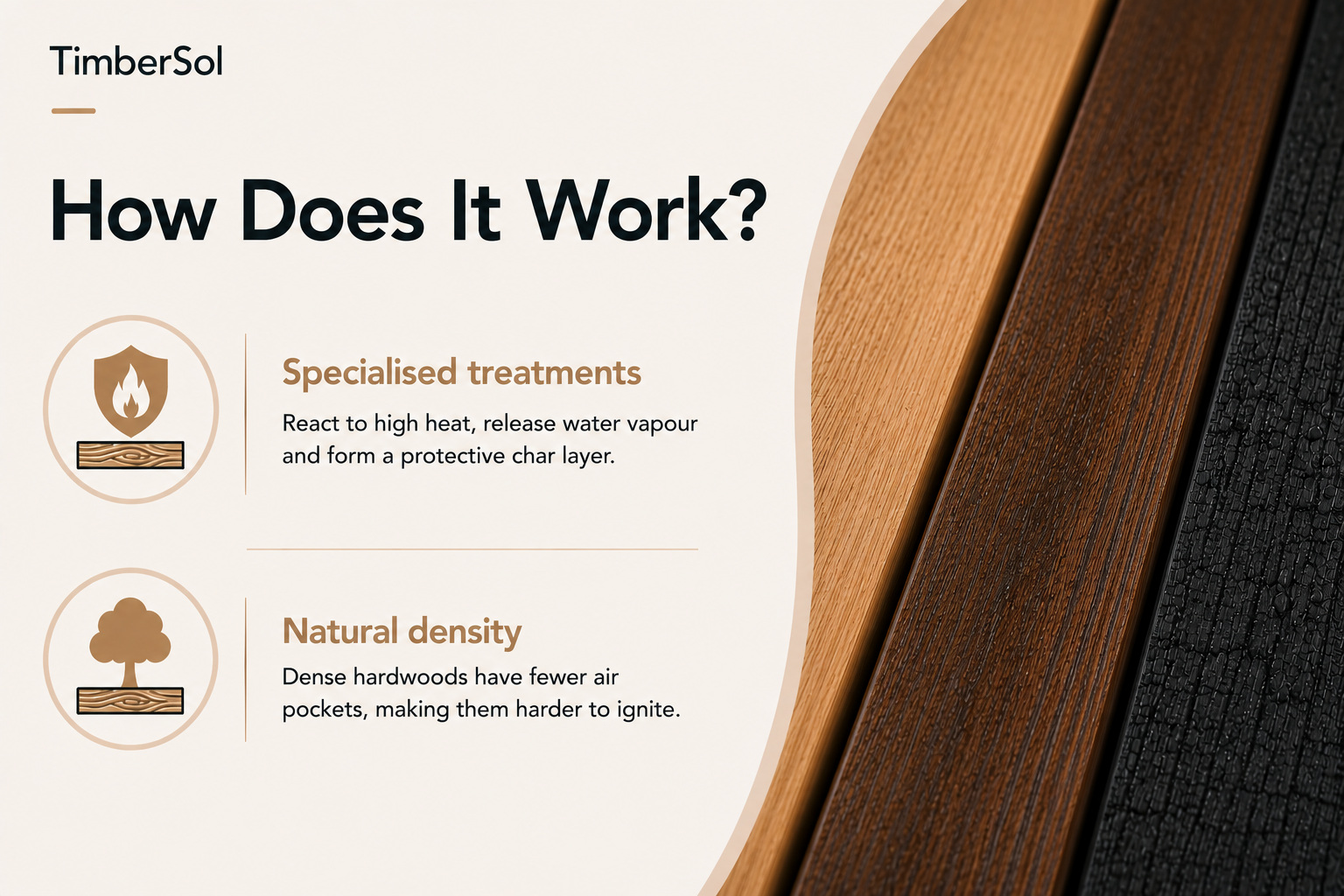
- Specialised treatments – the most common approach involves pressure-treating timber with fire-retardant chemicals. These treatments penetrate deep into the wood fibres. When exposed to high heat, they trigger a reaction that releases water vapour and promotes the formation of a protective char layer, helping to insulate the underlying wood from flames.
- Natural density – certain hardwoods, such as Ipe, Teak, or oak cladding, offer inherent fire resistance due to their dense cellular structure. With fewer internal air pockets, these woods are naturally harder to ignite.
The purpose of fire-resistant wood siding is not to make timber fireproof, but to significantly delay ignition and reduce how quickly fire can spread across a building’s exterior. This delay plays a critical role in improving overall building safety.
Choosing fire-resistant wood siding is a practical way to “harden” your home against external fire risks, particularly in higher-risk areas. It combines the natural appeal of timber with enhanced safety performance, making it an increasingly popular and responsible choice for homeowners across the UK.
Why Siding Fire Safety Is Critical in the UK
Siding fire safety has become a critical consideration in the UK, driven by stricter regulations, increased awareness of fire risks, and evolving building safety standards. Today, exterior materials must do more than provide weather protection—they must also help slow fire spread and safeguard both homeowners and neighbouring properties.
Where siding choices were once largely based on appearance and durability, they are now recognised as an essential part of a building’s overall safety strategy. This shift reflects a broader national focus on fire performance across residential construction.
Choosing fire-resistant wood siding is therefore not just about meeting regulatory requirements—it is a proactive decision. It helps protect your home, your family, and surrounding properties by reducing the speed at which fire can spread.
The Evolving Landscape of UK Building Safety
The Grenfell Tower fire in 2017 marked a turning point in how external cladding safety is viewed in the UK. The rapid spread of the fire, driven by combustible materials, led to the tragic loss of 72 lives. In response, the UK government and regulatory bodies began closely examining the performance of all construction materials.
This concern has continued beyond a single event. Data from Fire and Rescue Services shows that fires involving external cladding in urban residential areas increased by approximately 15% between 2017 and 2023. This stark reality pushed officials to mandate the use of much safer, fire-resistant alternatives. Discover more insights about the UK fire-retardant treated wood market.
As a homeowner, understanding these evolving building regulations is essential. It enables more informed, responsible decisions when selecting materials for your property.
Protecting Your Home and Community
In real-world scenarios, fire-resistant wood siding is designed to slow the progression of fire—and that delay is critical for several reasons:
- Buying you time – those extra minutes can make all the difference, allowing your family to evacuate safely and giving emergency services a better chance to respond before the fire escalates.
- Maintaining structural integrity – by resisting ignition, the siding helps protect the building’s structural core, reducing the risk of severe damage or collapse.
- Limiting fire spread – in densely built areas such as terraced streets, fire can spread rapidly between properties. Fire-resistant cladding helps act as a barrier, reducing the likelihood of flames spreading to neighbouring homes.
By selecting materials that resist combustion, you are not only protecting your own property but also contributing to the wider safety of your neighbourhood.
The Financial Benefits of Fire Safety
Investing in fire safety is not only a protective measure but can also make strong financial sense. While fire-resistant wood siding may involve a higher upfront cost compared to standard materials, the long-term value and potential savings are important to consider.
One of the most immediate financial benefits can be seen in home insurance. Insurers often offer lower premiums to properties that incorporate risk-reducing features. Using certified fire-resistant materials can make your home more attractive to insurers, potentially reducing annual costs. Over time, these savings can help offset the initial investment.
Making Sense of UK Fire Safety Ratings
Trying to understand fire safety ratings can feel a bit like learning a new language. When you start exploring fire-resistant wood siding, you’ll come across classifications such as “Class B-s1, d0”. While they may seem technical, these codes clearly describe how a material is expected to behave in the event of a fire.
Think of these ratings as a performance report card. They are not random labels, but the result of rigorous, standardised testing designed to assess how materials react under fire conditions.
In the UK, you will mainly encounter two systems: the older British Standard (BS 476) and the current European classification system, known as Euroclass.
Decoding the Euroclass System
The Euroclass system (BS EN 13501-1) is now the primary standard used across the UK and Europe. It provides a clearer picture of a material’s fire performance, going beyond simple combustibility. This makes it particularly useful when comparing different types of fire-resistant wood siding.
A Euroclass rating has three parts. Let’s use B-s1, d0 as our example:
- The Main Class (A1 to F) – this indicates how much the material contributes to fire. A1 represents non-combustible materials like stone or brick, while F indicates high flammability. For wood products, achieving a Class B rating is a strong result, meaning the material contributes very little to fire spread.
- Smoke Production (‘s’) – this measures the amount of smoke generated during combustion, rated from s1 (minimal smoke) to s3 (high smoke output). Lower smoke levels are critical for maintaining visibility and enabling safe evacuation.
- Flaming Droplets (‘d’) – this assesses whether the material produces burning droplets that could spread fire. Ratings range from d0 (no droplets) to d2 (significant droplets). A d0 rating indicates the material will not produce flaming droplets, improving safety for people and surrounding structures.
Comparing UK Fire Rating Systems
While Euroclass is now the primary standard, older BS 476 ratings—such as “Class 0” or “Class 1”—are still sometimes referenced. Understanding how these systems align can help you make clearer comparisons when selecting materials.
A rating of Class B-s1, d0 is considered the benchmark for fire-resistant wood siding. It indicates that the material makes a very limited contribution to fire spread, produces minimal smoke, and does not generate flaming droplets—meeting key fire safety criteria.
To simplify the comparison, the table below translates these ratings and explains what they mean in practical terms for your home’s cladding.
UK Fire Rating Classes for Siding Explained
| Euroclass Rating | BS 476 Equivalent | Performance Description | Typical Use Case for Siding |
|---|---|---|---|
| A1, A2 | Non-combustible | Materials that make no or a negligible contribution to a fire. | Not applicable to wood. This is for materials like stone, concrete, and glass. |
| B | Class 0 | Has a very limited contribution to fire. This is the highest rating achievable for wood. | Ideal for high-rise buildings, public spaces, and homes where maximum fire safety is a priority. |
| C | Class 1 | Offers good resistance with a limited contribution to fire. | A solid choice for many residential projects, like low-rise buildings and homes not in high-risk areas. |
| D, E | Class 3 | Has an acceptable but higher contribution to fire. | Generally not recommended for exterior siding where better fire performance is needed for safety. |
| F | Unclassified | No fire performance has been determined. These materials are easily flammable. | Must be avoided for any cladding or siding application. |
Once you’re familiar with these classifications, it becomes much easier to see beyond marketing claims and properly assess the true safety performance of any fire-resistant wood siding.
Always look for products that clearly state a Euroclass B rating, as this ensures you are choosing a material that genuinely contributes to improving your home’s fire safety.
Types of Fire Resistant Wood Siding
When choosing fire-resistant wood siding, there are two main approaches to consider. Each enhances fire performance in a different way, offering its own character and benefits. One method relies on advanced treatments to alter the wood’s properties, while the other draws on the natural characteristics of the material itself.
Understanding these options is key to finding the right solution for your project. Broadly, they fall into two categories: timber that has been treated to improve fire resistance, and timber that is naturally more resistant to it.
Fire-Retardant Treated Wood (FRTW)
Fire-Retardant Treated Wood (FRTW) is the most common approach to improving the fire performance of timber. It involves enhancing standard wood species—such as cedar, pine, or spruce—through a specialised treatment process.
The timber is placed in a high-pressure chamber, where fire-retardant chemicals are driven deep into its cellular structure, particularly in commonly used species like douglas fir wood cladding. This is not a surface coating; the treatment becomes an integral part of the wood itself.
When exposed to high temperatures, these chemicals activate. They release water vapour and promote the formation of a protective char layer on the surface. This char acts as an insulating barrier, shielding the inner wood and significantly slowing the rate of combustion.
FRTW has become increasingly popular as UK building regulations have tightened. The market reflects this shift, with fire-retardant treated wood projected to grow by approximately 4.7% annually until 2032, and exterior siding applications expected to grow at nearly 5% per year. You can dig deeper into the fire-retardant treated wood market trends if you’re interested.
Naturally Fire-Resistant Hardwoods
The second approach relies on the power of nature itself. Certain tropical hardwood species are so dense and rich in natural oils that they are inherently difficult to ignite. Their tightly packed cellular structure contains very few air pockets, limiting the oxygen that fire needs to take hold and spread.
It’s similar to trying to ignite a solid block of steel versus a piece of paper—these dense hardwoods behave much more like steel.
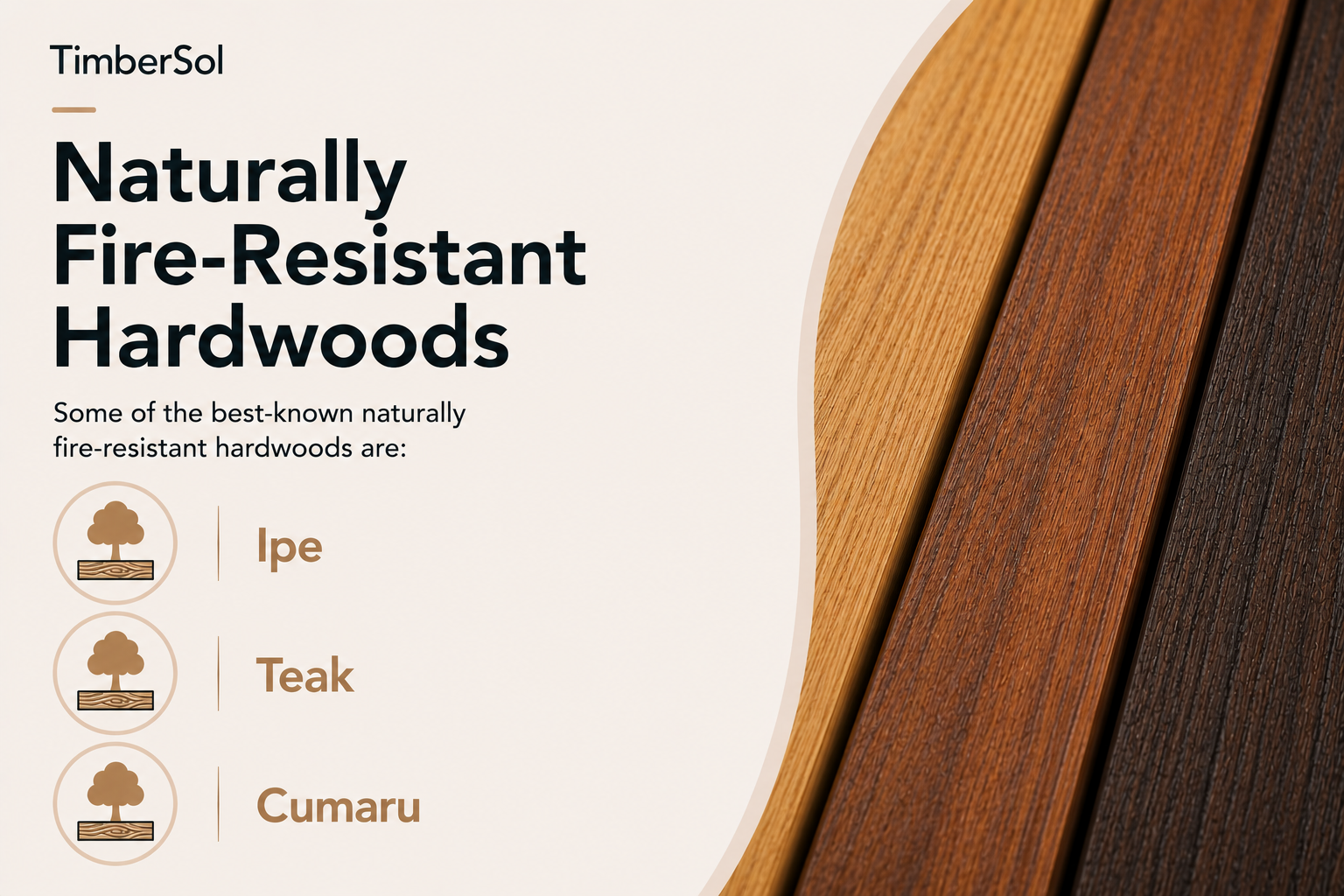
Some of the best-known naturally fire-resistant hardwoods are:
- Ipe – often referred to as “ironwood” due to its exceptional density and durability. This South American hardwood achieves a Class A fire rating, comparable to materials like concrete, making it a top-tier option for high-risk areas.
- Teak – widely used in boat building, Teak contains high levels of natural oils that provide strong resistance to water, rot, and insects. These same properties also contribute to its ability to resist fire.
- Cumaru – another dense Brazilian hardwood, Cumaru combines strong fire-resistant properties with a rich, attractive grain, offering both performance and visual appeal.
These hardwoods provide a completely chemical-free solution, relying on their natural physical characteristics to deliver fire resistance.
Comparing Your Siding Options
Choosing between treated wood and naturally fire-resistant hardwood ultimately comes down to balancing several key factors. There isn’t a single “best” option—it depends on your project’s specific requirements, your design preferences, and your budget.
The decision typically involves weighing upfront costs against long-term maintenance, considering the desired visual style, and ensuring the material meets the fire performance standards required by local building regulations.
To help clarify these differences, the comparison below outlines the key characteristics.
| Feature | Fire-Retardant Treated Wood (FRTW) | Naturally Resistant Hardwoods |
|---|---|---|
| Effectiveness | Excellent. Can achieve a high fire rating (often Class B) by chemically altering the wood to slow combustion. | Superior. Many species achieve the highest Class A fire rating without any chemical additives, purely due to their density. |
| Aesthetics | Looks very similar to the untreated wood species, though some treatments might add a slight hue. Offers a wide variety of wood looks. | Offers a rich, premium look with distinctive grain patterns. The colour palette is limited to the natural tones of the specific species. |
| Cost | Generally more affordable upfront than premium tropical hardwoods. The treatment adds to the base price of the timber. | Higher initial investment. These are premium, sought-after materials, and their cost reflects their natural performance and rarity. |
| Maintenance | May require periodic reapplication of a protective finish to maintain the wood’s condition, depending on the product and climate. | Typically low-maintenance. The natural density and oils protect the wood, often requiring only occasional cleaning or oiling to preserve its colour. |
| Sustainability | Varies. Look for treatments using non-toxic chemicals and wood sourced from sustainably managed forests (FSC or PEFC certified). | Sourcing is a key consideration. It’s vital to ensure the hardwood comes from a certified, sustainable source to avoid environmental harm. |
At the end of the day, both FRTW and naturally dense hardwoods represent a significant safety improvement over untreated wood. By carefully weighing these factors, you can select a fire-resistant siding solution that aligns with your goals—delivering a home that is safe and built to last.
Discovering Yakisugi: The Art of Charred Wood Siding
Long before modern chemical treatments, a centuries-old Japanese technique was already producing highly effective and visually striking fire-resistant wood siding. Known as Yakisugi (also called shou sugi ban), this method transforms ordinary timber into a material that is not only durable but also naturally more resistant to fire, as seen in charred douglas fir cladding.
It’s a strong example of how traditional craftsmanship can offer practical solutions to modern building challenges.
The Yakisugi process involves carefully charring the surface of timber planks. This is not uncontrolled burning, but a precise and controlled application of heat that creates a dense, black carbon layer on the wood’s surface. This carbonised layer acts as a natural protective shield.
This simple process fundamentally changes how the wood behaves in a fire. While untreated timber can act as fuel, the charred surface created through Yakisugi is far more resistant to ignition. The carbon layer works as an insulating barrier, protecting the underlying wood and significantly slowing the rate at which fire can spread.
The Science Behind the Scorch
The effectiveness of Yakisugi comes down to relatively simple chemistry. During the charring process, the more flammable components of the wood’s surface—primarily cellulose—are burned away. What remains is a dense carbon layer, which is significantly more stable and far less combustible.
It’s similar to the difference between lighting kindling and lighting coal. Kindling ignites quickly, while coal requires much more heat and time to catch. By charring the timber, the surface is effectively transformed into a coal-like barrier.
But the benefits go well beyond fire resistance. The carbon layer also protects against several other common threats:
- Rot and moisture resistance – the charring process seals the wood’s pores, making it highly resistant to water ingress and decay.
- Insect deterrence – pests such as termites and wood-boring insects are deterred by the carbonised surface.
- UV protection – the dark, carbon-rich layer acts as a natural barrier against UV exposure, reducing weathering and greying over time.
As a result, Yakisugi offers a siding solution that is not only safer but also highly durable and low-maintenance, often without the need for chemical treatments or frequent resealing.
Yakisugi is more than just a technique—it’s a philosophy. It centres on working with nature to enhance the wood’s natural strengths, creating a material that is protected from fire, pests, and weather through its own transformed surface.
Beautiful Aesthetics and The Best Woods for the Job
Not all timber is suited to the Yakisugi process. The technique works best with specific softwoods that char evenly and form a stable, protective surface. Japanese Cedar (Sugi) is the traditional benchmark, but other species also perform exceptionally well, including:
- Siberian Larch
- Pine
- Cypress
Alongside its practical benefits, Yakisugi offers a distinctive and highly sought-after aesthetic. The deep, velvety black finish of the charred wood—often featuring a rich, textured pattern known as “alligator skin”—creates a look that is both bold and refined, making it a popular choice among architects and designers.
It can be used to create a bold, modern statement or to introduce a subtle touch of rustic elegance to a building’s exterior. To see how this material can enhance a project, you can explore the versatile applications of Yakisugi cladding in our detailed guide.
By combining traditional craftsmanship with contemporary design, Yakisugi offers a solution that is sustainable, durable, and visually striking—making it a compelling choice for fire-resistant wood siding.
Installation Costs and Long-Term Maintenance
Choosing your fire-resistant wood siding is an important step, but it’s only part of the overall investment. To fully understand its value, it’s essential to consider the entire lifecycle—from installation through to long-term upkeep.
The upfront cost is just one element. The total investment also includes professional installation, any required finishes, and the ongoing maintenance needed to ensure the siding continues to perform effectively and retain its appearance over time.
Analysing the Upfront Investment
The initial cost of fire-resistant wood siding can vary significantly depending on the material you choose. Each option balances price per square metre with installation complexity, both of which directly influence your overall project budget.
In the UK, there is a clear shift towards safer and more durable materials. Projections indicate that by 2030, fire-retardant treated wood could account for over 20% of the wood siding market. This trend is driven by stricter safety regulations and an increasing demand for sustainable building solutions.
So, how do the options stack up on price? Here’s a rough guide:
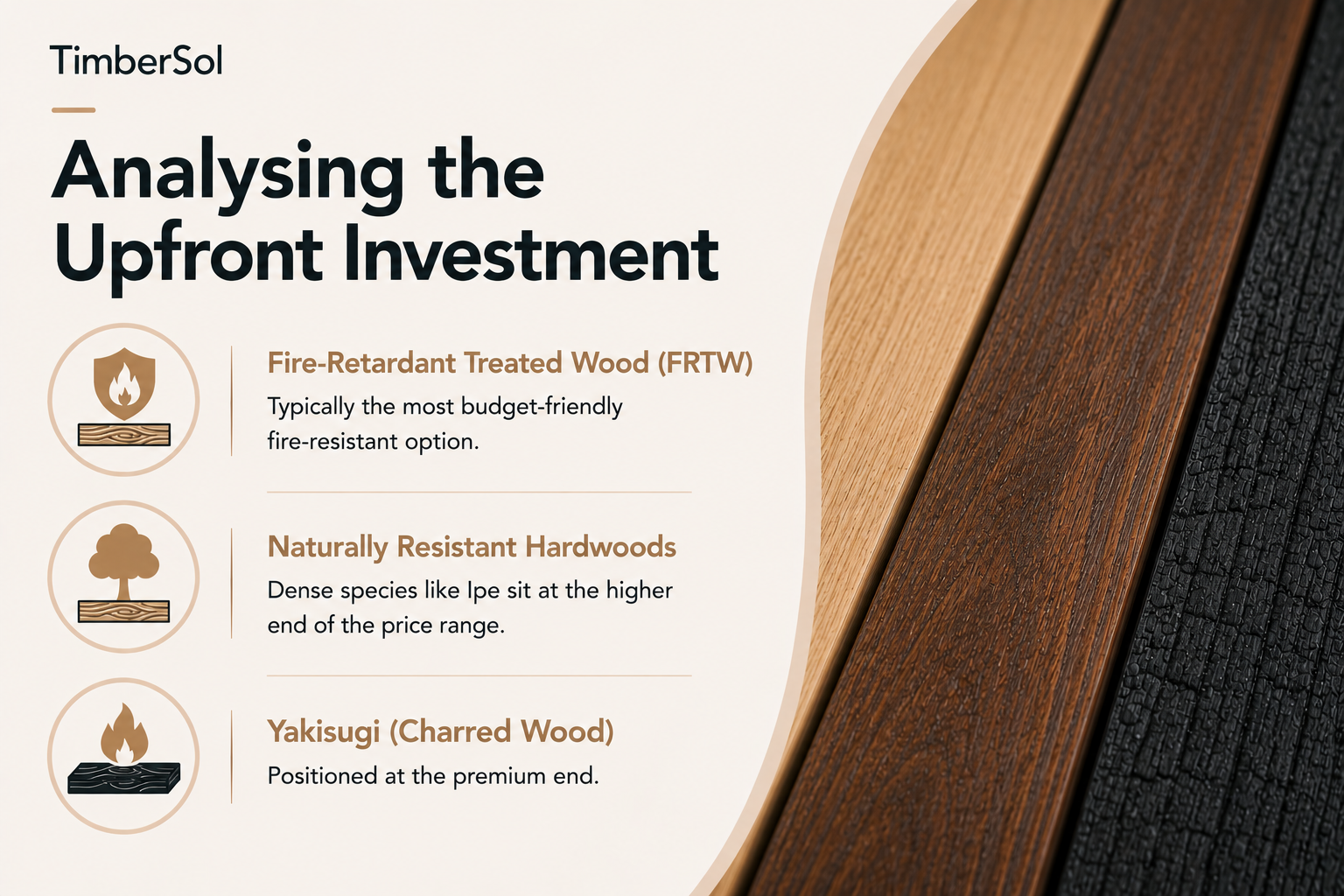
- Fire-Retardant Treated Wood (FRTW) – typically the most budget-friendly fire-resistant option. While it costs more than untreated timber, it is generally more affordable than premium hardwoods or Yakisugi.
- Naturally Resistant Hardwoods – dense species like Ipe sit at the higher end of the price range. The cost reflects their exceptional durability and natural fire-resistant properties.
- Yakisugi (Charred Wood) – positioned at the premium end due to the craftsmanship and specialised process involved in charring the timber, including high-performance options like charred accoya cladding. For a more detailed cost breakdown, refer to our guide to charred wood siding costs.
Installation Best Practices
Proper installation is essential. If fire-resistant wood siding is not installed correctly, it will not perform as intended. A beautiful finish means little if critical steps are missed during the build.
One of the most important factors is the ventilation gap behind the cladding. This air space is vital for moisture control, but it also helps heat dissipate, reducing the risk of it transferring to the building’s main structure during a fire. Using the correct fixings is equally important—stainless steel nails or screws prevent rust and ensure the cladding remains secure over time.
A correctly installed system, with proper ventilation and suitable fixings, is just as important as the material itself. It ensures the entire cladding assembly works together effectively to protect your home.
Long-Term Care and Maintenance
The level of maintenance your siding requires will depend on the material you choose. Considering this from the outset helps avoid issues later and ensures your cladding continues to look and perform at its best.
For Fire-Retardant Treated Wood, maintenance is similar to standard timber. A protective finish will typically need to be reapplied every few years to protect against UV exposure and moisture, helping to preserve the fire treatment.
Yakisugi, by contrast, is well known for its low maintenance. The charred surface is not purely aesthetic—it naturally resists rot, insects, and UV damage. In most cases, occasional light cleaning is enough to keep it in excellent condition over the long term.
Got Questions? We’ve Got Answers
Choosing the right siding can feel overwhelming, especially when balancing visual appeal with essential safety features like fire resistance. Let’s clear up some of the most common questions people have about fire-resistant wood.
First and foremost, it’s important to understand that no wood siding is completely “fireproof”. The purpose of fire-resistant timber is to significantly slow ignition and reduce the speed at which fire spreads—providing valuable time for safe evacuation.
How Long Does The Protection Last, and What About Existing Siding?
With high-quality, pressure-treated timber, the protection is long-lasting. The treatment is driven deep into the wood’s fibres, meaning it won’t wash away with rain or easily degrade—it is designed to remain effective for the full lifespan of the siding.
But can I just paint a fire-retardant coating onto the siding I already have? While surface coatings are available, they are generally a temporary solution. They are less effective than factory-applied treatments and require regular reapplication. For reliable, long-term performance and to meet UK building regulations, it’s best to choose timber that has been pressure-treated during the manufacturing process.
Installation and Everyday Maintenance
Installing treated wood is not significantly different from standard timber cladding. The same best practices apply for any timber cladding—ensuring a proper ventilation gap behind the boards and using high-quality stainless steel fixings. It’s essential to follow the manufacturer’s specific guidelines to maintain both warranty coverage and fire certification.
For ongoing maintenance, the same principles as general timber care apply. For more great tips on keeping your timber looking its best against the elements, take a look at our guide on how to protect wood outdoors.
At TimberSol, we specialise in crafting high-quality, fire-resistant charred timber cladding, fencing and decking, using the traditional Yakisugi method. Discover the perfect blend of safety and style for your project by exploring our premium timber solutions at https://timbersol-backup.elnoirstudio.com.
