
How Long Does Larch Cladding Last? Lifespan, Weathering & Maintenance

A timber cladding project is a long-term investment, so it’s only natural to ask how long the boards will actually last once they are exposed to the British weather. While larch has earned a reputation as one of the most durable softwoods for exterior use, its lifespan is not determined by the species alone. Installation quality, building design, ventilation, and exposure all play a significant role in how well the timber performs over time.
The good news is that, when larch cladding is specified and installed correctly, it can provide decades of reliable service with very little maintenance. Whether you’re comparing European and Siberian larch, wondering whether treatment is necessary, or simply wanting to understand how the timber weathers over time, knowing what influences its lifespan will help you make a more informed decision.
In this guide, we’ll explain how long larch cladding typically lasts, what affects its durability, how its appearance changes over time, and the practical steps that help maximise its service life.
How Long Does Larch Cladding Last?
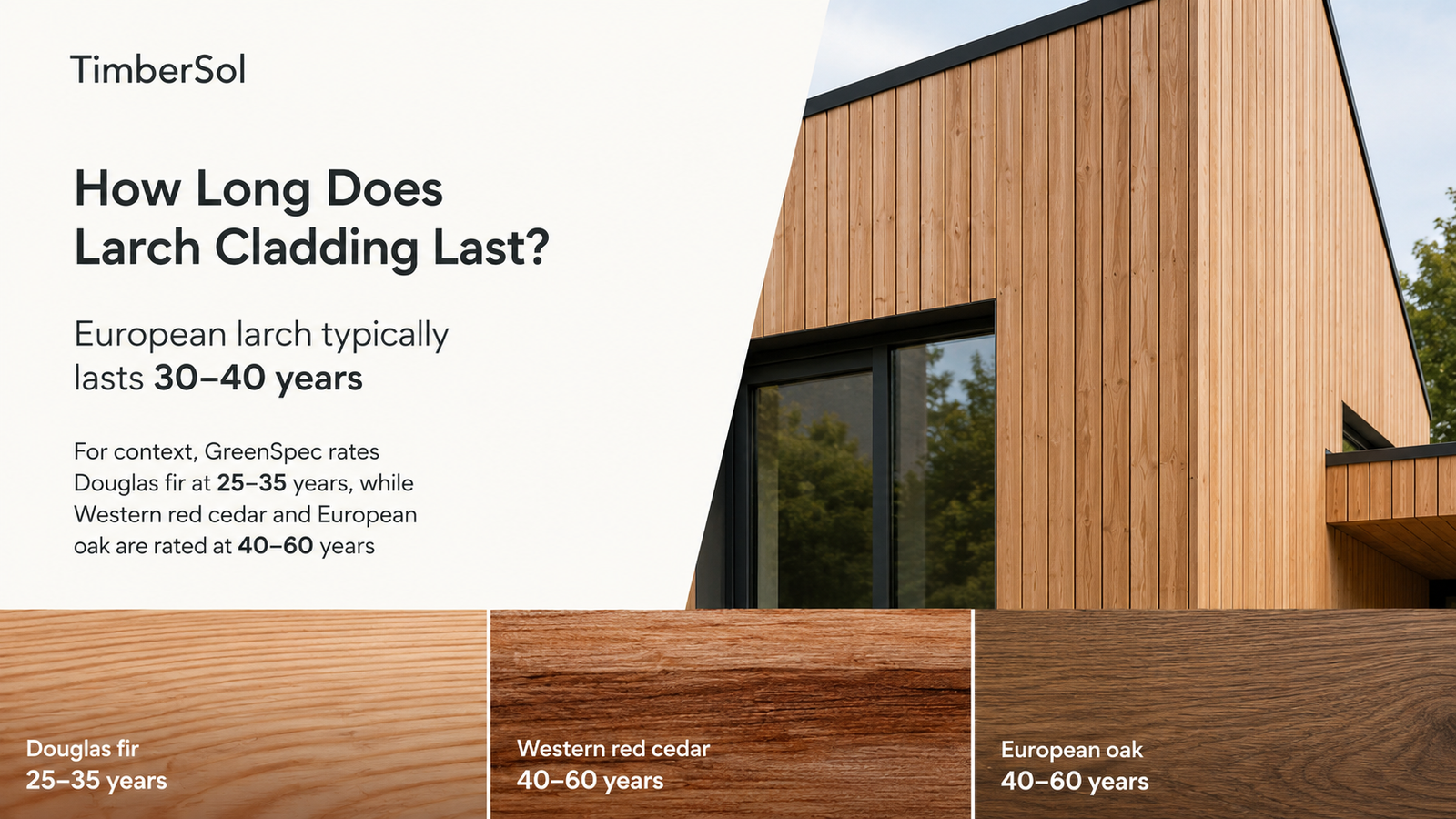
European larch typically lasts 30–40 years as exterior cladding, provided that only heartwood is used and the boards are properly detailed. This reflects its classification as Durability Class 3 (moderately durable) under BS EN 350-2, meaning it can be installed untreated while still resisting decay for decades.
Published lifespans vary widely because installation quality and exposure have a significant impact on durability. Untreated boards in fully exposed locations, in ground contact, or with poor ventilation are at the lower end, often quoted at 10–15 years. Well-installed, well-ventilated, and properly maintained cladding with adequate ground clearance reaches, and sometimes exceeds, the upper end of the range because moisture is kept under control.
UK service-life expectations are benchmarked against BS 8417, which defines design service-life categories of 15, 30, and 60 years. These are design expectations under good detailing, not guarantees, as exposure, mechanical damage, and poor detailing can all shorten real-world service life.
For context, GreenSpec rates Douglas fir at 25–35 years, while Western red cedar and European oak are rated at 40–60 years. For projects requiring exceptional dimensional stability and durability, Accoya cladding is another premium option worth considering. Larch therefore sits comfortably in the mid-range among naturally durable cladding species.
Charred larch, such as that supplied by TimberSol, develops a protective carbon layer through controlled surface charring, improving its resistance to moisture, insects, and decay. The robust, verifiable durability figures still come from the Class 3 data above. Lifespan claims specific to charred timber reflect manufacturer and industry experience rather than primary standards, so they are best regarded as practical observations rather than certified facts.
What Affects Larch Cladding Lifespan: Climate, Orientation & Installation
Climate, orientation, and installation quality determine whether larch cladding reaches the lower or upper end of its 30–40-year lifespan. The wood’s durability rating sets the potential, but the detailing determines the outcome.
Environmental exposure has the greatest impact. High rainfall, prolonged sunlight, and salt-laden coastal air all accelerate weathering, which is why GreenSpec advises particular care when using larch in exposed coastal locations.
Orientation also matters because UV exposure and driving rain are not distributed evenly across a building. South- and west-facing elevations weather and turn silver more quickly than sheltered north-facing walls, often resulting in visibly different shades on the same house.
Building design helps counter these effects. Deep eaves, overhangs, and a ventilated cavity behind the boards help shed water and maintain airflow, reducing moisture content and extending service life.
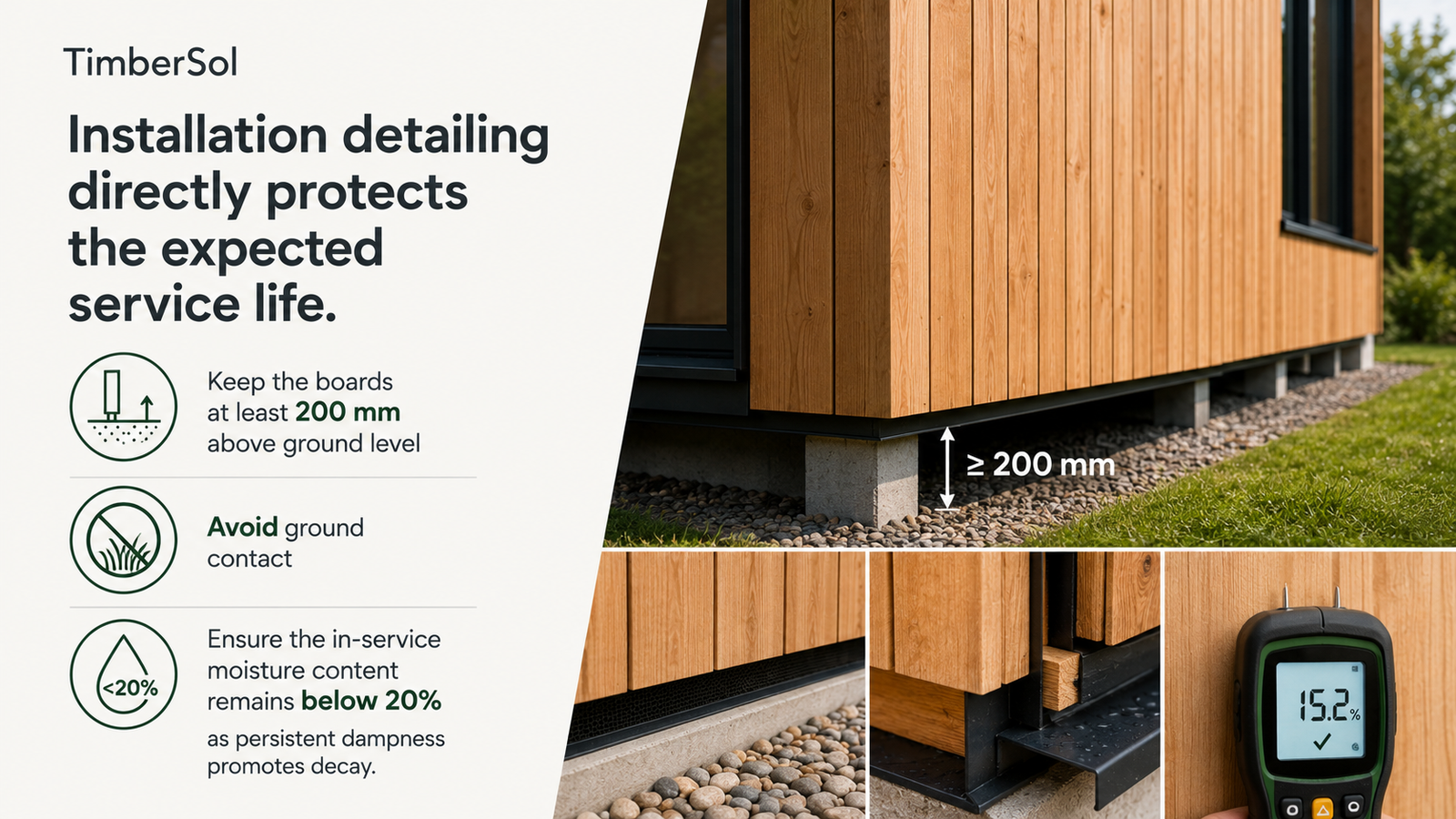
Installation detailing directly protects the expected service life. Keep the boards at least 200 mm above ground level, avoid ground contact, and ensure the in-service moisture content remains below 20%, as persistent dampness promotes decay.
Helpfully, larch has a ‘small’ movement classification, so it remains dimensionally stable through seasonal moisture changes. This helps keep joints tight and fixings secure over decades.
How Larch Cladding Weathers and Silver Over Time?
Weathering changes how larch looks, not how it performs. The surface fades and turns silver as it ages, but the timber beneath remains structurally sound. In other words, “looking old” and “wearing out” are two different things, and understanding that distinction is important before judging a board by its colour.
Why Larch Turns Silver-Grey?
Uncoated larch turns silver-grey because UV light breaks down the lignin in the surface fibres. Lignin binds the wood cells and gives timber its warm colour, so as it degrades, the surface gradually weathers to the familiar silver-grey patina.
This colour change typically takes around five years to develop into an even silver-grey finish. South- and west-facing walls weather and turn silver more quickly because of greater UV exposure and driving rain, while areas with high rainfall accelerate the process further.
Crucially, this greying is purely cosmetic. Lignin breakdown affects only a thin surface layer, so the heartwood beneath remains sound, and its durability and service life are unchanged.
A silvered board has not worn out. It has simply changed colour, which is why many owners embrace the look rather than try to prevent it.
Treated vs Untreated Larch
Larch can be left untreated because its Durability Class 3 rating allows the heartwood to resist decay for decades without protective coatings. Treatment is therefore a matter of appearance rather than a structural requirement.
This leaves you with two options. You can embrace the natural silvering and allow the boards to weather to a silver-grey finish, or apply a UV-protective oil or stain to slow the colour change and preserve the timber’s original warmth.
The trade-off is maintenance. Oiled finishes require periodic re-coating to retain their colour, whereas untreated boards are effectively maintenance-free apart from occasional cleaning to remove dirt and algae.
Charred larch sits somewhere in between. Brushed and finished with oil to achieve the final shade, it provides a stable, low-maintenance surface that retains its appearance and resists rub-off under normal use, helping the colour remain consistent across the elevation.
Disadvantages of Larch Cladding
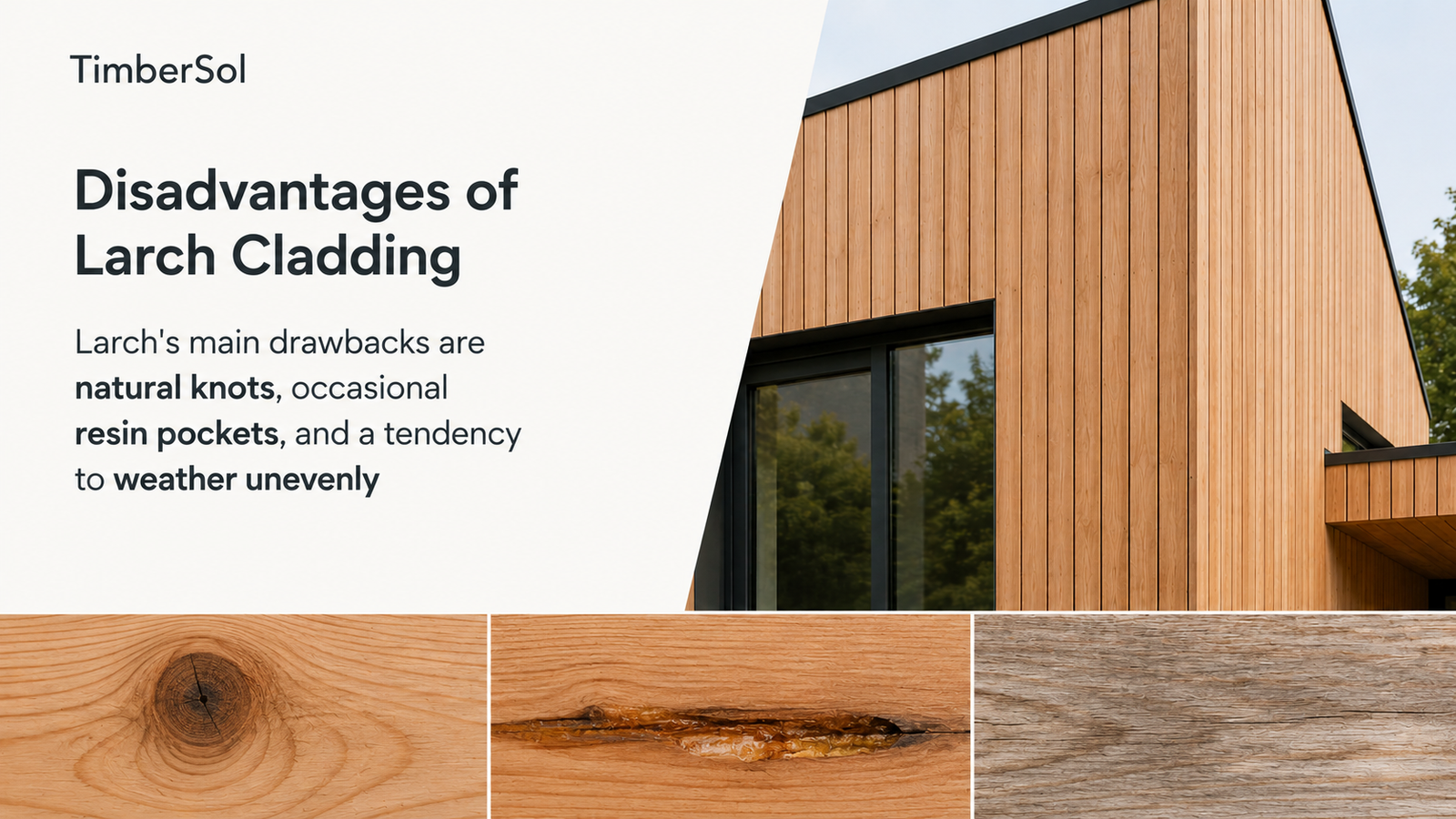
Larch’s main drawbacks are natural knots, occasional resin pockets, and a tendency to weather unevenly, all of which affect appearance rather than structural performance. Knots and resin pockets can detract from a clean, uniform appearance, which is why selecting quality-graded heartwood is important.
The wood can also become susceptible to rot under the wrong conditions. Larch resists decay well above ground, but ground contact, poor ventilation behind the boards, or sustained moisture content above 20% can significantly shorten its service life.
Weathering can also appear uneven. A sheltered elevation silvers more slowly than an exposed south- or west-facing elevation, so the same building can display two shades of grey at the same time.
That natural greying itself divides opinion. Some owners appreciate the natural patina, while others apply a UV-protective oil or choose a charred finish to preserve the original colour.
Yet none of these issues are deal-breakers. With the right species selection, good detailing, and proper installation, they are all largely manageable, making larch a dependable, durable choice for exterior cladding.
How Long Does Larch Cladding Last: FAQ
Can You Leave Larch Cladding Untreated?
Yes, larch is durable enough to be left untreated because its Durability Class 3 rating allows the heartwood to resist decay for decades without protective coatings. The boards will simply weather to a natural silver-grey patina over time.
Untreated, fully exposed larch tends to fall at the lower end of its 30–40-year service life. Keeping the boards at least 200 mm above ground level and ensuring good ventilation behind the cladding helps extend their service life towards the upper end of the range.
Treatment is therefore a matter of appearance rather than a structural requirement. You can leave larch untreated and still expect decades of reliable performance.
Does Larch Cladding Turn Grey, and How Long Does It Take?
All uncoated larch turns silver-grey because UV light breaks down the lignin in the surface fibres, gradually changing the timber’s warm colour to a natural silver-grey patina. This process occurs in all naturally weathering timber cladding species, not just larch.
The colour change typically takes around five years to develop into an even silver-grey finish. South- and west-facing walls, as well as buildings in high-rainfall areas, weather and turn silver more quickly because of greater UV exposure and driving rain.
This colour change is purely cosmetic and does not weaken the wood or shorten its service life. To slow the process, apply a UV-protective oil to retain the timber’s natural colour for longer, or choose a charred finish to achieve the desired colour from the outset.
How Long Does Siberian Larch Cladding Last Compared with European Larch?
Both are classified as Durability Class 3 under BS EN 350-2, so their official durability rating is the same. In practice, however, Siberian larch often provides a longer service life because it is denser and more durable.
This difference comes down to growth conditions. Siberian larch grows slowly through short summers and long winters, producing tight grain, fewer knots, and a higher proportion of heartwood. Its greater density and higher heartwood content help the boards resist weathering and remain structurally sound over time.
That is why Siberian larch is often considered the premium choice for cladding, even though it has the same Durability Class 3 rating as European larch.
Larch already offers a dependable 30–40-year service life as untreated cladding, but charring it using the traditional Yakisugi method creates a protective carbon layer that further improves its resistance to moisture, insects, and decay. At TimberSol, we carefully char British and Siberian larch, then brush and oil each board to achieve a distinctive, low-maintenance finish that enhances a building’s character while helping the timber perform for decades.
If you are planning a house exterior, extension, or garden room, the easiest first step is to see and feel the material for yourself. Order a charred larch sample in your chosen shade, then request a quote when you are ready to specify your project.
