
Max fence height uk: Essential UK fence rules for homeowners

Thinking about putting up a new fence? One of the first questions most homeowners ask is, “How high can I build a fence without needing council approval?”
It’s a valid concern, and in most cases, the answer is straightforward. For rear gardens in the UK, the maximum permitted fence height is 2 metres (approximately 6 ft 6 in). If a fence runs alongside a public highway, such as a road or public footpath, the height limit is reduced to 1 metre (around 3 ft 3 in).
Maximum fence height in the UK is the set of planning rules and permitted development guidelines, which define how tall a fence can be without planning permission. The allowed height depends on the fence’s location on the boundary, its position relative to a highway or road, proximity to neighbouring properties, visibility and safety considerations, and local council regulations that apply to residential areas.
The article discusses the maximum fence height rules in the UK, including the 2-metre limit for rear gardens and the 1-metre limit for fences next to roads or public footpaths. It explains how fence height is measured from natural ground level, what elements are included in the total height, and when planning permission is required for special properties.
Getting to Grips with Permitted Heights
Understanding these two height limits is the starting point for a hassle-free fencing project. The rules are set out under permitted development rights, which allow homeowners to carry out certain home improvements without applying for formal planning permission. This framework is designed to balance the need for privacy, road safety, and the overall appearance of residential areas.
By following these guidelines, you can install a fence without the extra time, paperwork, or cost associated with a planning application. These limits are not arbitrary. They are based on long-established UK planning law, first introduced under the Town and Country Planning Act and refined over time. If you want deeper context, you can explore how UK fence regulations have evolved.
A Quick Guide to Fence Heights
To keep things simple, below is a clear summary of the standard fence height rules that apply without the need for planning permission.
Permitted Fence Heights Without Planning Permission
This table breaks down the maximum heights you can build to, depending on where the fence is located on your property.
| Fence Location | Maximum Permitted Height |
|---|---|
| Rear Garden (not next to a highway) | 2 Metres |
| Front Garden (next to a highway) | 1 Metre |
| Anywhere next to a Public Highway | 1 Metre |
Getting this right from the start helps you avoid problems later with neighbours or your local planning authority.
Key takeaway: The rule is simple – 2 metres for rear garden fences and 1 metre for any fence bordering a public road or footpath. Always measure height from ground level on your side of the boundary to ensure compliance.
How to Measure Your Fence Height Correctly
Measuring fence height may seem straightforward, but many neighbourhood disputes start with an incorrect measurement. To stay compliant, your fence height should be measured exactly as a planning officer would, which means starting from the correct reference point.
The key rule is to measure from the natural ground level on your side of the boundary. You cannot raise the ground with added soil or raised beds to increase the apparent height. Measurements must be taken from the original, undisturbed level of the land.
Using dimensionally stable materials is essential where height tolerance is limited. Charred accoya cladding is widely used for precision-built fencing because it remains stable under changing moisture conditions, helping fences stay within permitted development height limits throughout their service life.
The visual guide below explains the standard height limits for front and rear gardens.
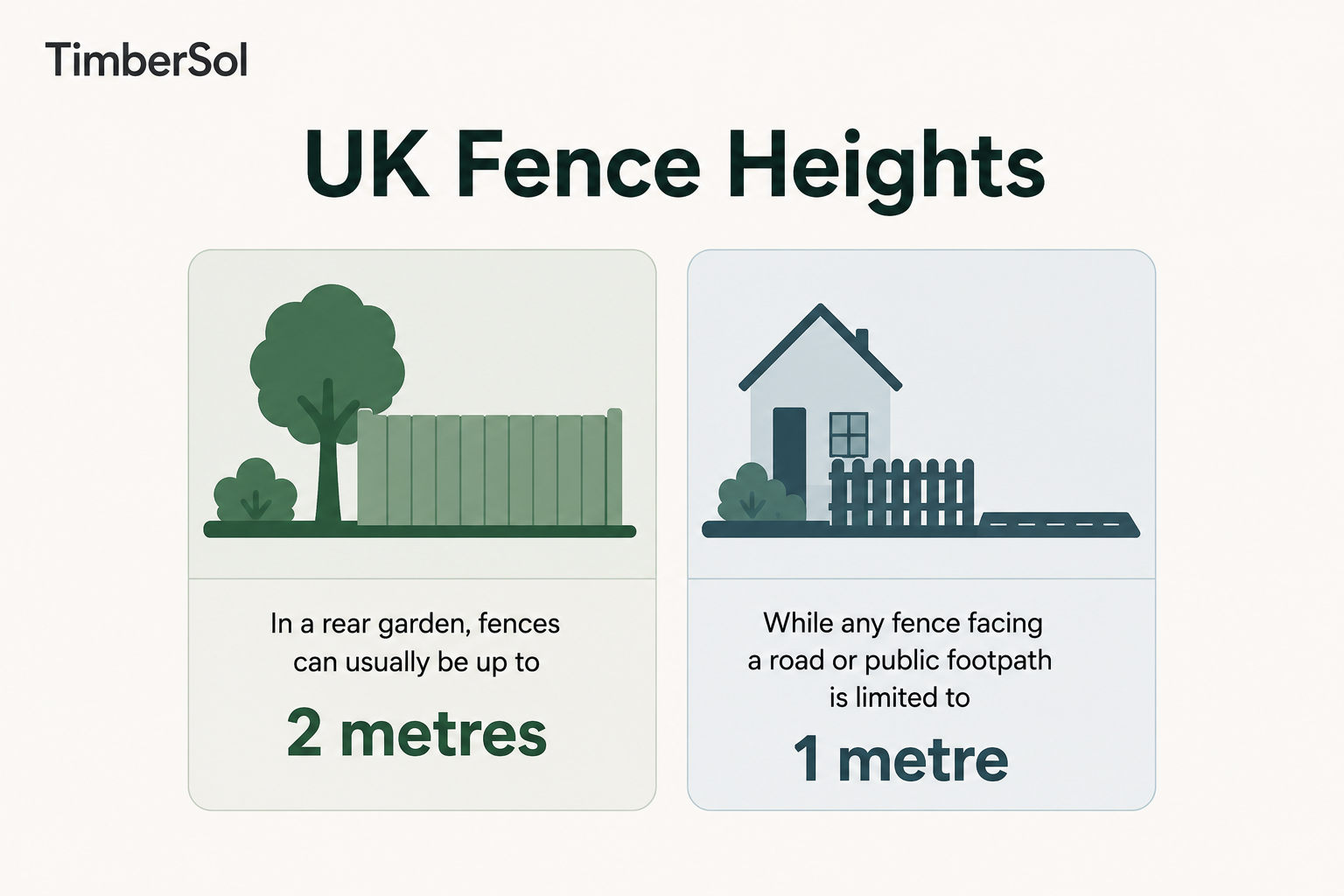
As shown, the permitted height depends on the fence’s location. In a rear garden, fences can usually be up to 2 metres, while any fence facing a road or public footpath is limited to 1 metre.
What About Slopes and Uneven Ground?
Of course, not all gardens are perfectly level. If your property sits on a slope, fence height must be measured from the lowest point of the natural ground level. This ensures that no section of the fence exceeds the legal height limit when viewed from lower ground.
The same principle applies when your garden is higher or lower than your neighbour’s. Local councils assess fence height only from the ground level on your property.
One of the most common mistakes is forgetting to include decorative toppers in the total fence height. Trellis panels, lattice sections, and post caps all count toward the overall measurement. For example, if a fence panel is 2 metres high and you add a 30 cm trellis on top, the fence becomes non-compliant.
It’s All About the Total Height
When planning a new fence, remember that every component contributes to the final height. The total height, measured from ground level to the highest point, is what determines compliance with max fence height UK rules.
Accurate material calculations also matter for budgeting and compliance. Using an online fence board calculator helps you work out exactly how much timber is required. Careful planning at this stage reduces the risk of breaching regulations and helps ensure the project runs smoothly.
Material choice affects long-term compliance and maintenance. Charred cladding systems are commonly used for boundary fencing because the charring process improves resistance to moisture, rot, and UV exposure without increasing panel thickness. This allows homeowners to achieve privacy and durability while remaining within maximum permitted fence height UK limits. Species-based options such as charred douglas fir cladding are often chosen where stronger grain definition is required without compromising height compliance.
Darker finishes, such as black charred wood cladding, are often selected to enhance privacy without increasing the overall fence height, as the deeper tone reduces visibility and creates a stronger visual barrier.High-contrast options like black charred wood fencing are also specified where a defined architectural boundary is required, particularly when projects must comply with permitted development height restrictions.
When You Must Get Planning Permission
The standard 1-metre and 2-metre fence height limits fall under permitted development rights, which allow many common home improvements without formal approval. These rules act as a pre-approved framework for most residential fencing projects.
However, permitted development rights do not apply in every situation. Certain circumstances override these general limits, meaning you must apply for planning permission before installing a fence.
The most common reason permission is required is when you want to build a taller fence. If a proposed fence exceeds the max fence height UK limits for its position on your property, approval from your local council is required before construction begins.
Special Property Designations
Fence height is not the only deciding factor. In some cases, a property’s status or location automatically requires planning permission, regardless of how tall or short the fence is. These controls exist to protect areas with historical or architectural significance.
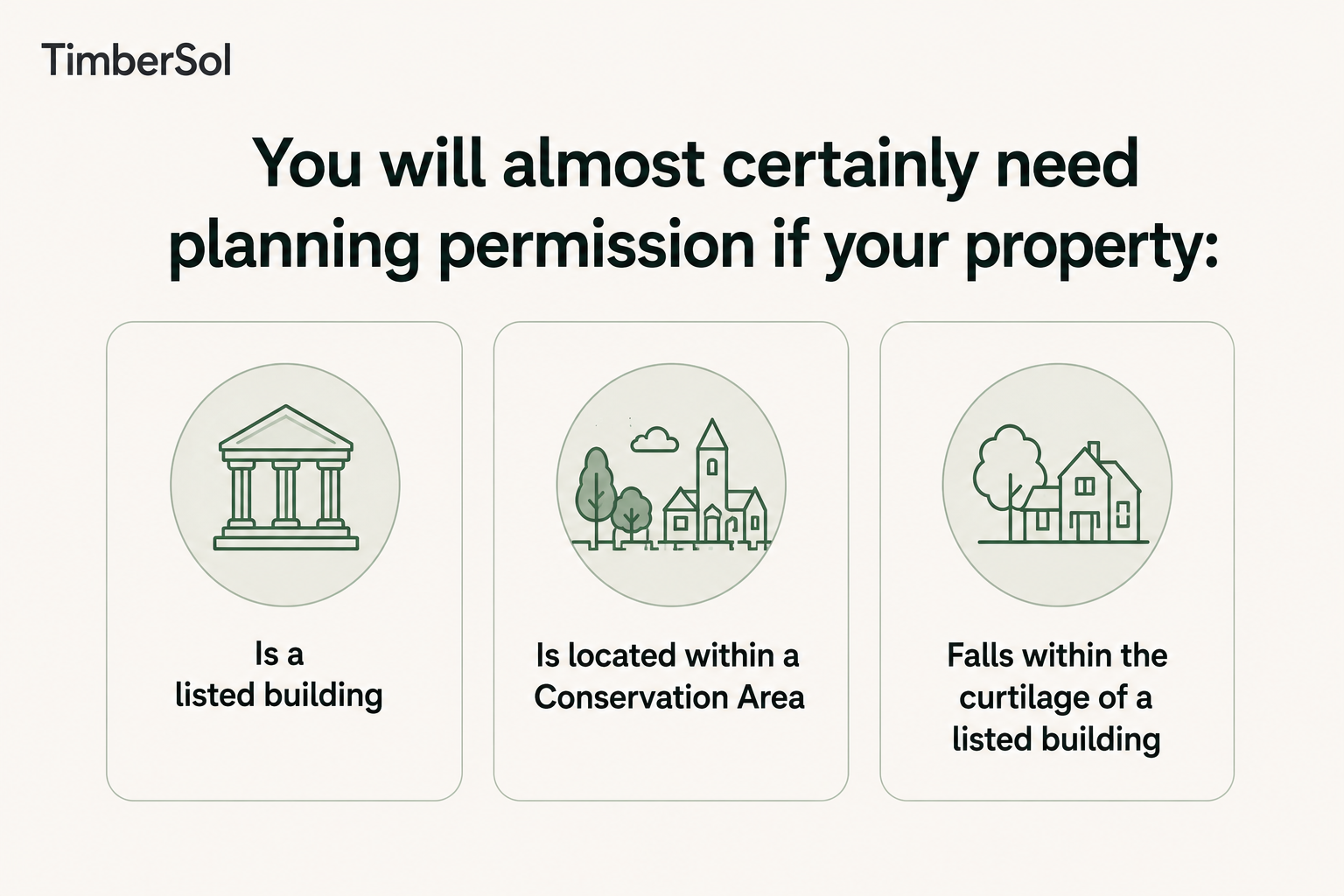
You will almost certainly need planning permission if your property:
- Is a listed building: Any alteration, including installing a new fence, that could affect the building’s character requires special consent.
- Is located within a Conservation Area: These designated areas are subject to stricter controls, and many permitted development rights are limited or removed.
- Falls within the curtilage of a listed building: Even if your home is not listed, being on the same plot as a listed structure can place the project under tighter planning requirements.
Crucial first step: Before progressing too far, arrange a pre-application discussion with your local planning authority. This informal check can clarify site-specific rules early on and help you avoid unnecessary time, cost, and complications later.
The Consequences of Ignoring the Rules
Building a fence without the correct permission carries real risk. If the council’s planning enforcement team receives a complaint- whether from a neighbour or a member of the public – they are required to investigate.
If a breach is confirmed, the council can issue a legally binding enforcement notice. This may require you to reduce the fence to a compliant height or, in more serious cases, remove it entirely at your own expense. What begins as a straightforward DIY project can quickly turn into a costly and stressful legal issue.
For wider context on how planning permission applies to other types of home improvements, it may be helpful to explore UK home extension planning permission.
Navigating Common Fencing Scenarios
Understanding the basic rules is one thing; applying them in real-world gardens is another. Few plots are perfectly flat or neatly shaped, which is where the max fence height UK rules can start to feel unclear. The sections below walk through some of the most common situations homeowners encounter.
Shared boundary fences are a frequent source of confusion. Before choosing fence panels or setting posts, check your property deeds. These documents often show boundary responsibility, usually marked with a small “T” symbol pointing into the property that maintains the fence.
Even if the fence is entirely your responsibility, having a friendly conversation with your neighbour is strongly advised. This is not just about courtesy – it can prevent disputes later. A 2020 survey found that 35% of homeowners discussed fence height with neighbours before starting work, making it a sensible and practical first step.
In properties where fencing is combined with outdoor living areas, materials such as black charred wood decking are often specified alongside compliant-height fences to maintain a consistent architectural finish.
Topping Off Your Fence
A common mistake is adding decorative trellis to a fence that is already at the 2-metre height limit. Any addition to the top of a fence counts toward its total height, even small decorative elements.
This means a standard 2-metre fence with a 30 cm trellis on top becomes a structure that requires planning permission. Finishing details must be considered from the outset to avoid breaching the rules. Material choice can also influence design decisions; for inspiration, see our guide to the best types of wood for fences.
Retaining Walls And Height Calculations
Fence height calculations become more complex when a fence is installed on top of a retaining wall. The height is still measured from ground level, but the key question is which ground level applies.
The general rule is to measure from the lowest adjacent ground level. If your garden is higher than your neighbour’s, the total height is measured from your neighbour’s ground level up to the highest point of the fence.
This approach prevents land from being artificially raised to allow taller fences and helps protect light, outlook, and fairness between properties. While these rules apply to permanent structures, temporary fencing solutions used for construction projects are often assessed under different guidelines.
What Happens If Your Fence Is Too High
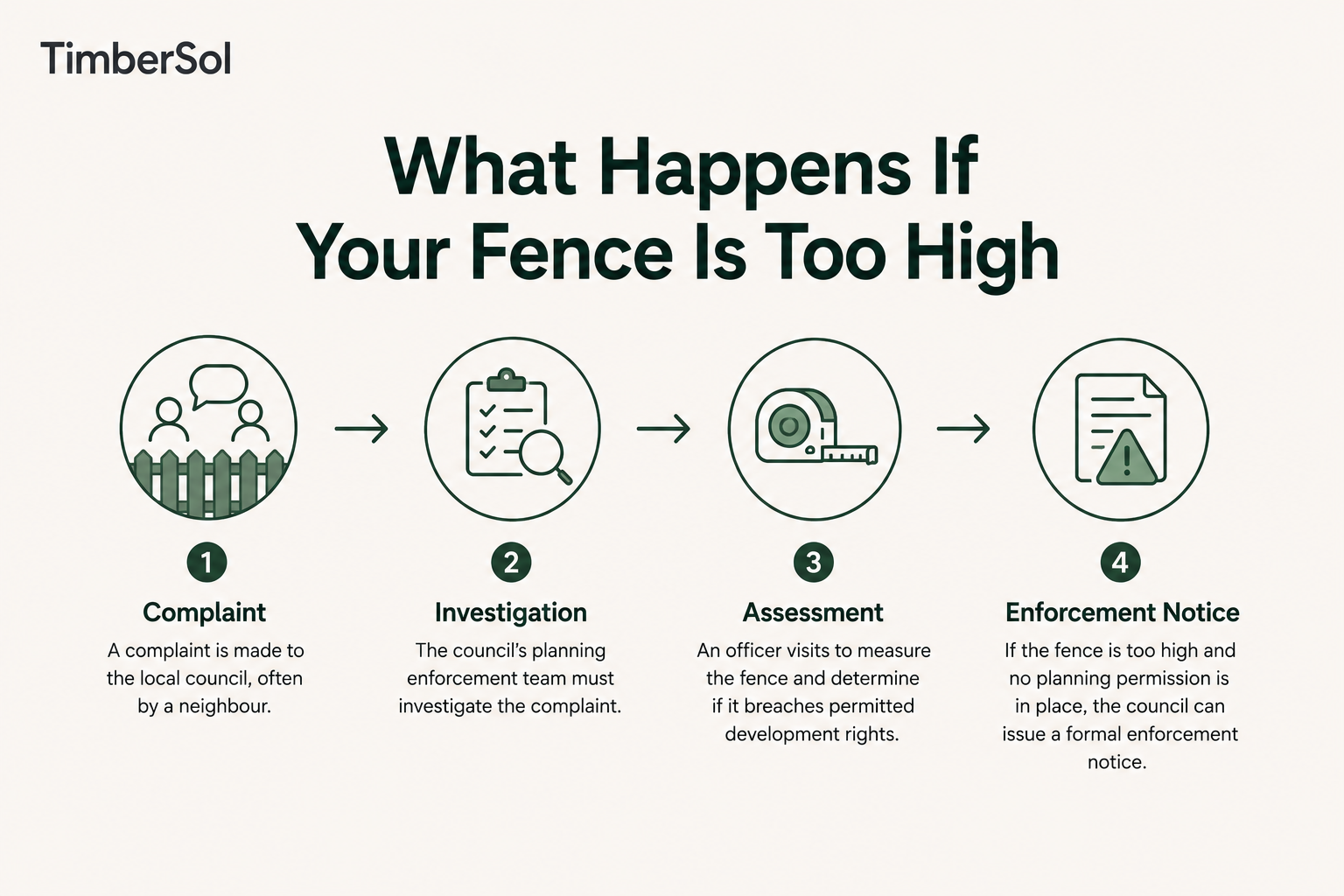
Exceeding the max fence height UK rules may seem minor, but it can quickly turn into a costly and stressful issue. In most cases, the process begins with a complaint to the local council, often from a neighbour who feels the fence is overbearing.
Once a complaint is received, the council’s planning enforcement team is legally required to investigate. An enforcement officer may visit the property to measure the fence and assess whether it breaches permitted development rights. Their role is to establish the facts and determine whether a violation has occurred.
If the fence is found to be too high and no planning permission is in place, the council can issue a formal enforcement notice.
The Power of an Enforcement Notice
An enforcement notice is not a suggestion; it is a legally binding order. It sets out what breach has occurred and specifies exactly what actions are required to resolve it.
In most cases, the notice gives a fixed period to take one of two actions:
- Alter the fence: Typically by reducing its height to a compliant level, such as the standard 2-metre limit.
- Remove the fence: In more serious or clear-cut breaches, you may be required to remove the structure entirely at your own expense.
Failure to comply with an enforcement notice is a criminal offence. It can result in a substantial fine and prosecution in the Magistrates’ Court, turning a simple fencing project into an expensive legal dispute.
The Gamble of Retrospective Permission
Applying for retrospective planning permission after a fence has already been installed can seem like an easy fix, but it carries significant risk. While retrospective applications are legally allowed, approval is never guaranteed.
The application is assessed on its own merits, in the same way as a standard planning request. If permission is refused, the enforcement notice remains in force. You will still be required to alter or remove the fence, and you will also lose the cost of the planning application fees.
Your Fence Height Questions Answered
Even when the rules seem clear, practical questions often arise once planning begins. Below, we address some of the most common questions about UK fence height regulations to help you move forward with confidence.
Can My Neighbour Force Me to Lower My Fence?
The short answer is no – not if your fence complies with the rules.
If your fence is at or below the legal height limit, such as the standard 2 metres for a rear garden, and it does not breach local planning policies or property deeds, your neighbour cannot legally require you to lower or remove it.
However, if the fence exceeds permitted height limits and no planning permission has been granted, a neighbour can report it to the local council. The council may then investigate and, if a breach is confirmed, issue an enforcement notice requiring the fence to be reduced in height or removed.
Does Adding Trellis to a 2m Fence Need Permission?
Yes, absolutely. This is one of the most common mistakes homeowners make.
Local councils assess the total height of the structure, measured from ground level to the highest point. This measurement includes all decorative additions fixed to the top of the fence.
In practice, this means:
- Trellis panels: Adding even a 30 cm trellis to a 2-metre fence exceeds the permitted height.
- Decorative toppers: Post caps, finials, and similar features all count toward the total height.
- Lattice work: Whether built in or added later, it is included in the final measurement.
If your fence panels are already at the maximum permitted height, adding anything on top means planning permission is required before work begins.
Do These Fence Height Rules Apply Everywhere in the UK?
The 2-metre limit for rear gardens and 1-metre limit for fences fronting a road are the standard permitted development rules in England. Wales follows a very similar framework, while Scotland and Northern Ireland operate under separate planning systems.
Although the underlying principles are often similar, specific height limits and local requirements can vary. For this reason, it’s always advisable to check with your local planning authority before starting any fencing work.
For further clarification, you can also explore our full frequently asked questions page.
