
Best Timber for Decking: Species, Frames and Costs Compared (UK Guide)

Choosing the best timber for decking isn’t simply a matter of appearance or budget. Unlike cladding, decking has to withstand constant foot traffic, standing water, and changing weather conditions, making durability just as important as aesthetics. The wrong choice can lead to premature wear, ongoing maintenance, and a shorter lifespan than expected.
From pressure-treated softwood and Siberian larch to premium hardwoods like Balau and Iroko, every decking timber comes with its own strengths, trade-offs, and price point. Factors such as density, durability class, and moisture resistance often have a far greater impact on long-term performance than the initial purchase price alone.
This guide compares the best timber for decking in the UK, explaining how popular species perform, how long they typically last, what they cost, and which materials are best suited to decking boards, joists, and subframes. By the end, you’ll have a clearer understanding of which timber offers the right balance of durability, maintenance, and value for your project.
What Is the Best Timber for Decking? Top Species Compared
Balau and Iroko are the best all-round hardwoods for UK decking, while Thermo-D thermowood and Siberian larch offer the best value among softwoods.
Unlike vertical cladding, deck boards sit horizontally, hold water, and take constant load, so density becomes the practical proxy for foot-traffic performance. Siberian larch, at roughly 628 kg/m³, holds up well as decking, whereas western red cedar (340–370 kg/m³; Janka hardness: 350 lbf, according to the USDA Forest Products Laboratory) dents and wears more readily.
The species in the timber decking range below all meet both criteria.
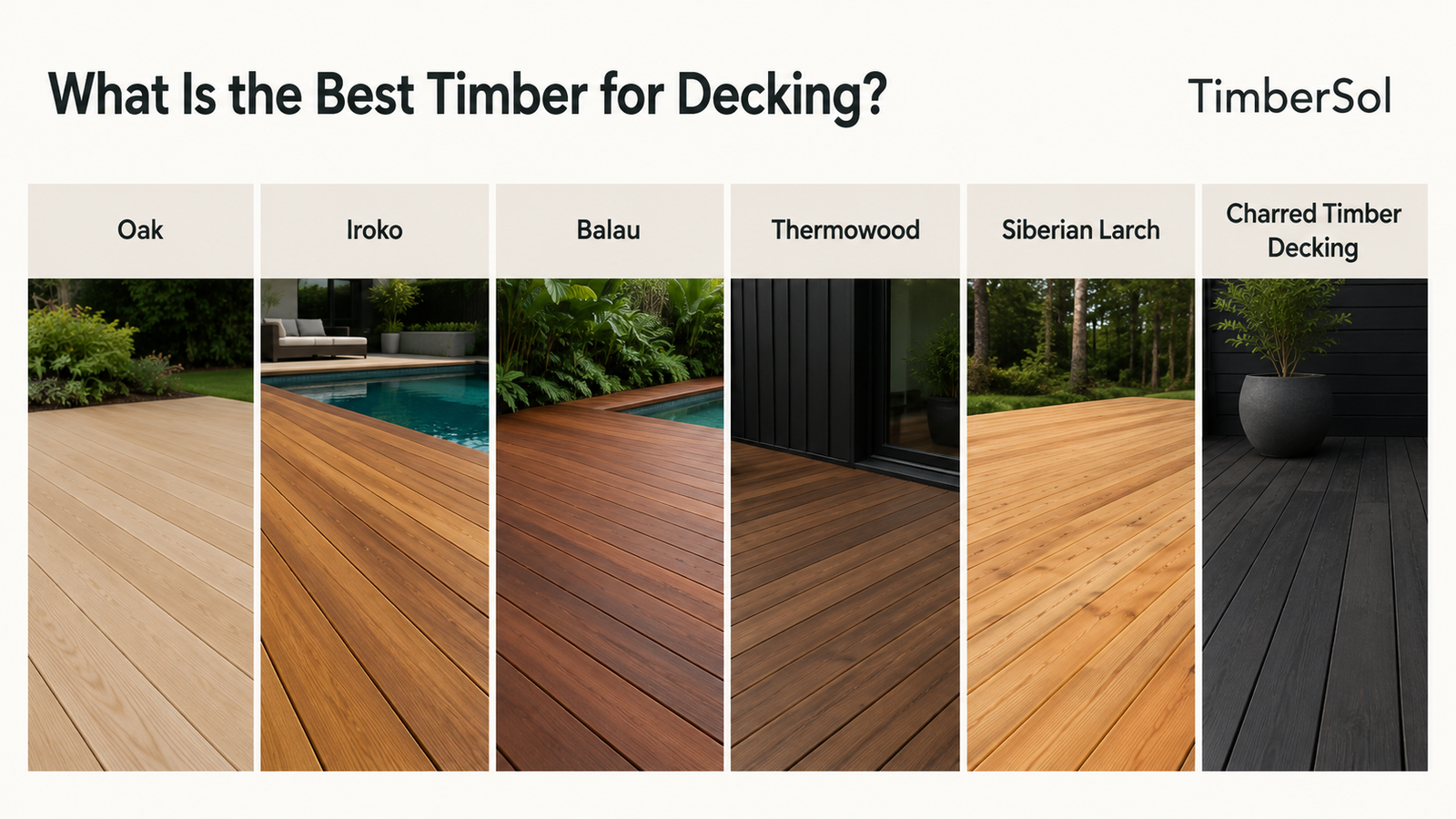
Oak: Cost-Effective Hardwood
European oak sits at the more accessible end of the hardwood decking market, typically costing £40–70 per m². Its density delivers solid wear resistance underfoot, so the boards handle regular foot traffic without denting.
One caution: oak’s tannins corrode standard steel fixings, so stainless steel screws are the only reliable way to avoid black staining.
For a darker, contemporary look, charred-effect oak decking combines oak’s toughness with a distinctive modern finish.
Iroko: Premium Tropical Hardwood
Iroko is often specified as an alternative to teak, offering a rich golden-brown colour at roughly £70–100 per m². Its natural oils repel moisture without the need for pressure treatment, making the boards suitable for fully exposed UK decks.
That same natural oil content keeps Iroko stable through wet British winters. Compare it with other hardwood decking options before committing.
Balau: Water-Resistant Hardwood for Wet Conditions
Balau is the timber to specify for the wettest, highest-traffic decks. This very dense, reddish-brown Southeast Asian hardwood costs roughly £60–90 per m², and its density resists denting, scratching, and water absorption, which is why it is routinely used around pools and hot tubs.
However, that density brings trade-offs: the boards are heavy to handle and require pre-drilling. Also, check for FSC or PEFC certification to confirm responsible sourcing.
Thermowood and Siberian Larch: High-Performing Softwoods
Thermal modification turns an affordable softwood into a genuinely durable decking material. The process uses heat and steam, with no chemicals, and permanently changes the wood’s structure, reducing its equilibrium moisture content to 4–7% and sharply improving dimensional stability, according to the International ThermoWood Association. BRE assesses thermowood’s exterior service life at more than 25 years.
For decking, always specify Thermo-D, the durability class designed for decking and terraces; Thermo-S is suitable for interior use only.
Prefer untreated timber? Siberian larch delivers hardwood-like wear resistance at £30–50 per m² because its ~628 kg/m³ density and natural resin content resist denting and decay.
Charred Timber Decking: Durability with a Distinctive Finish
Yakisugi (Shou Sugi Ban) uses controlled surface charring to form a protective carbon layer, improving resistance to moisture, insects, and decay. Each board is then brushed and oiled to achieve the desired finish.
The technique suits larch, spruce, and oak, giving softwoods extra protection alongside a contemporary look, with shades ranging from black and anthracite to teak and natural. TimberSol supplies charred larch decking in custom sizes with matching maintenance oil.
How Long Does Each Decking Timber Last? Durability Compared
Decking lifespans range from around 10 years for pressure-treated pine to 50+ years for modified timbers. Under EN 350, hardwoods like Balau and Iroko fall into Durability Classes 1–2, while most softwoods fall into Classes 3–4, where the UK’s rain, freeze-thaw cycles, and damp conditions accelerate decay.
| Timber | Expected lifespan |
| Pressure-treated pine | 10–15 years |
| Siberian larch | 15–20+ years |
| Thermo-D thermowood | 25+ years (BRE-assessed) |
| Balau / Iroko | 25+ years |
| Accoya | 50-year above-ground warranty |
Accoya (acetylated radiata pine) is the durability benchmark: Class 1 durable, with acetylation reducing cell-wall water absorption by roughly 80%, so the boards barely swell or shrink.
However, maintenance is the multiplier. An oiled, well-drained deck of any species will outlast a neglected one because standing moisture drives rot faster than species choice alone can prevent it.
Best Timber for Decking Frames, Joists, and Subframes
Boards are only half the build; the hidden structure matters just as much. Pressure-treated softwood, kiln-dried and graded C16 or C24, is the standard choice for decking subframes, posts, and bearers. Treatment chemicals penetrate pine and spruce deeply, and with the frame hidden from view, appearance matters far less than it does for the boards above.
Treatment level matters as much as the timber itself. Per BS 8417 industry practice, specify Use Class 3 for above-ground joists and Use Class 4 (UC4) for posts in ground contact because ground moisture attacks timber far more aggressively.
For sizing, 4×2 (100 × 47 mm) joists suit ground-level decks with shorter spans, while 6×2 (150 × 47 mm) joists handle raised decks or spans beyond roughly 2.4 m. Joist centres of 400 mm work for most boards.
Three habits extend frame life considerably:
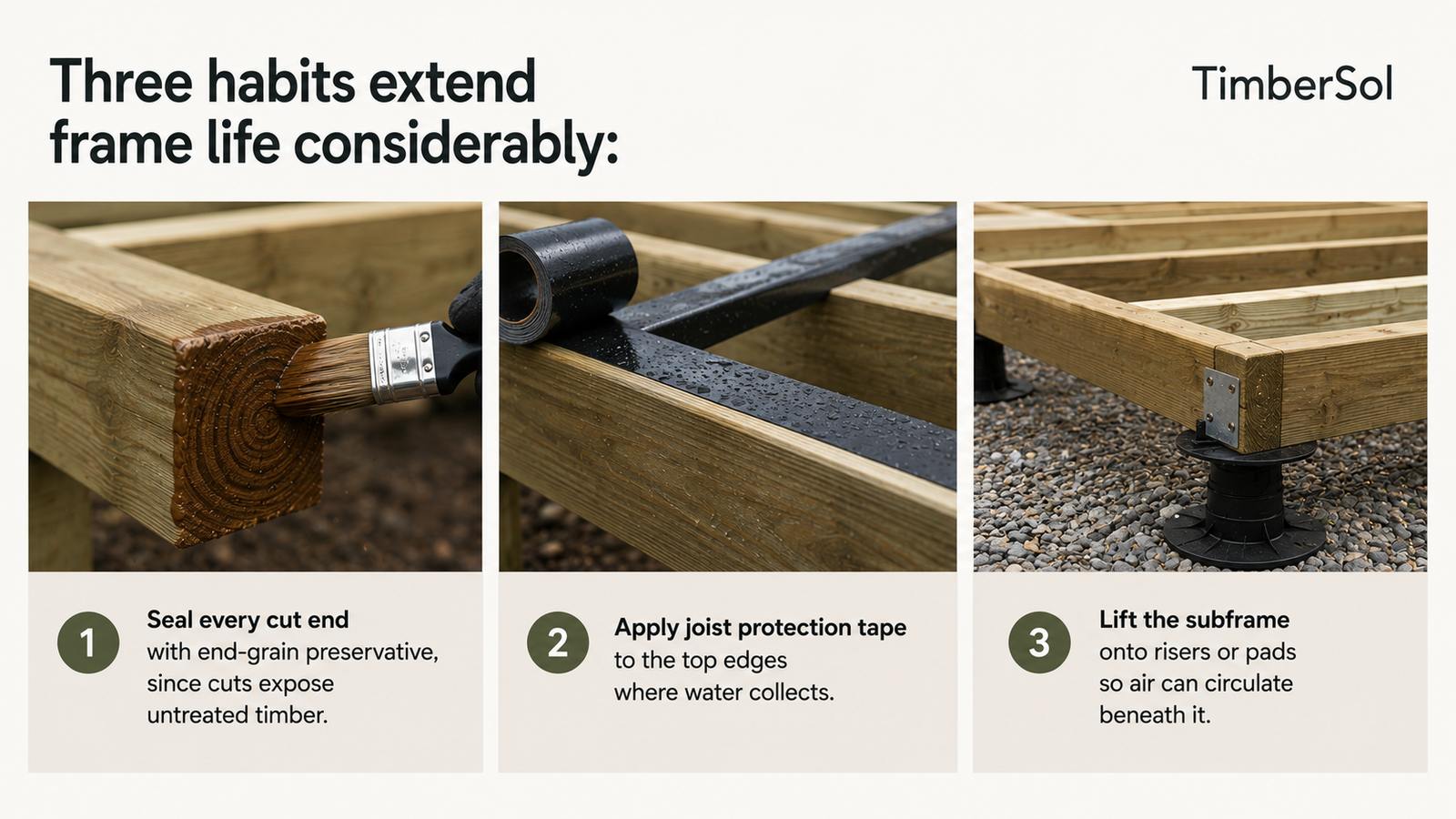
- Seal every cut end with end-grain preservative, since cuts expose untreated timber.
- Apply joist protection tape to the top edges where water collects.
- Lift the subframe onto risers or pads so air can circulate beneath it.
Use the board calculator to work out the exact quantities before placing a larger order.
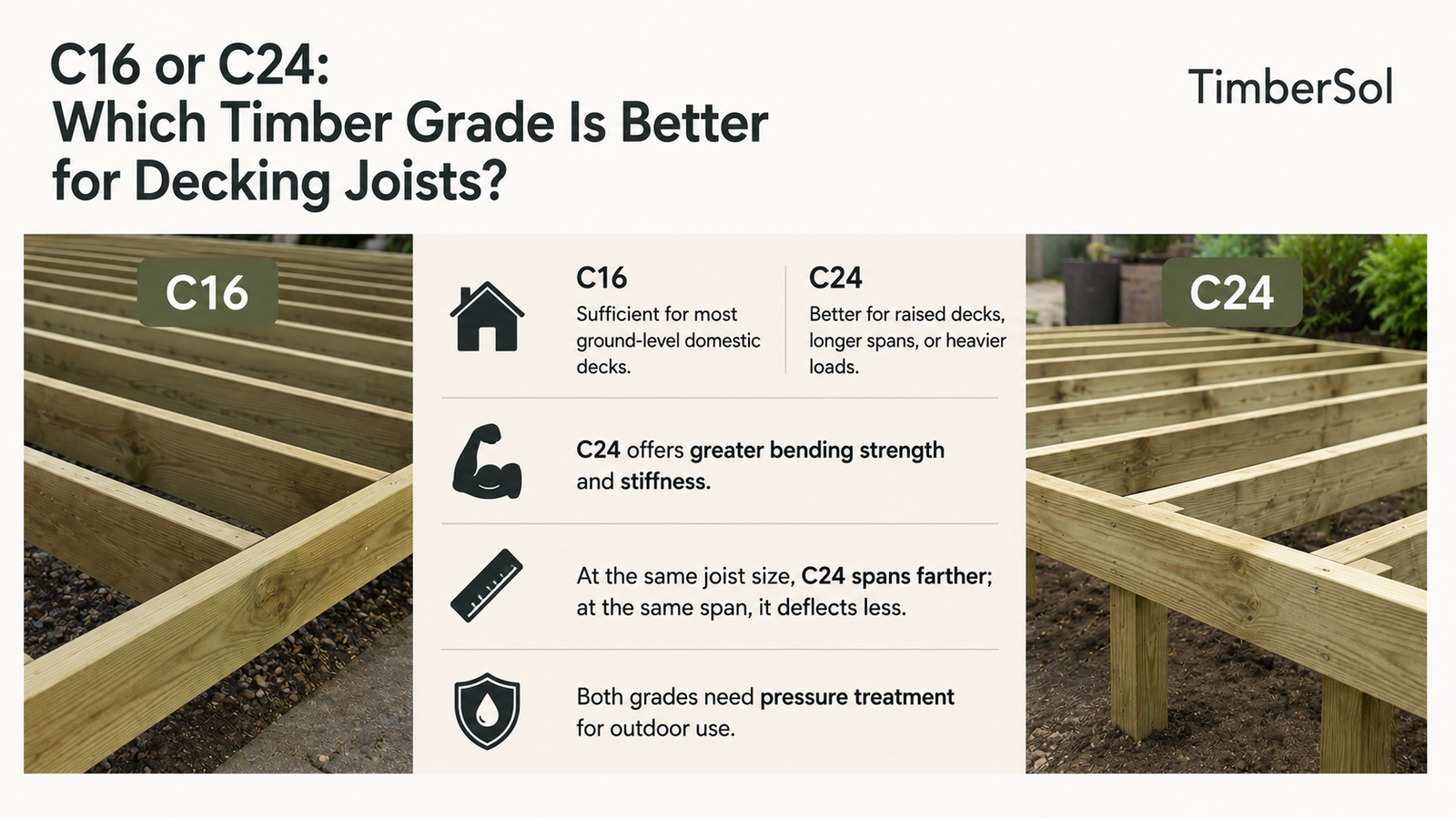
C16 or C24: Which Timber Grade Is Better for Decking Joists?
C16 is sufficient for most ground-level domestic decks, while C24 justifies its higher price on raised decks, longer spans, or heavier loads such as hot tubs and planted borders.
Both grades are strength classes under BS EN 338. C24 offers greater bending strength and stiffness. It is cut from denser, straighter-grained, often slower-grown timber with fewer knots and defects.
The practical difference shows up underfoot. At the same joist size, C24 spans farther than C16; at the same span, it deflects less, so the deck feels solid rather than bouncy. For a low deck with short spans, that extra stiffness is rarely needed.
One caveat applies to both: the grade covers strength only, not decay resistance. C16 and C24 joists alike must still be pressure-treated for outdoor use.
Best Timber for Decking Around a Pool
Dense, low-absorption timbers such as Balau, Cumaru, or Thermo-D thermowood handle constant splashing and chlorinated water best because they absorb little moisture and remain dimensionally stable through repeated wetting.
Slip resistance needs equal attention. Smooth, dense hardwoods can turn slippery when wet, so specify ribbed or grooved profiles or anti-slip inserts for poolside zones. Keep boards oiled rather than film-coated; film finishes become slippery underfoot.
Barefoot comfort matters too. Avoid splinter-prone species, and fit fixings flush or use hidden fixings. Dark boards also absorb more heat in direct sun, which is worth considering on a south-facing terrace.
Finally, lay a 1:80drainage fall away from the pool, and ventilate the subframe to prevent trapped moisture beneath the deck.
Best Timber for Decking: FAQ
Quick answers to the questions UK deck builders ask most often, covering species choice, joist sizes, treatments, and costs.
What Is the Best Wood for Outdoor Decking?
Balau and Iroko top the hardwood category. Balau’s exceptional density resists denting and water absorption, while Iroko’s natural oils repel moisture without the need for pressure treatment.
On a softwood budget, Thermo-D thermowood offers superior moisture stability because thermal modification permanently reduces water uptake. Siberian larch delivers hardwood-like wear resistance underfoot thanks to its high density.
Should I Use 4×2 or 6×2 Joists for Decking?
Joist size depends on span and spacing. 4×2 (100 × 47 mm) joists suit ground-level decks with spans up to roughly 1.8–2.4 m at 400 mm centres, while 6×2 (150 × 47 mm) is the safer choice for raised decks and longer spans.
When in doubt, go bigger because undersized joists deflect underfoot and create noticeable bounce that no board choice can fix.
What Is the Best Treatment or Oil for Timber Decking?
Penetrating decking oil is the best choice for hardwoods and thermowood: it nourishes the timber and provides UV protection without forming a film that can peel. Softwoods need a preservative treatment first, followed by a stain or decking oil.
Re-oil annually, or sooner if water stops beading on the surface. Charred boards need the supplier’s matching oil to preserve the finish.
What Is the Cheapest Timber for Decking?
Pressure-treated softwood, typically pine or redwood, is the cheapest decking option at roughly £15–25 per m². However, it has the shortest lifespan of any decking timber and requires the most maintenance, so its cost per year of service can exceed that of Siberian larch or thermowood. Compare full pricing across species in our decking cost guide.
Is Composite Decking Better Than Timber?
Neither is better outright. Composite decking suits damp UK gardens where low maintenance matters most; it resists moisture consistently without the need for oiling.
Timber wins on natural aesthetics, repairability, and lower upfront cost. Moreover, modified boards such as thermowood, Accoya, and charred timber narrow the maintenance gap considerably while retaining the character of real wood.
Charred spruce decking offers that modified durability at an affordable price. Order a sample to see the finish first-hand, or request a quote for your project.
Whichever species you choose, the right board is the one that matches your garden’s exposure, your budget, and how much maintenance you’re honestly willing to do. At TimberSol, we take that thinking one step further by charring larch, spruce, and oak decking boards, so the protective carbon layer adds moisture and insect resistance to the timber’s natural durability.
If you’d like to see how a charred finish looks and feels underfoot, order a sample in your preferred shade and compare species side by side. If you’re planning a larger project, our team is happy to talk through sizes, finishes, and fixings before you commit.
