
Charred Wood Blog
Best Cladding for a Garden Room: Materials, Costs & How to Choose

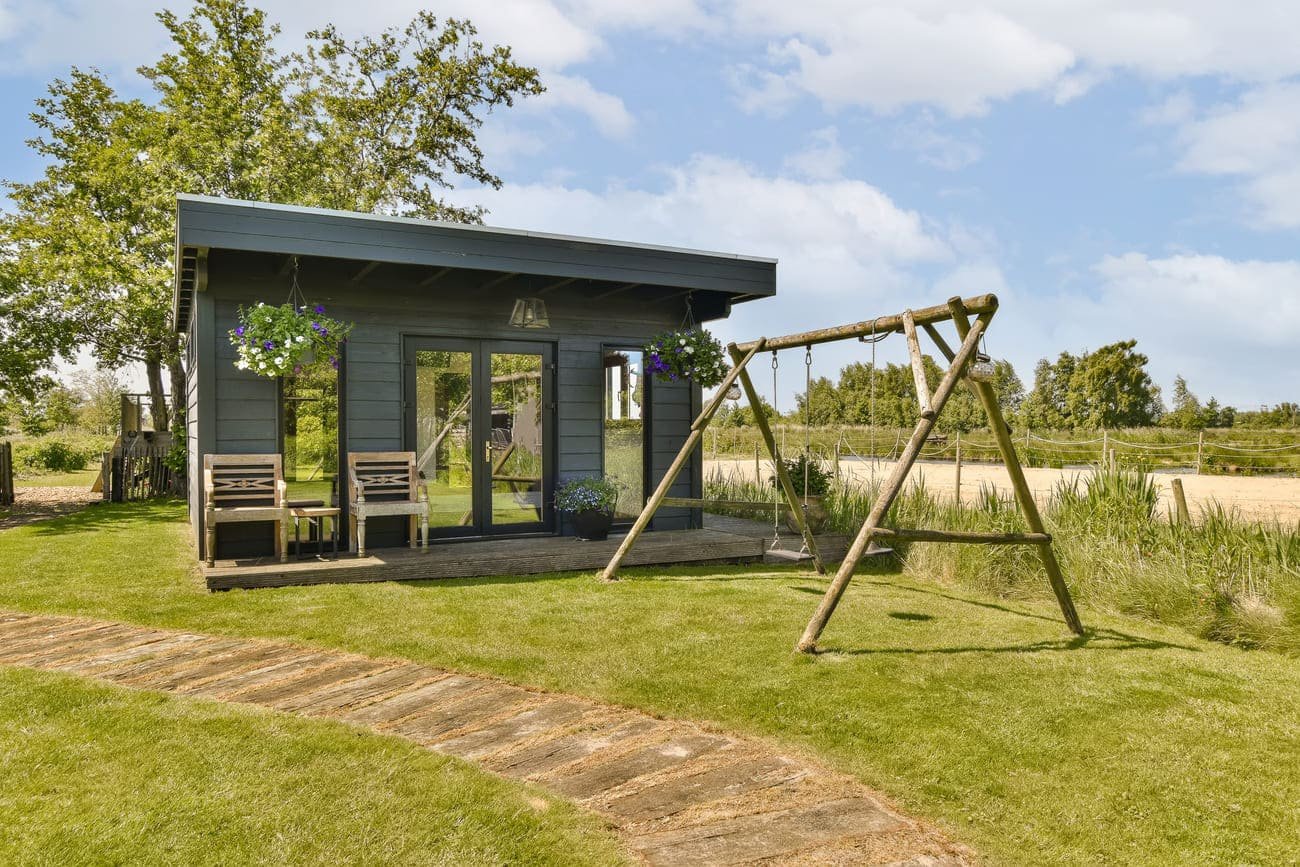
Choosing the best cladding for a garden room isn’t simply a question of style. While appearance plays a major role, factors such as maintenance, lifespan, budget, and even the distance between your building and the nearest boundary can have a greater impact on which material makes the most sense in the long run.
Today’s market offers a wide range of options. Natural timbers such as Western red cedar and Siberian larch remain popular for their warmth and character, while composite, fibre cement, metal, and charred timber are often chosen for their durability and relatively low maintenance requirements. Each material comes with its own balance of cost, performance, and visual appeal.
The right choice depends on your priorities. Whether you’re building a premium garden office, a contemporary garden studio, or a practical outdoor room on a tighter budget, this guide compares popular cladding materials, their costs, maintenance requirements, and relevant regulations to help you make an informed decision.
Best Cladding for a Garden Room: Material Comparison
Your priorities will help determine the most suitable material. Western red cedar and Siberian larch are often chosen for their natural appearance, while charred timber and composite cladding are popular for their relatively low maintenance requirements. Fibre cement and metal cladding can also be suitable where fire-performance considerations are particularly important, such as near boundaries. Most homeowners weigh budget, appearance, and how well the cladding complements the main house.
| Material | Cost band | Maintenance | Lifespan | Appearance |
| Treated softwood | £ | High | 10–15 yrs | Painted or stained |
| Western red cedar | £££ | Medium | 25+ yrs | Warm tones, silvers over time |
| Siberian larch | ££ | Medium | 25+ yrs | Dense grain, silvers over time |
| Thermowood | ££ | Low | ~30 yrs | Rich brown tones |
| Charred timber | ££–£££ | Low | Long-life | Bold, contemporary black finish |
| Composite/Millboard | £££ | Very low | Long-life | Consistent appearance, no silvering |
| Fibre cement | ££ | Low | Long-life | Flat, contemporary appearance |
| Metal | ££–£££ | Low | Long-life | Sleek, industrial appearance |
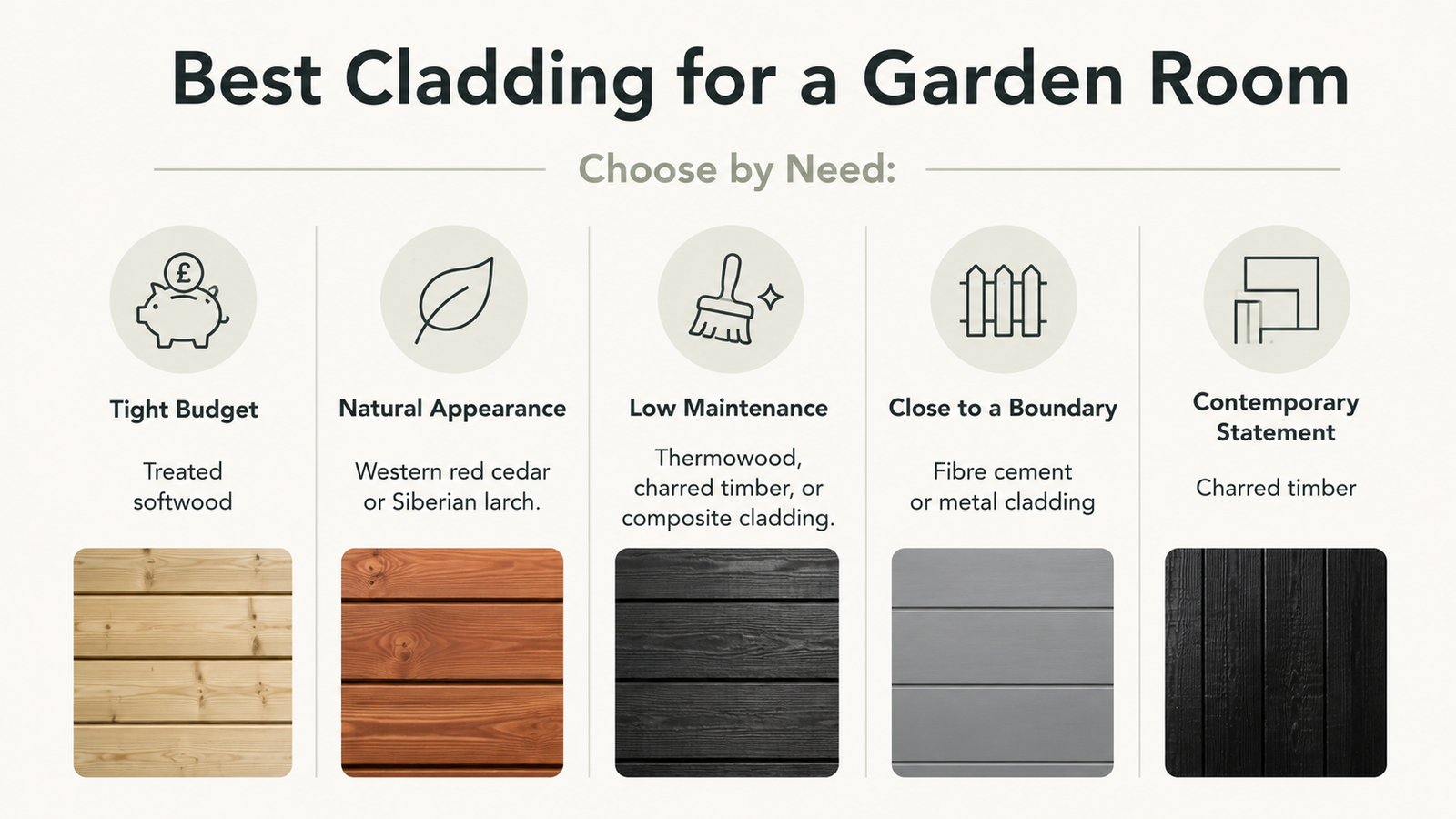
Choose by need:
- Tight budget: Treated softwood, accepting the need for regular re-treatment.
- Natural appearance: Western red cedar or Siberian larch.
- Low maintenance: Thermowood, charred timber, or composite cladding.
- Close to a boundary: Fibre cement or metal cladding may be suitable where fire-performance requirements are a key consideration.
- Contemporary statement: Charred timber for a distinctive, low-maintenance finish.
A growing design trend is to mix materials across different elevations, pairing cedar or charred timber cladding with metal or stone for visual contrast. This approach allows a premium material to be used on the most visible areas, while a more practical option is used elsewhere.
But before settling on a material, check the relevant requirements. Planning permission and fire-safety regulations can influence which cladding options are suitable, particularly for garden rooms between 15 m² and 30 m² located close to a boundary. The section below explains when timber cladding may be appropriate and when a non-combustible material may be required.
Timber & Cedar Cladding for Garden Rooms
Timber remains one of the most popular choices for garden rooms because it provides a natural appearance, works well with insulated timber-frame walls, and can be machined into shiplap, shadow gap, and feather edge profiles for a clean, contemporary finish.
For outdoor longevity, the species matters more than appearance. Choose a timber rated BS EN 350Class 2 or Class 3, such as Western red cedar, European larch, or Douglas fir, and exclude sapwood, as it lacks the natural durability of heartwood and is more susceptible to decay. This is one of the key factors influencing how well timber cladding resists decay over time.
Western Red Cedar
This softwood is among the more durable cladding options, with a service life that can exceed 25 years in suitable conditions. Its natural oils help improve resistance to decay and insect attack. As a BS EN 350 Class 2 species, it is commonly used for exterior cladding when sapwood is excluded.
Left untreated, Western red cedar weathers to an even silver-grey colour over time. To retain its warm honey tones, apply a UV-protective oil and reapply it periodically, as UV exposure gradually breaks down the surface finish.
Cedar sits at the premium end of natural timber, carrying a higher upfront cost than Siberian larch or treated softwood. That price reflects its stability, fine straight grain, and relatively low maintenance requirements.
For owners prioritising a refined natural appearance, cedar can justify the investment through its long service life, stability, and relatively low maintenance requirements.
Siberian Larch & Thermowood
Siberian larch offers a lower-cost alternative to cedar while still providing a dense grain and good dimensional stability, helping to reduce the risk of cupping and twisting in changing UK weather conditions. Like cedar, it weathers to a silver-grey patina over time unless treated with a UV-protective oil.
Thermowood, or thermally modified timber, takes durability further. The heat-treatment process reaches up to Durability Class 1 under BS EN 350, making it one of the strongest low-maintenance options for small buildings that rarely require re-treatment.
The choice comes down to budget and upkeep. Siberian larch suits owners who want a natural, cost-effective finish and accept some weathering and occasional re-oiling.
Thermowood costs more upfront but rewards you with greater stability and minimal maintenance over its long service life. Both pair well with insulated timber-frame walls, so either option complements a contemporary garden room without overspending on appearance alone.
Charred (Shou Sugi Ban) Timber
Controlled surface charring builds a protective carbon layer that improves resistance to moisture, insects, and decay. The board is then brushed and finished with oil to achieve the desired appearance. This traditional Japanese technique, also known as Yakisugi, turns ordinary timber into a durable, contemporary cladding.
The result is a distinctive, deep-textured finish available in larch, spruce, oak, Douglas fir, and Accoya, allowing designers to match the species to the budget and project style. Charring also improves fire performance, though it should never be described as fireproof.
Maintenance stays low because the carbon layer shields the surface. The finish is brushed during production, so it does not rub off with normal handling or use, and occasional re-oiling helps keep the colour fresh.
TimberSol’s charred larch cladding suits garden rooms seeking a striking, low-upkeep finish that feels both modern and natural.
Composite Cladding for Garden Rooms
Composite cladding combines recycled wood fibre and plastic, while resin-mineral boards such as Millboard mimic real timber grain. Both resist rot, fading, and warping because they contain no exposed natural fibre to absorb moisture.
This stability makes composite a genuine fit-and-forget finish. It needs no oiling or staining, requiring only an occasional wash to remove dirt, making it well suited to owners who want minimal seasonal upkeep for a small building.
The trade-off is the upfront cost. Composite typically costs more than treated softwood or Siberian larch, but its lower maintenance requirements over a long lifespan can help offset that premium, bringing the whole-life cost closer to that of a re-treated timber finish.
Where composite clearly stands out from timber is colour consistency. Unlike cedar or larch, it does not silver to grey, so each board retains its chosen shade for years without the need for UV-protective oil.
That reliability also pays off in exposed or wet UK locations, where driving rain and persistent damp put natural timber under greater stress. For coastal or shaded gardens, composite offers more predictable performance.
Owners who still want a natural grain with a similar level of maintenance often compare composite and charred timber before deciding on a final finish.
Cheapest Cladding Options for a Garden Room
Treated softwood is the cheapest cladding option, followed by vinyl/uPVC and budget fibre cement products at the lower end of the market. These materials keep the initial cost down, which appeals to owners working with a tight build budget.
The saving comes with a maintenance trade-off. Treated softwood needs regular re-treatment and has a shorter lifespan than cedar or larch because the protective coating breaks down under UK rain and UV exposure.
A smart tactic is to mix materials by elevation. Cladding the rear and side walls with cheaper softwood and finishing the visible front elevation in a premium material such as cedar or charred timber helps control costs without sacrificing kerb appeal.
You can also upgrade later without significant administrative hurdles. Re-cladding an existing garden room or shed generally falls under permitted development rights (Class E), so replacing a worn finish with a new one normally does not require a planning application.
But the cheapest option rarely delivers the best value. Once you factor in re-treatment cycles and a shorter replacement interval, a low-maintenance option often costs less over the building’s lifespan. Weigh the upfront price against the total cost before committing to budget cladding.
Cladding to Avoid & Fire / Non-Combustible Rules
Avoid untreated softwood containing sapwood because it lacks natural durability and quickly rots, warps, and cups outdoors. Low-grade vinyl is a second pitfall, as cheap uPVC fades and cracks under UV exposure within a few years. Equally, avoid any high-maintenance finish you realistically will not keep up with, as skipped re-treatment shortens its lifespan and spoils its appearance.
Before choosing a material, check how planning and fire-safety rules apply to your project.
A garden room is normally permitted development as an outbuilding, provided it remains single-storey, with a maximum eaves height of 2.5 m and an overall height of 4 m for a dual-pitched roof or 3 m for any other roof , according to the Planning Portal.
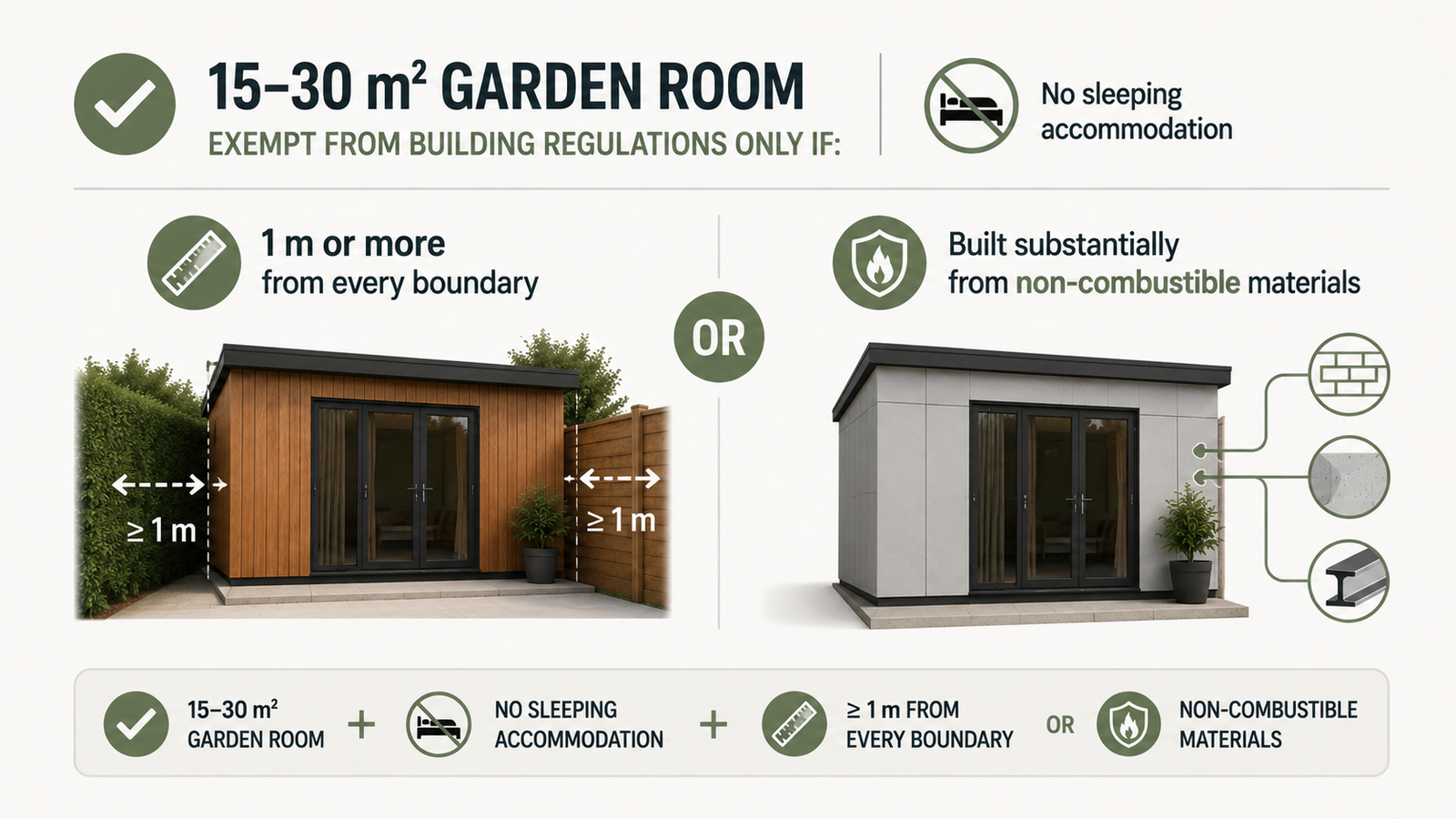
The fire and boundary rule matters most when choosing cladding. A garden room between 15 m² and 30 m² is exempt from Building Regulations only if it has no sleeping accommodation and is either 1 m or more from every boundary or built substantially from non-combustible materials. Buildings under 15 m² are normally exempt outright.
Timber is combustible, so a 15–30 m² garden room located closer than 1 m to a boundary should either be moved further back, remain under 15 m², or use non-combustible cladding.
For tight boundaries, fibre cement and metal cladding are practical non-combustible options, both of which suit modern, low-maintenance designs.
Finally, always confirm with your local council, as conservation areas and listed buildings may be subject to additional restrictions that override standard permitted development rights.
How to Choose and Install the Right Cladding
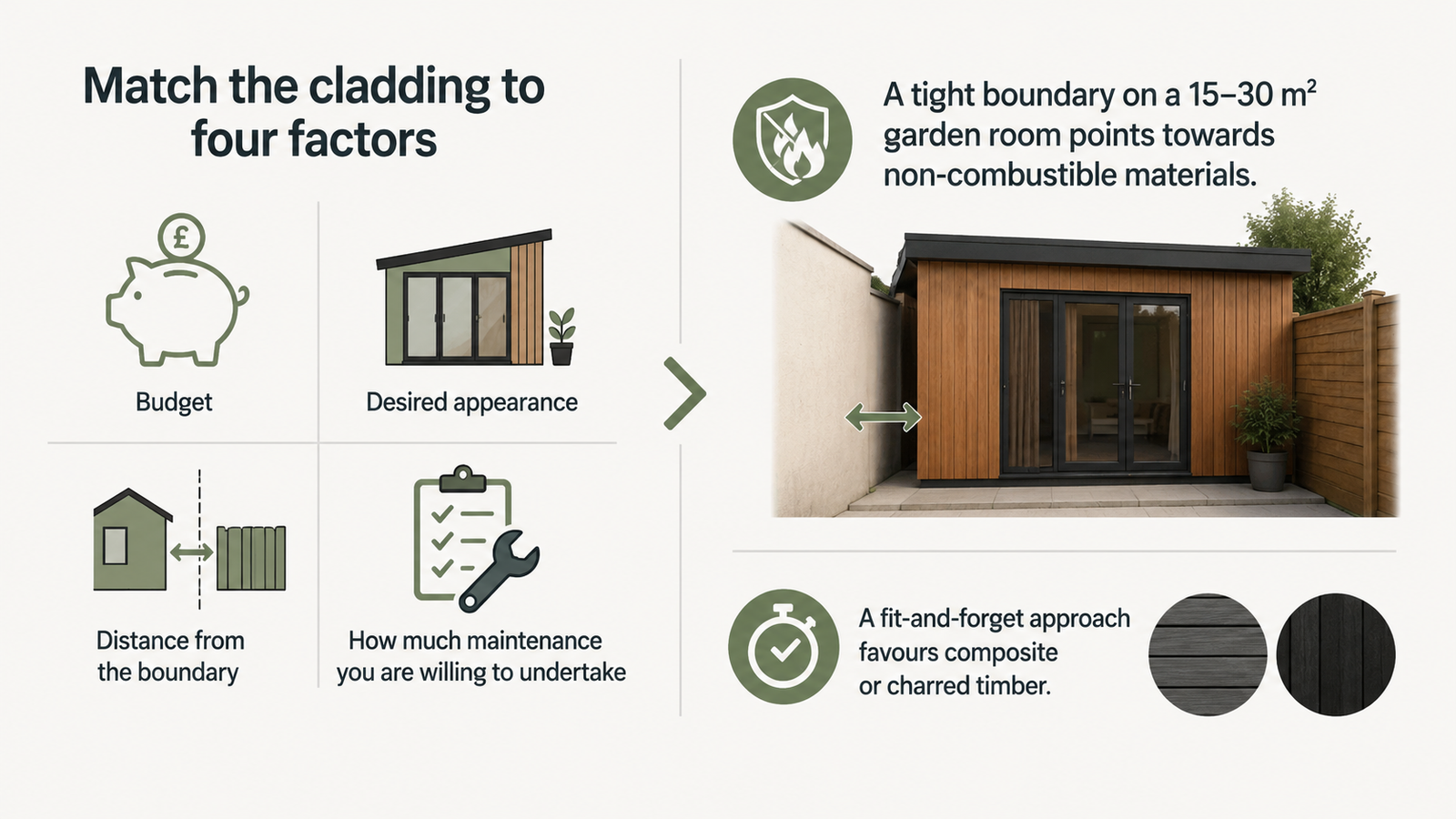
Match the cladding to four factors: budget, desired appearance, distance from the boundary, and how much maintenance you are willing to undertake. A tight boundary on a 15–30 m² garden room points towards non-combustible materials, while a fit-and-forget approach favours composite or charred timber.
Correct installation protects whichever material you choose. Fix the boards to battens with a ventilation gap behind them, as trapped moisture causes rot and reduces lifespan. Orientation also shapes the appearance: horizontal boards make a small building appear wider, while vertical boards add height and create a more contemporary look.
For layout inspiration, browse these external cladding ideas or this vertical cladding guide if you prefer a taller, contemporary finish.
Before committing to a full order, request a sample so you can compare the colour, shade, and profile against your garden room and main house in natural daylight.
Frequently Asked Questions
What is the best cladding for a garden room?
Western red cedar or Siberian larch suit a premium natural look, charred timber delivers a distinctive, low-maintenance finish, and composite or fibre cement provide a fit-and-forget solution. The right choice balances cost, maintenance, and lifespan with the style of your main house.
For tight boundaries on a 15–30 m² garden room, fibre cement or metal cladding meets the non-combustible requirement. The comparison table above sets out cost bands, maintenance requirements, and lifespan side by side, helping you match a material to your priorities quickly.
What is the cheapest way to clad a garden room?
Treated softwood is the cheapest cladding option, followed by vinyl/uPVC and budget fibre cement products. These materials keep the initial cost down, making them suitable for projects with a tight build budget.
A common tactic is to clad non-visible elevations, such as the rear and side walls, with a cheaper material while reserving a premium finish for the front elevation. However, the cheapest options carry a higher maintenance burden because softwood needs regular re-treatment and rarely matches the lifespan of larch, cedar, or composite.
What cladding should you avoid on a garden room?
Avoid untreated softwood containing sapwood, since it lacks natural durability and quickly rots, warps and cups outdoors. Low-grade vinyl is the second pitfall, because cheap uPVC fades and cracks under UV exposure within a few years.
Combustible timber also becomes a problem within 1 m of a boundary for a 15–30 m² garden room. In that case, Building Regulations may require non-combustible cladding, such as fibre cement or metal, so check the boundary distance before specifying timber.
How long does garden room cladding last?
Lifespan varies by material: Western red cedar lasts 25+ years, Thermowood lasts around 30 years, and charred timber, composite, and fibre cement all offer a long service life with low maintenance. These figures assume correct installation with a ventilated cavity behind the boards.
UK weather and upkeep shape the real outcome. Periodic re-oiling helps preserve colour in timber, while occasional cleaning keeps composite and fibre cement looking their best, so a low-maintenance material often delivers better long-term value than the cheapest upfront option.
Choosing the right cladding comes down to balancing durability, maintenance, and the look you want, all while respecting the boundary and fire rules that govern your project. Charred timber answers all three: controlled surface charring creates a protective carbon layer that improves resistance to moisture, insects, and decay. The board is then brushed and oiled to create a distinctive, low-maintenance finish that enhances a building’s character for decades.
At TimberSol, we craft charred cladding in larch, spruce, oak, Douglas fir, Accoya, and Thermowood, with bespoke sizes, profiles, and shades to match your garden room. Order a charred cladding sample to see and feel the finish before committing, and our team can guide you on the right species and fixings for your project.
