
Thermowood vs Cedar Cladding: Which Is Right for Your Project?

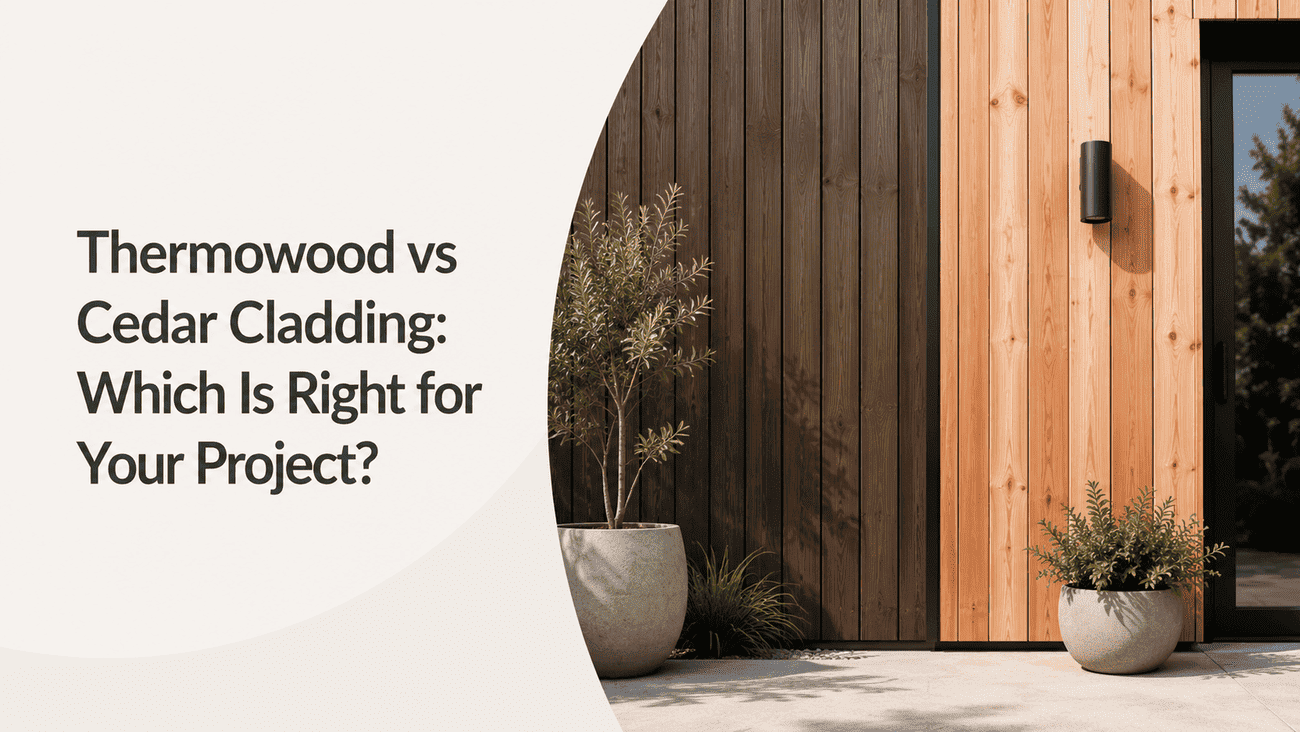
At first glance, thermowood and cedar cladding seem remarkably similar. Both are natural timber products, both are commonly specified for exterior projects, and both can deliver decades of performance when installed correctly. The real differences only become clear once you look beyond appearance and compare how each material handles moisture, movement, maintenance, and long-term value.
While cedar relies on its natural durability, thermowood achieves its performance through a chemical-free heat treatment that improves stability and reduces moisture absorption. Each approach has its advantages, making the right choice dependent on your project’s exposure, budget, and maintenance expectations rather than one material being universally better.
This guide compares thermowood and cedar cladding across the factors that matter most, including durability, lifespan, cost, maintenance, and appearance. We’ll also explore their drawbacks, explain how they compare with composite cladding, and help you decide which option is best suited to your next project.
Thermowood vs Cedar Cladding: Key Differences at a Glance
For exposed UK exteriors, thermowood typically outperforms cedar thanks to its engineered stability, 4–7% moisture content, and a service life of around 30 years with minimal upkeep. Cedar wins on its warm, varied natural grain, distinctive aroma, and centuries of pedigree. Both are chemical-free, so the choice hinges on stability, appearance, and budget.
ThermoWood® is a registered trademark of the International ThermoWood Association, based on a process patented in 1994 in collaboration with VTT, the Technical Research Centre of Finland. The generic term under CEN/TS 15679:2007 is thermally modified timber. Pine or spruce is heated in steam at atmospheric pressure with no added chemicals, permanently lowering the equilibrium moisture content to 4–7% and improving dimensional stability. Thermo-D is the grade specified for cladding.
Cedar, in the UK market, almost always means Western Red Cedar (Thuja plicata). Its heartwood resists decay naturally thanks to compounds called thujaplicins. It is a soft timber, at 350 lbf on the Janka hardness scale, yet the USDA Forest Products Laboratory records very low shrinkage, which is why cedar boards stay flat.
| Factor | Thermowood | Western Red Cedar |
| Durability (BS EN 350) | Thermo-D (enhanced by thermal modification) | Class 2 (imported) / Class 3 (UK-grown) |
| Moisture content | 4–7% | Higher, varies with climate |
| Typical lifespan | 25–30+ years | 20–25 years |
| Maintenance | Minimal if left to weather naturally to silver-grey | Regular oiling to retain colour |
| Indicative price | ~£55–£95/m² | ~£55–£140/m² |
| Weathering | Brown, fading to silver-grey | Warm tones, fading to silver-grey |
Neither material needs chemical preservatives, but each achieves its durability differently: one through engineering, the other through nature.
Thermowood vs Cedar Cladding Cost: Price per m² and Whole-Life Value
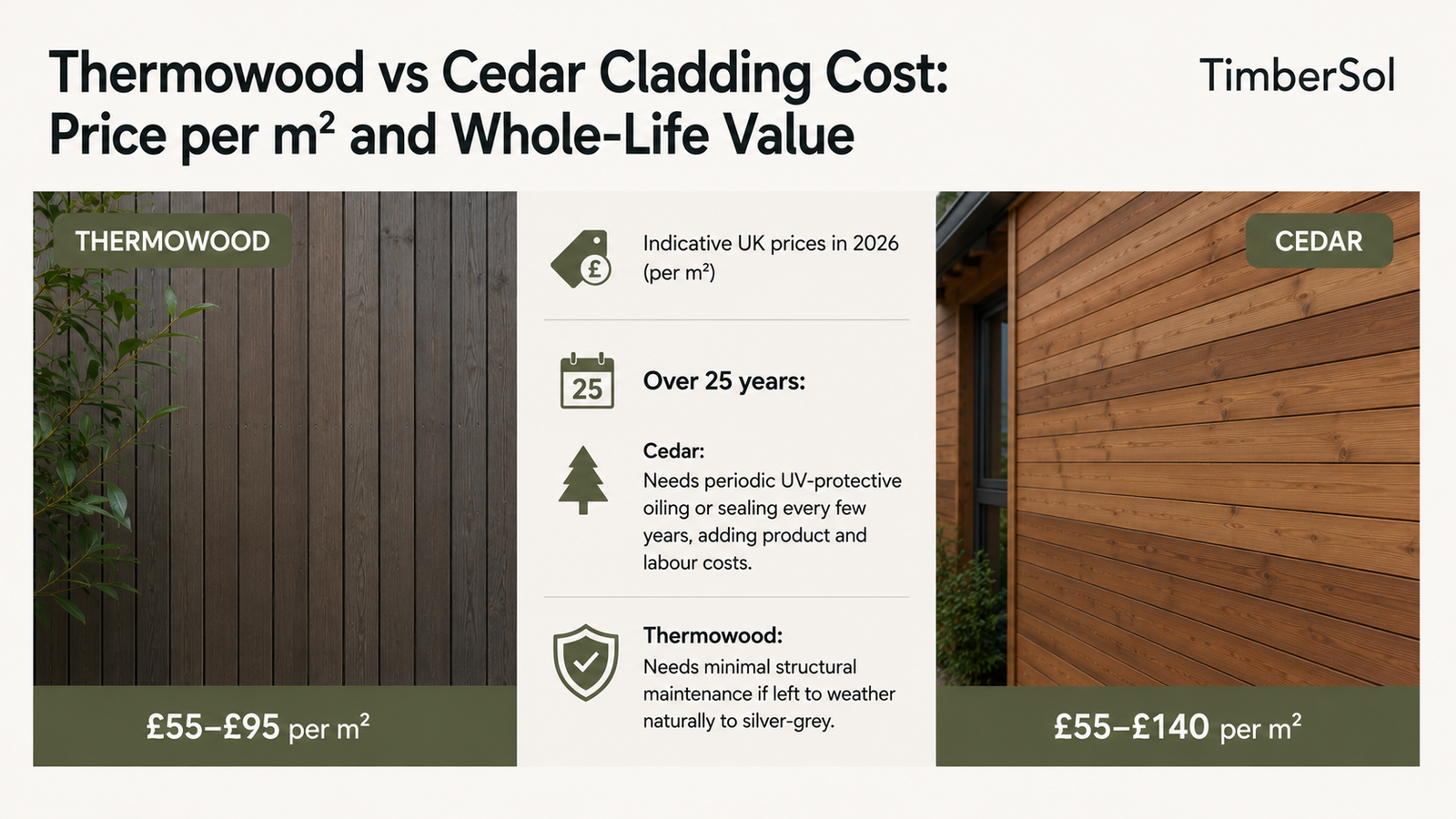
Indicative UK market prices in 2026 put thermowood cladding at roughly £55–£95 per m², while Western Red Cedar spans a wider range of £55–£140 per m², depending on grade and origin. Entry prices overlap, but the top end of cedar’s price range sits noticeably higher.
Cedar pricing has also been less predictable. North American supply constraints since 2022 have pushed imported Western Red Cedar towards the premium end of the market. Thermowood, by contrast, is produced from abundant Scandinavian pine and spruce, so its pricing has remained comparatively stable.
Upfront cost is only half the equation, however. Over a 25-year period, the two materials diverge:
- Cedar needs periodic UV-protective oiling or sealing every few years to retain its colour, adding product and labour costs over each maintenance cycle.
- Thermowood needs minimal structural maintenance if left to weather naturally to silver-grey because its low moisture content keeps the boards stable without recoating.
As a result, thermowood’s whole-life cost typically comes out lower than cedar’s despite similar upfront prices. Trade installers often factor this into specifications for rental properties and garden buildings, where repeat maintenance visits erode profit margins.
If you prefer a finished look from day one, TimberSol supplies charred thermowood cladding with a factory-applied oil finish, eliminating the need for an initial on-site coating. For project-specific pricing, you can request a quote with your measurements.
The Disadvantages of Thermowood and Cedar You Should Know
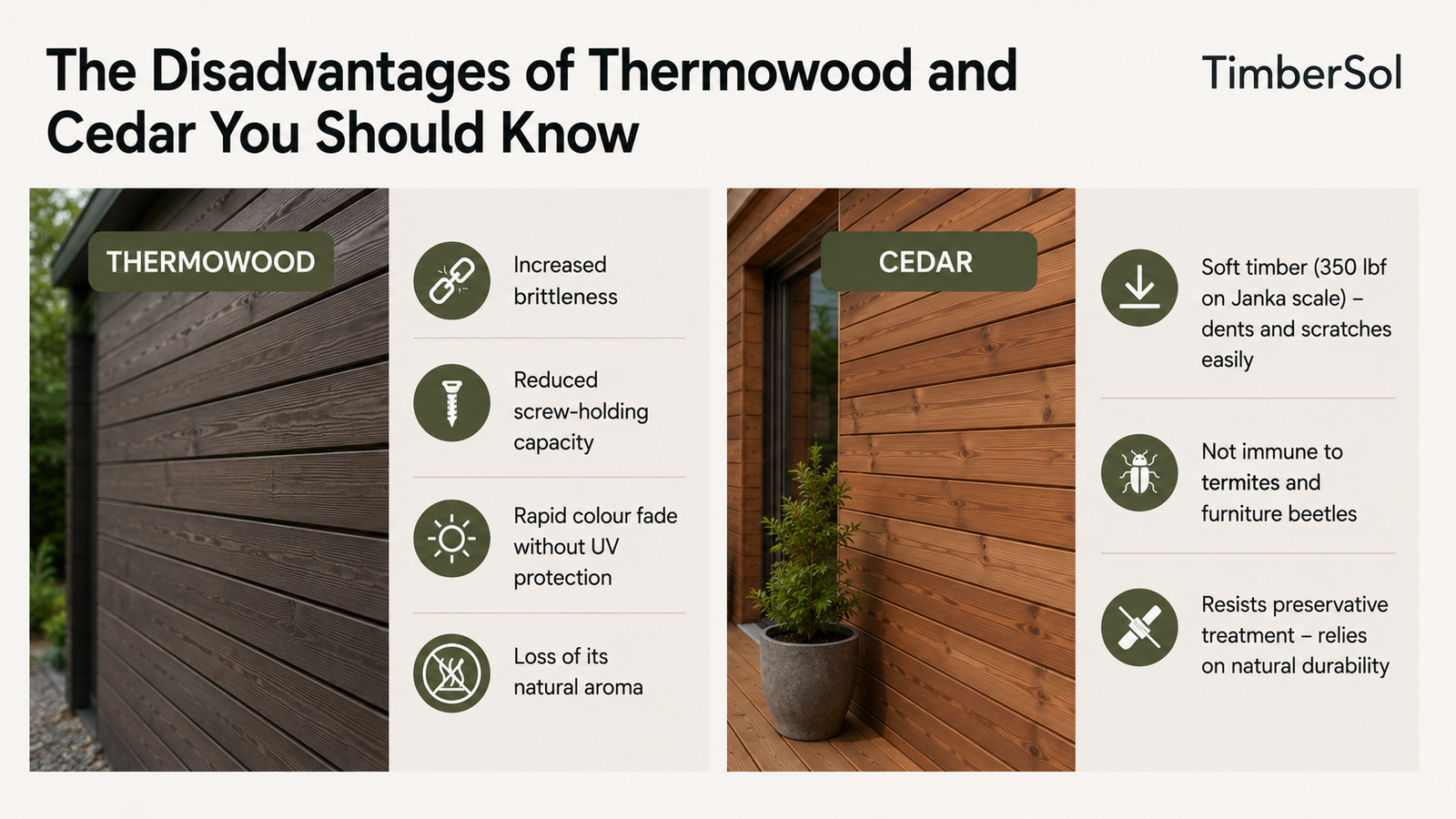
Thermowood’s main disadvantages are increased brittleness, reduced screw-holding capacity, rapid colour fade without UV protection, and the loss of its natural aroma. None of these is a deal-breaker, but each affects how you specify and install the boards.
The heat-treatment process that stabilises the timber also reduces its bending strength. In practice, that means:
- Brittleness: Boards need careful handling, particularly when fixing near edges or ends.
- Reduced screw-holding capacity: Pre-drilling and stainless steel fixings are standard practice, not optional extras.
- Colour fade: The chocolate-brown tone weathers to silver-grey within 1–2 years unless a UV-protective oil is applied.
- Neutral scent: The aromatic oils are driven off during treatment, so thermowood lacks cedar’s distinctive fragrance.
Cedar carries its own compromises. At 350 lbf on the Janka hardness scale, it is a genuinely soft timber, so surfaces dent and scratch easily near doorways and in high-traffic areas. The USDA Forest Products Laboratory also notes that Western Red Cedar is not immune to termites and furniture beetles, and it resists preservative treatment. You rely almost entirely on its natural durability.
There is a subtlety most buyers miss: under BS EN 350, imported North American cedar is classified as Class 2 (Durable), but UK-grown cedar is classified as Class 3 (Moderately Durable). Add regular oiling to retain its colour, along with the price volatility covered earlier, and cedar demands more ongoing maintenance than its reputation suggests.
Neither list is disqualifying. Both materials perform well when correctly specified and installed; the drawbacks simply determine which one is best suited to your project.
Thermowood vs Composite Cladding: How Does the Third Option Compare?
Composite cladding holds its colour with virtually no maintenance, but it typically costs more upfront than thermowood and lacks the character of real timber. For buyers weighing all three materials, the trade-off is convenience versus authenticity.
Wood-plastic composite boards are extruded from timber fibres and polymers, which gives them consistent colour and dimensions. Up close, however, that consistency can appear uniform and manufactured. Unlike solid timber, composite cannot be sanded, refinished, or repaired, so a damaged board usually needs to be replaced.
Both thermowood and cedar age and develop a natural silver-grey patina that many architects specify deliberately. Composite, by contrast, remains largely unchanged. That suits projects requiring consistent colour, but it lacks the living quality that most designers want from cladding.
There is also a fourth option worth considering: charred timber, using the Japanese Yakisugi (Shou Sugi Ban) technique. Controlled surface charring adds a protective carbon layer to thermowood or larch, improving resistance to weather and insects while retaining the natural texture of the timber. Charred thermowood cladding combines engineered stability with that finish, and the wider timber cladding range includes larch, spruce, and oak alternatives.
Thermowood or Cedar: Which Should You Choose?
The right choice depends on your site conditions, maintenance expectations, and design brief rather than one material being universally better.
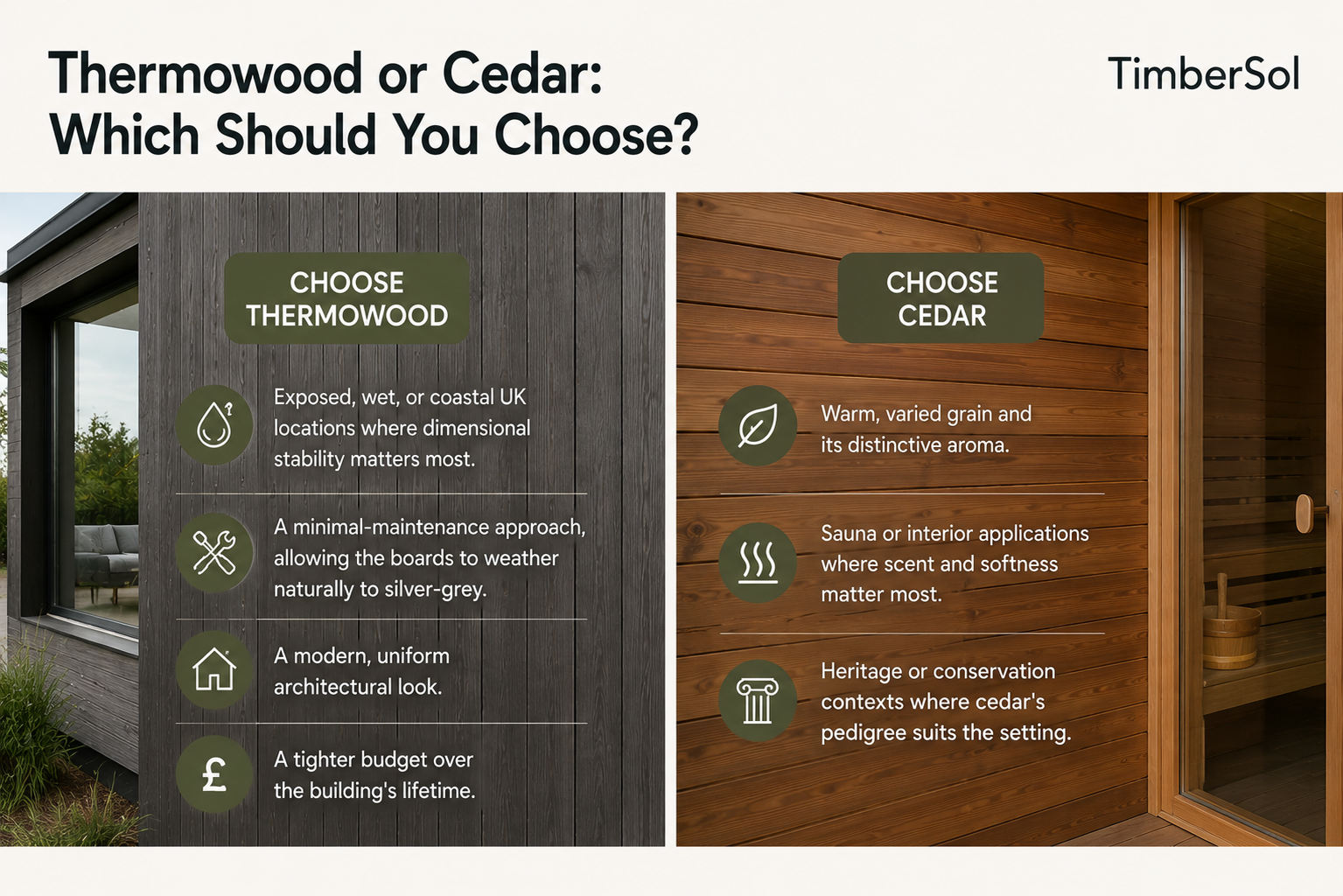
Choose thermowood if your project involves:
- Exposed, wet, or coastal UK locations where dimensional stability matters most.
- A minimal-maintenance approach, allowing the boards to weather naturally to silver-grey.
- A modern, uniform architectural look.
- A tighter budget over the building’s lifetime.
Choose cedar if you value:
- Warm, varied grain and its distinctive aroma.
- Sauna or interior applications where scent and softness matter most.
- Heritage or conservation contexts where cedar’s pedigree suits the setting.
The contrast in performance mechanisms can be summed up in one line: thermowood is engineered for very low moisture content and dimensional stability, while cedar relies on natural thujaplicins and its famously low shrinkage (5.0% tangential, 2.4% radial, according to the USDA Forest Products Laboratory). Both are legitimate, chemical-free options for untreated cladding, but for different reasons.
Appearance need not limit you either. Beyond the familiar chocolate brown, thermowood is available in charred and oiled finishes, spanning everything from natural thermowood cladding to deep black thermowood cladding. This allows a single species to cover a wide design palette.
Still comparing modified timbers? The Accoya vs Thermowood guide explains how acetylated wood compares with thermowood.
For most exposed UK exteriors in 2026, thermowood is the safer long-term choice; cedar remains the preferred option where character and scent are the priorities. The easiest way to decide is to compare sample boards and judge the finish and texture in person.
Thermowood vs Cedar Cladding: FAQ
Is Thermowood Better Than Cedar Cladding?
For exterior use in the UK, thermowood typically performs better technically thanks to its 4–7% moisture content, approximately 30-year service life, and minimal maintenance requirements. However, cedar remains the stronger choice where warm natural grain, its distinctive aroma, or sauna applications matter most. Both are legitimate, chemical-free cladding options.
Is Thermowood Cladding Good?
Yes, thermowood is a proven exterior cladding material. Its Thermo-D durability classification, chemical-free heat modification, and expected outdoor service life of 25–30+ years make it well suited to wet UK conditions. The one caveat is slightly reduced screw-holding capacity due to the heat treatment, so pre-drilling and stainless steel fixings are standard practice.
Is Thermowood Expensive?
Not especially. At roughly £55–£95 per m², thermowood overlaps with cedar, which typically costs £55–£140 per m². However, thermowood’s whole-life cost over 25 years is typically lower because maintenance is minimal if the boards are left to weather naturally to silver-grey, whereas cedar requires regular oiling to retain its colour.
How Long Does Thermowood Cladding Last Compared to Cedar?
Thermowood cladding typically lasts 25–30+ years outdoors with minimal maintenance, while cedar typically achieves around 20–25 years with regular oiling. On coastal or west-facing elevations, the gap widens in thermowood’s favour because its low moisture content helps resist repeated wetting cycles. These are typical service lives rather than guarantees, as detailing, installation quality, and maintenance all affect longevity.
Whichever way you lean, the decision becomes much easier with a sample board in your hands. At TimberSol, we take thermowood a step further by pairing its engineered stability with the depth and character of traditional Yakisugi charring, available in finishes ranging from natural thermowood to deep black. The charred finish adds a protective carbon layer while creating a distinctive appearance that cedar cannot replicate.
Order a charred cladding sample to see the texture and finish up close, or get in touch for a quote tailored to your project. Our team is happy to advise on profiles, finishes, and fixing details, whether you’re a self-builder or specifying for a client.
