
Siberian Larch vs Cedar: Which Cladding Should You Choose?

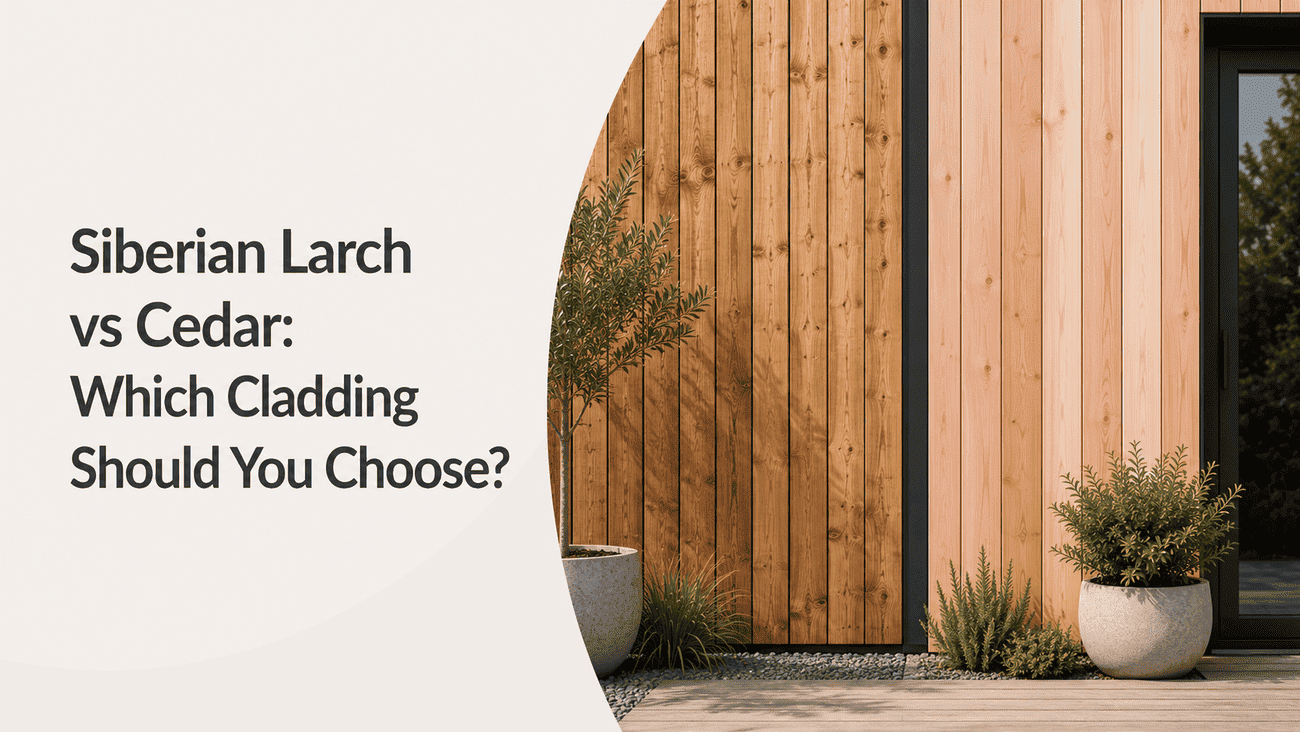
Siberian larch and Western Red Cedar are two of the most popular choices for timber cladding, but they excel in different areas. Larch is valued for its density, strength, and affordability, while cedar is prized for its natural durability, light weight, and refined appearance. Understanding these differences is far more useful than comparing the two on price alone.
Although both species perform well in exterior applications, they achieve that performance in different ways. Siberian larch offers greater hardness and impact resistance, whereas Western Red Cedar provides better dimensional stability and is classified as more durable. The right choice depends on your priorities, whether that’s long-term value, architectural appearance, or performance in demanding conditions.
This guide compares Siberian larch and cedar cladding across the factors that matter most, including durability, service life, density, cost, and maintenance. We’ll also explain where each timber performs best, highlight their limitations, and help you determine which option is best suited to your project.
What Are Siberian Larch and Cedar? Species, Origins and Appearance
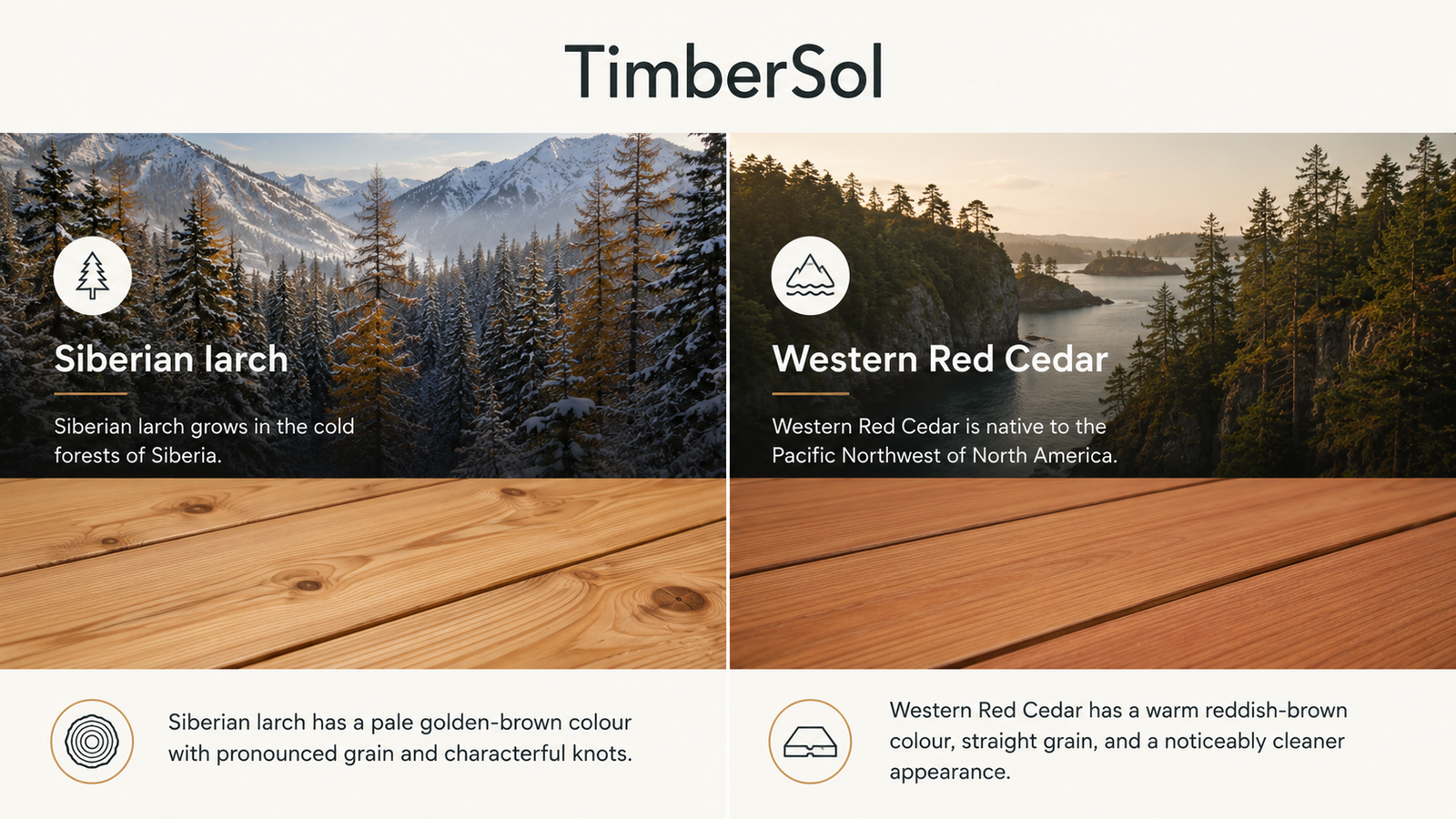
Siberian larch (Larix sibirica) and Western Red Cedar (Thuja plicata) are the two most commonly compared softwoods for exterior cladding in the UK. Siberian larch grows in the cold forests of Siberia, while Western Red Cedar is native to the Pacific Northwest of North America. Both grow slowly in harsh climates, producing tight growth rings that contribute to their strength and suitability for exterior cladding.
Visually, they are easy to distinguish when freshly milled. Siberian larch has a pale golden-brown colour with pronounced grain and characterful knots. Western Red Cedar has a warm reddish-brown colour, straight grain, and a noticeably cleaner appearance.
Grading reflects that difference. Under BS 1186-3, Western Red Cedar is one of only two softwoods (alongside Douglas fir) available in Class 1 knot-free cladding quality, whereas most cladding is specified to Class 2, which allows sound knots up to 35 mm. Larch is naturally the knottier, more rustic option.
Left uncoated, however, both timbers gradually develop a natural silver-grey patina. UV light breaks down lignin at the surface through photodegradation, causing both species to weather in a similar way over time.
If you want to retain a consistent appearance and avoid patchy weathering, charred larch cladding offers a stable, architectural finish that removes the guesswork from natural ageing.
Durability, Density and Lifespan: Is Larch as Good as Cedar?
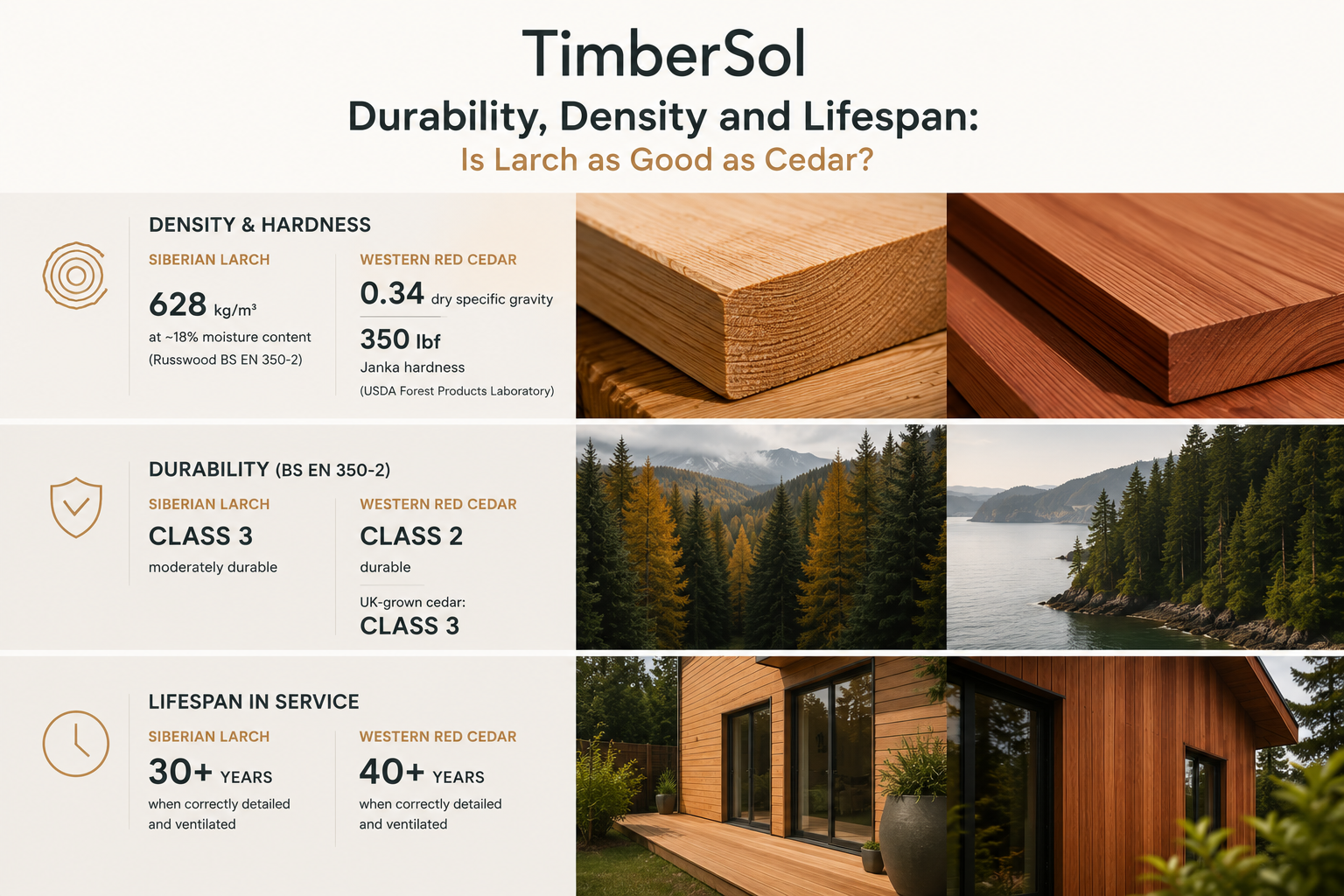
Larch is the harder, denser timber, while imported Western Red Cedar is the more decay-resistant and dimensionally stable option. Those two characteristics—density and durability classification—explain almost every practical difference between the two timbers.
The numbers make it clear. Siberian larch weighs around 628 kg/m³ at roughly 18% moisture content, according to Russwood’s BS EN 350-2 data. Western Red Cedar has a dry specific gravity of about 0.34 and a Janka hardness of just 350 lbf, according to the USDA Forest Products Laboratory. Larch is nearly twice as dense, so it holds fasteners better and is more resistant to denting. However, that density also makes it heavier to handle and slower to machine on site.
Decay resistance tells a different story. Under BS EN 350-2, Siberian larch is classified as Class 3 (moderately durable), while imported North American Western Red Cedar achieves Class 2 (durable). UK-grown cedar falls back to Class 3. Both species can be specified untreated for cladding, but imported cedar has a one-class advantage in rot resistance.
In terms of movement, cedar is the more stable material. The FPL records very low shrinkage values (tangential 5.0%, radial 2.4%), placing it at the stable end of the TRADA movement scale. Larch is also stable thanks to its tight growth rings and high latewood content, but its resin content makes it more prone to exudation and slightly greater movement.
In service, larch is commonly quoted as lasting 30+ years and cedar 40+ years when correctly detailed and ventilated. The factors behind these figures are covered in our guide to larch cladding lifespan.
Siberian Larch vs. Cedar Cost: Which Is Cheaper?
Siberian larch is typically the less expensive of the two cladding options. Western Red Cedar is generally more expensive because of its slower growth, limited North American supply, and higher import costs. Both are premium softwoods, but larch delivers similar performance at a lower cost per square metre, making it the most common, more affordable alternative to cedar cladding.
For a published reference point rather than a vague estimate, premium-grade Siberian larch cladding (Russwood SILA Select) starts at £78 per m², excluding VAT, with factory-applied coatings adding approximately £20–25 per m². Cedar is generally priced above this benchmark.
Several factors affect the final price. Timber grade matters most: unsorted larch costs more than sawfalling grade, and Class 1 knot-free cedar carries a significant premium over Class 2. Board profile, finish, and import logistics add further variation between suppliers.
Availability also influences UK pricing in 2026. Genuine Siberian larch imports have been constrained by supply disruptions, affecting both costs and lead times. British and European larch fill part of the gap, although they have lower density.
Finally, budget for the entire project, not just the cost per square metre. Cedar’s softness requires stainless steel fixings to avoid tannin staining, and its higher material cost compounds across large elevations. As a result, larch often offers a lower total installed cost.
Siberian Larch vs. Cedar: Which Should You Choose?
Choose Siberian larch for its hardness, impact resistance, and lower cost. Choose Western Red Cedar for its knot-free appearance, lighter weight, and superior dimensional stability. The table below summarises the key practical differences.
| Property | Siberian Larch | Western Red Cedar |
| Density | ~628 kg/m³ | Specific gravity ~0.34 |
| Hardness | Hard, dent-resistant | Soft (350 lbf Janka) |
| Durability class | Class 3 | Class 2 (imported) |
| Movement | Stable, with some resin bleed | Very stable |
| Appearance | Golden, knotty, rustic | Reddish, clean, straight-grained |
| Price | Lower | Higher |
| Lifespan | 30+ years | 40+ years |
A simple decision framework:
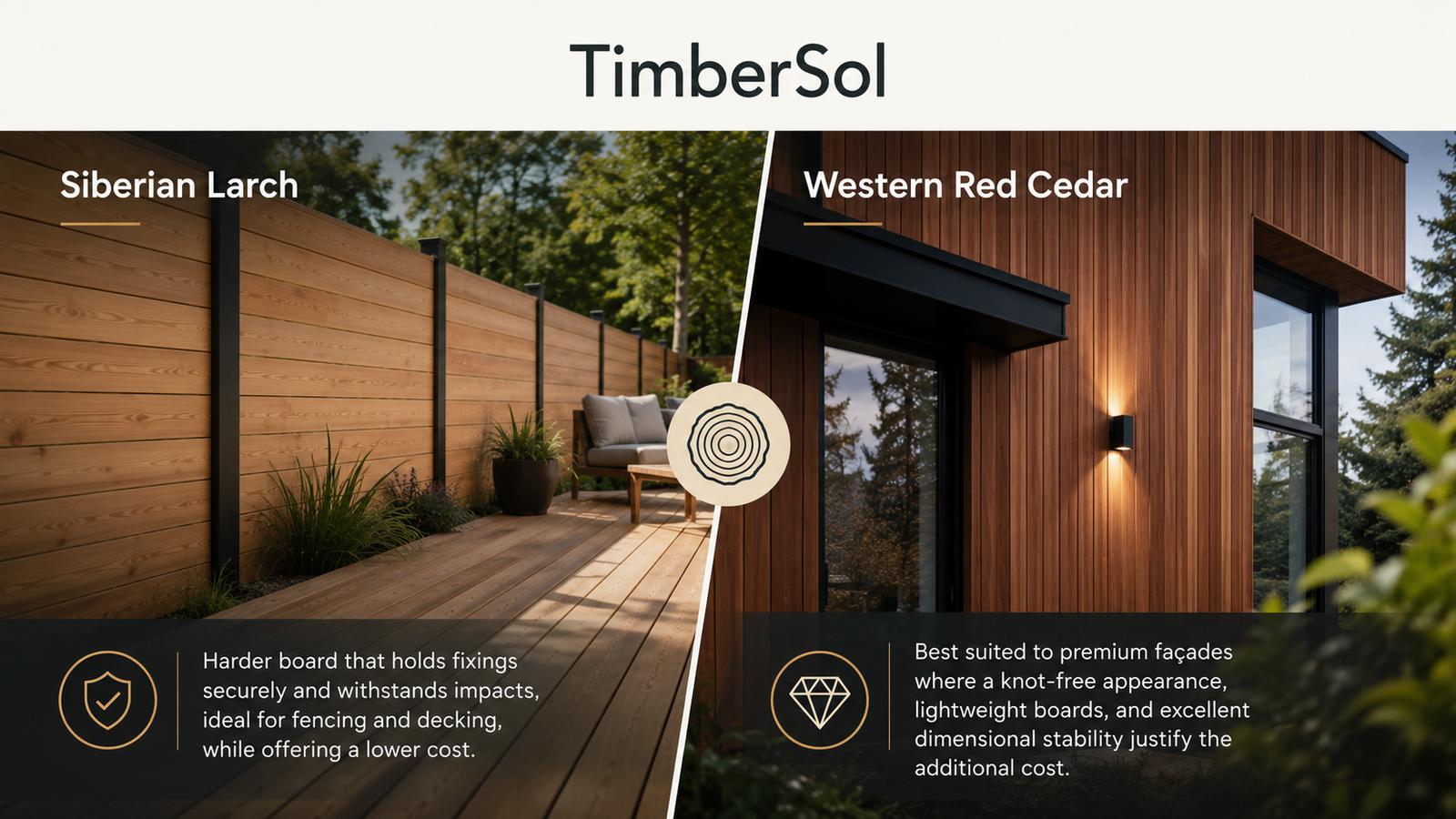
- Siberian larch is well suited to projects requiring a harder board that holds fixings securely and withstands impacts, including fencing and decking, while offering a lower cost.
- Western Red Cedar is best suited to premium façades where a knot-free appearance, lightweight boards, and excellent dimensional stability justify the additional cost.
Neither timber is flawless. Larch has resin bleed and knots, while cedar dents more easily and costs more. The right choice depends on the application, level of exposure, and budget.
There is also a third option. Charred larch retains larch’s density and cost advantage while providing a durable architectural finish. TimberSol’s charring process creates a protective carbon layer that is sealed with oil, improving resistance to weathering, rot, and insects. See our black larch cladding or browse our full timber cladding range.
Still undecided? Order a sample or request a quote to compare the boards in person.
Siberian Larch vs Cedar: FAQ
Can You Get Siberian Larch in the UK?
Yes, Siberian larch is still available in the UK in 2026, but the supply of genuinely Siberian-grown timber has been constrained in recent years, so availability and lead times vary between suppliers.
British and European larch fill part of the gap. Both are faster-growing, so they have lower density and more knots, while still offering a similar appearance. Before ordering, confirm the timber’s origin and grade with your supplier, as boards sold simply as “larch” can differ significantly in performance.
Is Larch as Good as Cedar?
Larch performs as well as cedar in most cladding applications, but each excels in different areas. Siberian larch is denser, harder, and more affordable, while imported Western Red Cedar is one durability class higher (Class 2 vs. Class 3 under BS EN 350-2), exhibits less movement, and typically lasts longer.
Therefore, the choice depends on the application. For impact resistance, fixing strength, and value for money, larch is the better choice. For a clean, knot-free appearance and maximum stability on large elevations, cedar justifies its premium price.
What Are the Benefits of Using Siberian Larch?
Siberian larch offers four main advantages as an exterior timber:
- Exceptional hardness and density for a softwood (around 628 kg/m³), making boards resistant to dents and allowing them to hold fixings securely
- Natural resin content that helps protect against rot and insect attack
- An attractive golden colour that weathers to a silver-grey patina
- A lower price than Western Red Cedar
That density also makes larch versatile beyond cladding, performing well in fencing and decking applications where boards are exposed to regular impacts and foot traffic.
What Are the Common Problems with Larch Cladding?
The main issues with larch cladding are resin bleed, movement as the boards dry, knot loss in lower sawfalling grades, and uneven weathering to a silver-grey colour on uncoated elevations. Resin bleed is most noticeable on dark, sun-exposed façades, as heat draws the resin to the surface.
Each issue has a practical solution. Specify higher grades to reduce knot loss, allow boards to acclimatise before installation, and install them on ventilated battens using the correct fixings. A UV-resistant finish or a charred surface helps ensure more even weathering. For a more detailed comparison, see our larch vs cedar guide.
Whichever species you choose, charring is a third option worth considering. At TimberSol, we char larch using the traditional Yakisugi technique, combining its natural density and strength with a protective carbon layer that improves resistance to weathering, rot, and insects. The result is a low-maintenance board with a distinctive, contemporary finish that neither untreated larch nor cedar can match.
If you would like to see how it looks and feels before making a decision, order a sample of our charred larch boards, available in shades ranging from deep black to soft greys and warm browns. If you already have a project in mind, our team will be happy to discuss the profiles, sizes, and finishes that best suit your specification.
