
Thermowood vs Larch Cladding: Which Is Better for Your Home?

Thermowood vs larch cladding comes down to one trade-off: thermally modified pine or spruce gives you a drier, more dimensionally stable board rated durability class 2 under the International ThermoWood Association’s EN 350 classification, while larch heartwood sits at class 3–4 but generally costs less and brings more visual character. If your elevation faces prolonged wetting, Thermo-D can offer greater durability than untreated larch; if budget or a rustic finish matters more, larch can be the stronger fit.
Most supplier pages tell only half the story. Thermowood loses splitting strength, can hold screws less firmly and, under EU Regulation 2024/1399, no longer qualifies for the automatic fire classification available to qualifying untreated wood. Larch, on the other hand, can bleed resin, loosen knots as it dries and vary in natural durability. Consequently, the right choice depends on how each weakness plays out on your specific wall.
The comparison below sets both timbers against the same criteria: EN 350 durability class and service life, moisture content and movement, fixings, fire performance, coating behaviour and 2026 UK price per m². It also compares Siberian with British larch and Thermowood with composite, so you can specify with confidence rather than from a sales sheet.
Thermowood vs Larch Cladding: Side-by-Side Comparison
Thermowood earns its durability through heat; larch through the natural durability of its heartwood. Thermo-D pine or spruce is modified at 212 °C (±3 °C) per the ThermoWood Handbook, with Nordic and Baltic softwood produced from selected heartwood, and leaves the process at a low moisture content.
| Criterion | Thermowood (Thermo-D) | Larch |
| Species/origin | Nordic/Baltic pine or spruce | Siberian or UK-grown |
| Durability source | Thermal modification | Natural heartwood durability |
| EN 350 class | DC2; suitable for Use Class 3.2 | Heartwood DC3–4, read as DC4; sapwood DC5 |
| Air-dry density | ~420 kg/m³ | UK ~515 kg/m³; Siberian generally denser |
| Moisture in service | Lower equilibrium moisture content than untreated softwood | Varies with ambient conditions |
| Movement | Swells and shrinks to a smaller degree than untreated wood | 4.5% tangential, 3% radial (European, green to 12%) |
| Resin | Resin removed during modification | Resinous |
| Knots | Pine fewer and larger; spruce smaller and more numerous | Often knotty, depending on grade and origin |
| Strength grading | Not intended for structural use unless separately verified | UK-grown larch can be strength graded up to C35 |
| Fire class without testing | Does not qualify as untreated wood for CWFT classification | D-s2,d0 where CWFT density, thickness and end-use conditions are met |
| Maintenance | Coating optional | Can be left natural or coated |
| Indicative UK supply price | ~£55–£95/m² | ~£35–£70/m² Siberian; UK lower |
The DC2 figure comes from the Association’s own suitability table rather than an independent EN 350 species listing, and Thermowood is not recommended for use in contact with soil or water.
But the same heat that removes resin and moisture can also reduce strength and toughness, which is where the trade-offs begin.
Thermowood vs Larch Cladding Pros and Cons
Neither option wins outright: each leads on different criteria, and their limitations help decide which suits your project.
What Are the Disadvantages of Thermowood Cladding? (And Its Advantages)
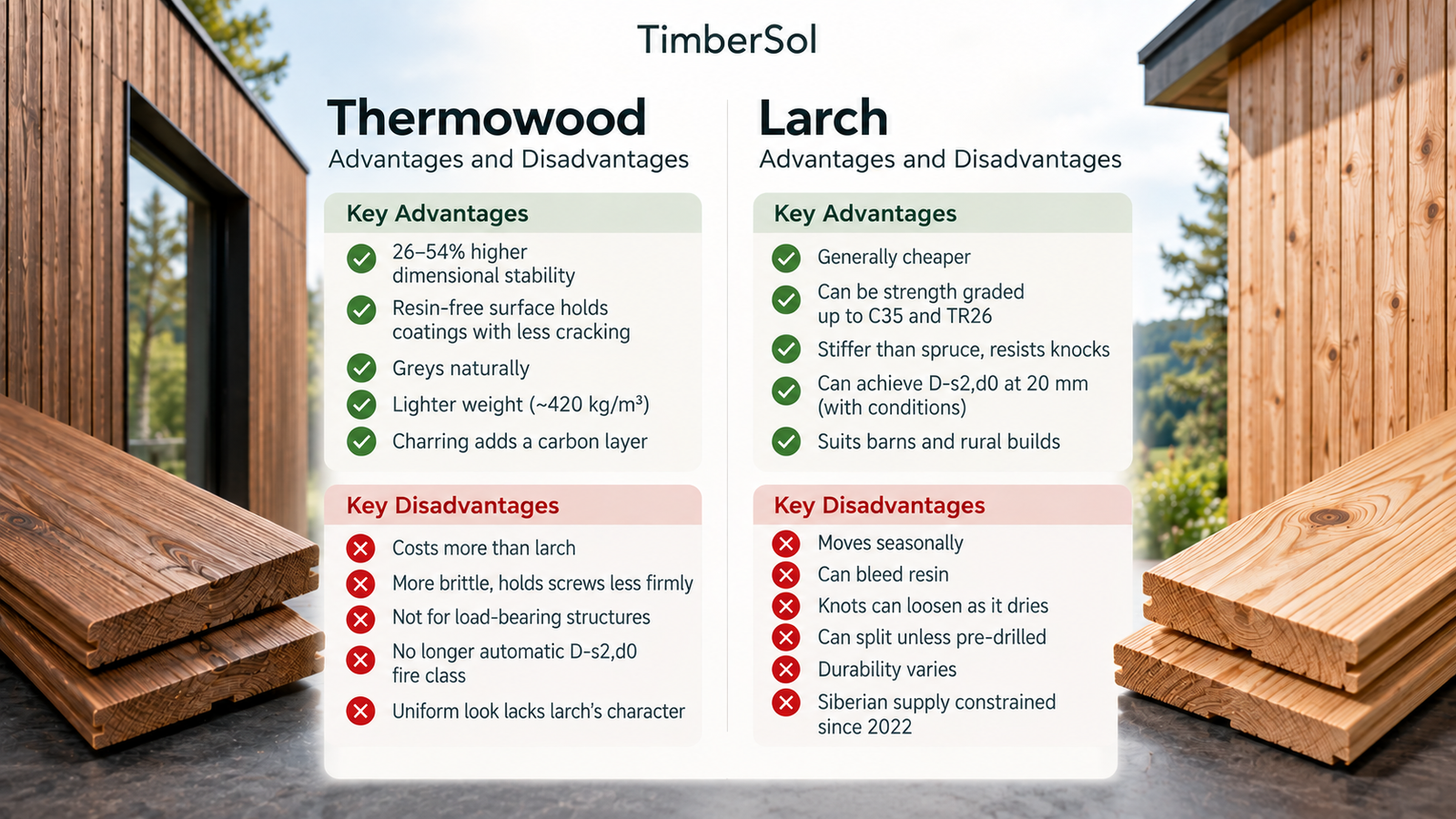
Thermowood typically costs more than larch, is more brittle, can hold screws less firmly, is not intended for load-bearing structures and no longer earns an automatic D-s2,d0 fire class. Its uniform look also lacks larch’s character.
The ThermoWood Handbook records Thermo-D bending strength falling from 60.7 to 38.1 N/mm² for pine and from 74.2 to 47.5 N/mm² for spruce, splitting strength down 30–40%, and spruce screw-holding strength from 22.0 to 14.9 N/mm². Not intended for load-bearing structures, it cannot form structural battens or frames. Its acidic pH calls for stainless steel screws, with pre-drilling near board ends, and linseed oil should not be used because it can promote fungal growth.
EU Regulation 2024/1399 limits deemed D-s2,d0 classification to untreated wood, so request a Declaration of Performance for Thermowood. Fire-retardant treatment can achieve B-s1,d0.
On the plus side, Čermák et al. measured 26–54% higher dimensional stability, although repeated soaking reduced the improvement, so keep boards ventilated. The resin-free surface holds coatings with less cracking and greys naturally, and Thermo-D weighs ~420 versus ~490 kg/m³ for untreated pine. Charring adds a carbon layer to charred thermowood cladding.
What Are the Disadvantages of Larch Cladding? (And Its Advantages)
Larch moves seasonally, can bleed resin, can loosen knots as it dries and can split when nailed near board ends unless pre-drilled. Durability also varies: Curnel et al. (2008) found larch heartwood ranging from very durable to not durable, with durability varying by heartwood position and tree age. Since 2022, sanctions have constrained Siberian supply.
UK-grown larch sits at the lower end of the density range, and any sapwood left on counts as DC5. Oils can perform inconsistently on the resinous surface, so it can be left natural; if coated, maintenance intervals depend on the coating system.
Yet larch costs less and can be strength graded up to C35 and TR26, so battens, frames and pergolas can share the species. It is stiffer than spruce and resists knocks on ground-floor walls, suiting barns and rural builds. At 20 mm, qualifying untreated larch can achieve D-s2,d0 without testing where the density and end-use conditions are met. Screw-fixed shiplap or feather edge profiles accommodate movement, and charred larch cladding hides knot variation.
Thermowood vs Larch Cladding Cost: Price per m² and Lifetime Value
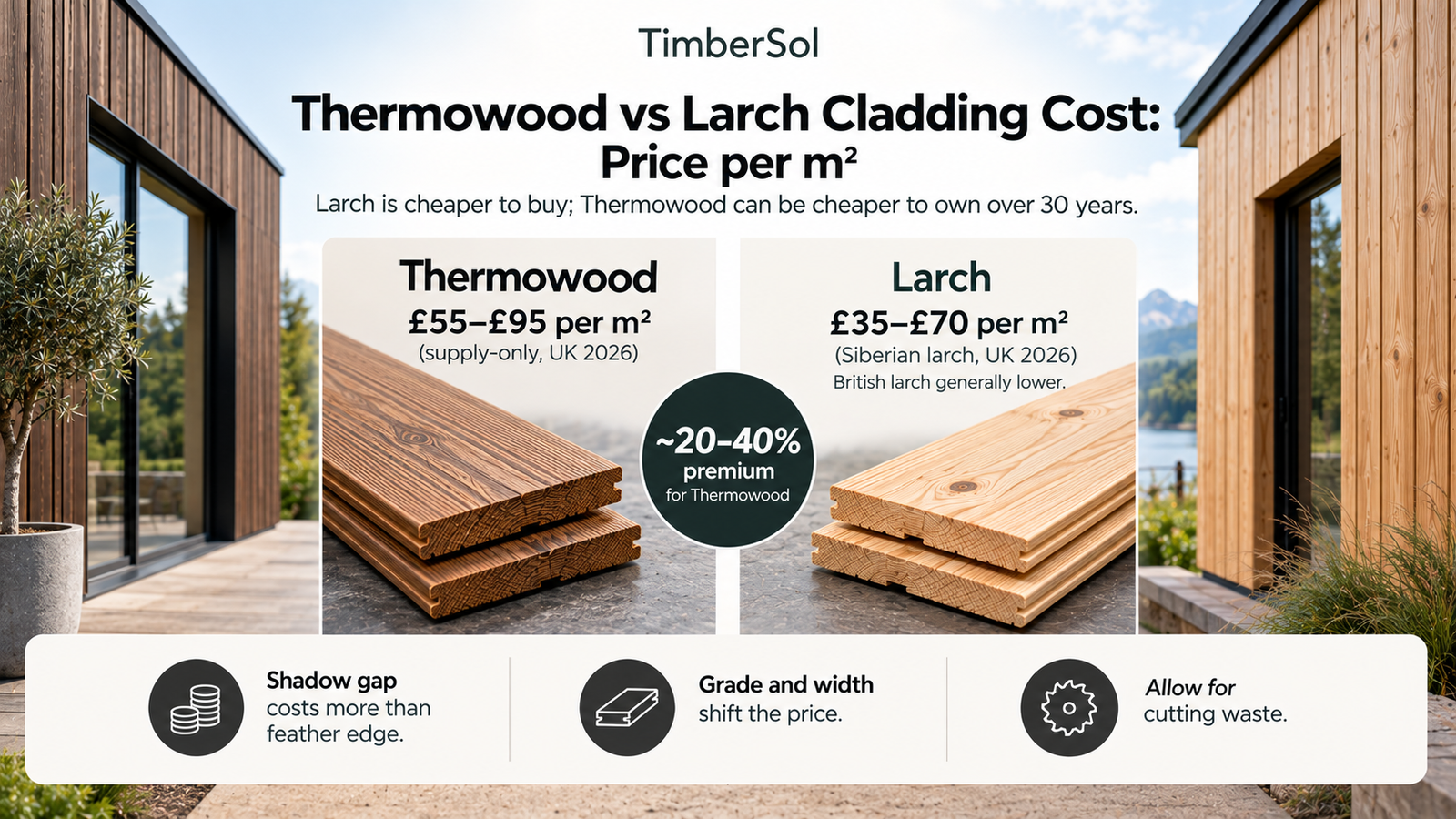
Larch is cheaper to buy; Thermowood can be cheaper to own over 30 years. UK supplier pricing for 2026 puts Thermowood at roughly £55–£95 per m² supply-only and Siberian larch at £35–£70 per m², with British larch generally lower, so Thermowood carries a roughly 20–40% premium. Shadow gap costs more than feather edge, grade and width shift the price, and allow for cutting waste.
Thermowood’s premium reflects its multi-day kiln cycle at 212 °C, selected Nordic and Baltic softwood feedstock and import logistics; larch is simply sawn and kiln-dried.
Lifetime cost can reverse the picture. Per COFORD Table 2, DC2 Thermowood corresponds to a 60-year desired service life in Use Class 3.1 and 30 years in 3.2, whereas DC4 larch corresponds to 15 years in 3.1. Over a 60-year domestic design life, larch may need maintenance or partial replacement; Thermowood may not.
Fixings add cost to both: stainless steel screws are recommended for Thermowood and larch to prevent staining. Pre-finished or pre-charred boards move maintenance cost into the purchase price but can cut site labour and re-coating.
Which Should You Choose: Thermowood or Larch Cladding for Your Project?
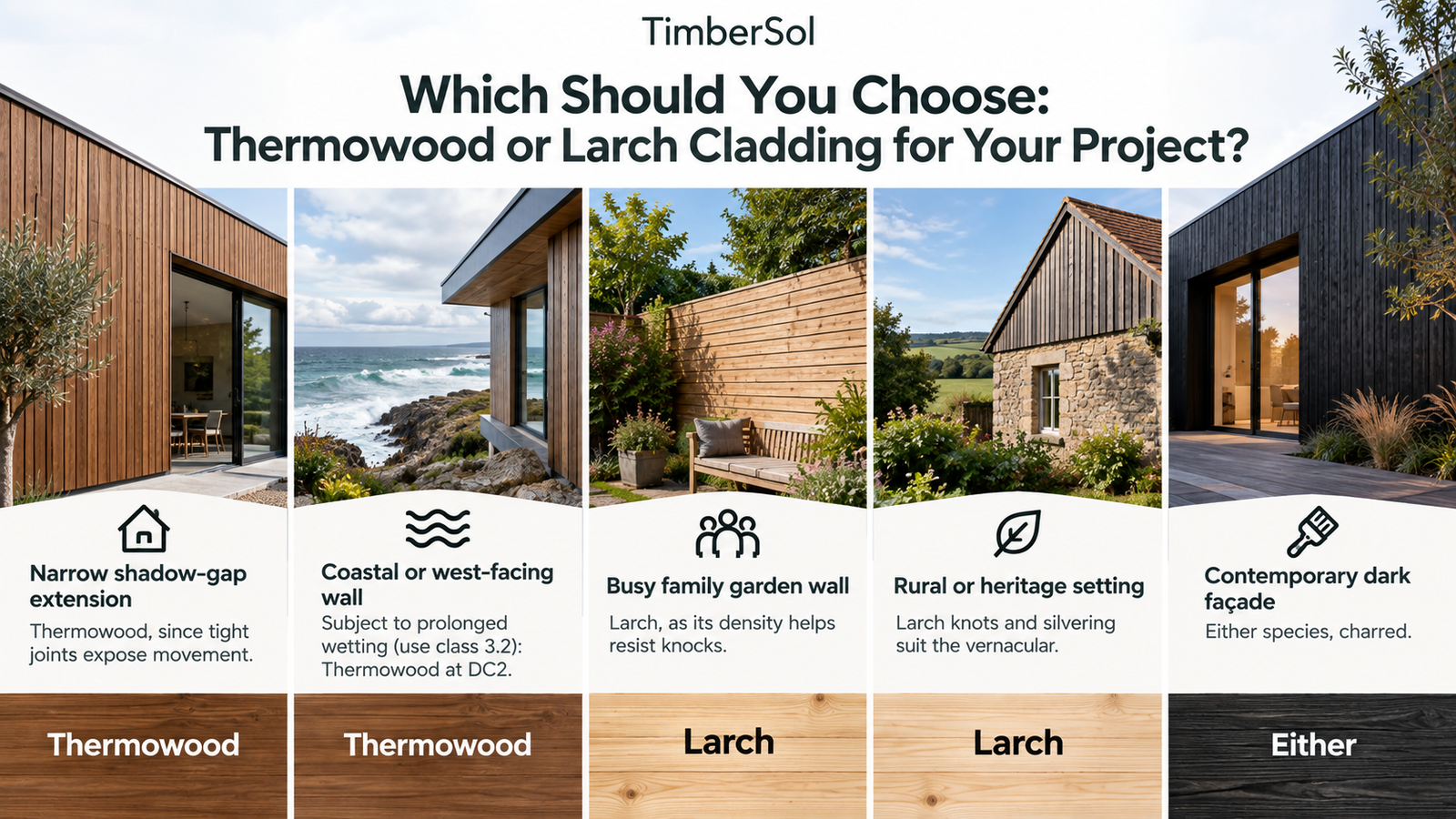
Choose Thermowood for precise modern façades, shadow gaps, coastal or persistently wet sites, and low-maintenance garden rooms. Choose larch for barn conversions, rustic builds, tight budgets, and anywhere the same timber must also carry loads, such as pergolas or exposed structures.
Typical scenarios:
- Narrow shadow-gap extension: Thermowood, since tight joints expose movement.
- Coastal or west-facing wall subject to prolonged wetting (use class 3.2): Thermowood at DC2.
- Busy family garden wall: larch, as its density helps resist knocks.
- Rural or heritage setting: larch knots and silvering suit the vernacular.
- Contemporary dark façade: either species, charred; compare black Thermowood cladding with black larch cladding.
Beyond these two, western red cedar offers lighter weight and straighter grain at higher cost; Accoya can reach DC1; composite suits projects where colour stability outranks natural grain.
Avoid untreated spruce or pine outdoors (DC4–5), fresh-sawn British larch on precision facades, untreated sapwood, unsuitable fixings on either species, nails near Thermowood board ends, cheap uncapped WPC and any wall without a ventilated cavity, because the ThermoWood Handbook requires air circulation behind cladding.
Fix 145 mm Thermowood shadow-gap boards with two A2 stainless fixings per batten, pre-drilled at the ends. The 18/12 mm fire threshold does not apply to Thermowood.
Thermowood vs Larch Cladding: FAQ
Does Thermowood or Larch Cladding Last Longer?
Thermowood. Thermo-D at DC2 meets the 30-year line in EN 335 Use Class 3.2 and 60 years in Class 3.1 under the COFORD/BS 8417 tables, whereas larch heartwood (DC3–4) corresponds to 15–30 years in Class 3.1, depending on its durability class. UK-grown larch should be read as DC4 unless the supplier proves otherwise. No lifespan is guaranteed, however: cavity ventilation, drip details and end-grain protection influence the real figure for both species.
Is There a Difference Between Thermowood vs Siberian Larch and British Larch?
Yes, on three counts. Siberian larch is generally denser than British larch at a similar EN 350 class. British larch costs less, grows locally and became more relevant after 2022 sanctions cut Siberian imports, but it can twist and shed knots as it dries. Thermowood beats both on stability and leaves the modification process at 4–7% moisture content, yet costs more. Also ask which larch species a supplier stocks: Japanese larch, widely grown in Britain, tested more durable than European or hybrid larch in Curnel et al. (2008).
How Does Thermowood Compare to Composite Cladding?
Thermowood is natural, resin-free, chemical-free timber with real grain that can be left to grey or oiled. Wood-plastic composite is generally colour-stable and does not need oiling, but it can look uniform, retain heat in the sun, cost a similar or higher price per m², and its fire class varies by product, so check the Declaration of Performance. Charred timber sits between the two, keeping timber grain under a dark, low-maintenance surface.
Should Thermowood or Larch Cladding Be Oiled?
Neither has to be. Thermowood can stay uncoated, although the Association recommends surface treatment on exposed elevations and warns against linseed oil. Larch can be left natural or oiled if colour matters. Weathering differs too: resin-free Thermowood greys naturally, whereas larch can weather unevenly and shed knots as it silvers.
Whichever way the durability tables lean, both timbers can benefit from a charred surface. Controlled charring forms a protective carbon layer that improves resistance to moisture, insects and decay, and the brushed, oiled finish helps larch hold its colour and gives Thermowood a deeper, more consistent tone. At TimberSol we char both species in shiplap, shadow gap and smooth profiles, with matched Hi-Tech Hybrid Oil for future re-coating.
Seeing the two side by side settles the debate faster than any spec sheet. Order a charred cladding sample in the shade you have in mind, hold it against your elevation in real light, then talk to us about sizes, fixings and a quote for the full run.
