
Mastering Construction Project Risk Management

At its core, construction risk management is all about getting ahead of problems. It’s the process of spotting, analysing, and dealing with potential threats before they have a chance to throw your project off course, blow the budget, or compromise on quality. Think of it as a blueprint for navigating the uncertainty that comes with any build.
Why Risk Management Is Your Project Blueprint for Success
Imagine a major construction project is like captaining a ship across a treacherous sea. You wouldn’t set sail without a map and a plan for rough weather, would you? Risk management is your navigation system, giving you the foresight to steer around hazards and get to your destination safely and on time.
This isn’t just abstract theory; it’s a practical framework for turning what-ifs into a real advantage. The goal isn’t to eliminate every single risk—that’s just not possible. It’s about understanding them so well that you can control their impact. A solid plan means your project is built on proactive strategy, not just reacting when things go wrong.
The Core of Construction Risk Management
So, what does this look like day-to-day? Construction risk management boils down to a few key activities. These aren’t just boxes to tick at the start; they’re part of a continuous cycle that runs through the entire life of the project.
- Proactive Identification: This is where you systematically hunt for potential threats. We’re talking everything from a sudden spike in material costs and a key subcontractor going bust to discovering unexpected ground conditions on site.
- Thorough Assessment: Once you’ve identified a risk, you need to size it up. How likely is it to happen? And if it does, how bad will the damage be?
- Strategic Mitigation: Here’s where the planning comes in. For the biggest threats, you’ll develop clear plans to either avoid them, transfer the risk (through insurance, for example), or reduce their impact to a manageable level.
When you treat risk management as an ongoing discipline rather than a one-off task, you stay in control. It helps protect your profit margins and builds a reputation for delivering what you promised. This mindset turns risk from something to fear into an area of genuine professional skill.
Take regulatory hurdles, for instance. Keeping on top of evolving building standards is a perfect example of proactive mitigation. Knowing the ins and outs of the latest requirements, like those we cover in our guide to top sustainable building certifications, helps you sidestep compliance risks that could lead to costly delays or major rework down the line. It’s that kind of foresight that really separates the successful projects from the ones that stumble.
Mapping the Terrain of Construction Risks
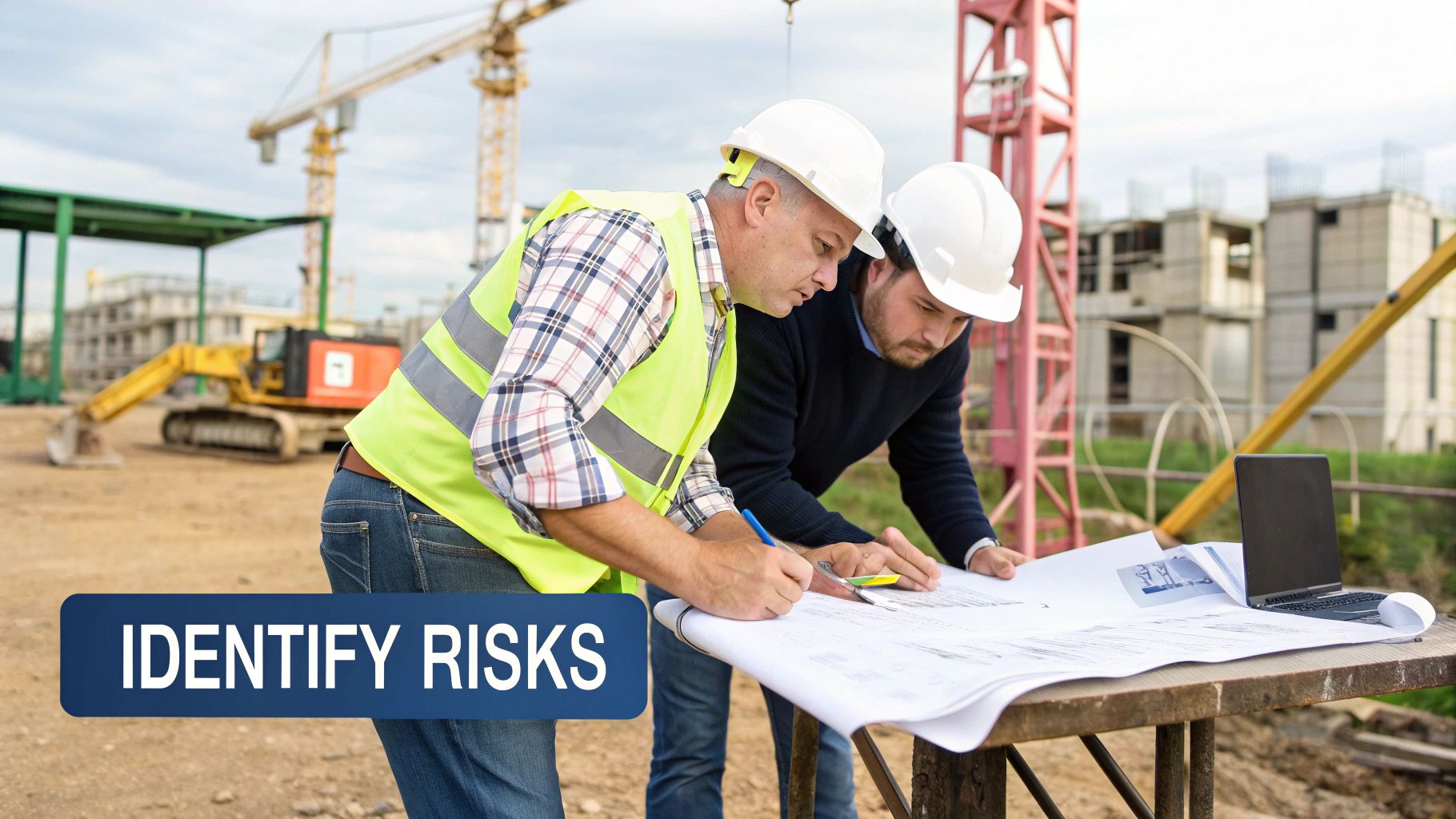
Before you can tackle any risk in construction, you first have to see it coming. Think of it like a surveyor meticulously mapping a new site—you need to know where every potential hazard lies, from hidden gullies to unstable ground, long before the first shovel breaks earth. This initial step, risk identification, is the bedrock of any solid management plan.
Risks on a building site are never one-size-fits-all. They creep in from all corners of a project, so grouping them into categories is the best way to make sure nothing slips through the cracks. It’s how you move from a general, nagging feeling of “what if?” to a concrete, actionable list of challenges to watch out for.
This organised approach is what gives birth to a risk register. This isn’t just a document; it’s a living, breathing log of every risk you’ve identified, its potential fallout, and how you plan to handle it. It turns the guesswork of risk management into a structured, team-wide discipline.
Where Do Risks Typically Hide?
So, where do you start looking? While every job has its own unique quirks, most construction risks can be sorted into a handful of common categories. Knowing these helps you and your team focus your attention where it’s needed most.
Let’s break down some of the most common risk areas you’ll encounter on a project. The table below gives you a clear picture of what these categories look like in the real world.
Common Construction Risk Categories and Examples
| Risk Category | Description | Practical Examples |
|---|---|---|
| Financial | Anything that directly threatens the project’s budget or profitability. | Unexpected material price spikes, sudden interest rate changes, a key client or subcontractor going bust. |
| Operational | Risks tied to the day-to-day running of the site and the physical work. | A crucial piece of machinery breaking down, a main subcontractor failing to perform, labour shortages, on-site accidents causing delays. |
| Environmental | Threats originating from the project’s physical location and natural surroundings. | Discovering contaminated soil during excavation, extreme weather events (floods, high winds) halting work, strict local noise regulations. |
| Contractual & Legal | Dangers hidden within the fine print of contracts and legal obligations. | Poorly worded clauses in an agreement, disputes over the defined scope of work, failing to secure the right planning permissions. |
Thinking about these categories helps to structure your risk assessments, ensuring you’re not just looking at the obvious physical dangers but also the financial and legal minefields that can derail a project just as quickly.
It’s a classic mistake to view risks in isolation. The reality is they’re a tangled web. A single flash flood (environmental) can wash out access roads, delaying material deliveries (operational), which in turn blows your budget and schedule (financial).
Walking the Financial Tightrope
Of all the categories, financial risks demand a special kind of vigilance. Why? Because a financial problem can spread like wildfire, threatening the viability of the entire project almost overnight. The stability of every single partner in your chain—from the client right down to the smallest specialist supplier—is a potential point of failure.
This isn’t just a theoretical worry, especially here in the UK. A recent analysis painted a sobering picture: nearly 98,000 UK construction firms were reported to be in significant financial distress, with a staggering 6,830 of them in critical trouble. As detailed in a report on the UK construction sector’s financial pressures, this makes our industry one of the most financially precarious in the entire UK economy.
That single statistic drives home why construction project risk management isn’t just a box-ticking exercise; it’s a survival strategy. By mapping out these financial weak points from day one, you can build contingency plans and brace for impact, rather than being knocked off your feet when a partner’s crisis becomes your own.
Prioritising Threats with a Risk Assessment Matrix
So you’ve done the hard work of identifying all the potential hazards on your project. The result? A long, frankly intimidating list. Effective construction project risk management isn’t about trying to fight every fire with the same amount of water; it’s about smart prioritisation. You need to know which threats demand your immediate attention and which are just minor bumps in the road.
This is exactly where a risk assessment matrix comes into its own. Think of it as a lens that brings your project’s most critical dangers into sharp focus. It’s a simple but incredibly powerful visual tool that helps you systematically evaluate and rank each risk, turning a jumble of worries into a clear, actionable game plan.
How the Matrix Works
The whole system hangs on two simple axes: likelihood and impact. For every single risk you’ve listed, you have to ask two fundamental questions:
- Likelihood: What are the real odds of this happening? Is it almost a dead cert, or is it a one-in-a-million long shot?
- Impact: If it does happen, how bad will the fallout be? Will it be a minor hiccup that costs you an afternoon, or a catastrophic failure that could derail the entire project?
By plotting each risk on the matrix based on your answers, you can see at a glance where it lands. The risks that are high-likelihood and high-impact will jump out at you from the “red zone,” signalling an absolute top priority for your team.
This visual process shows how analysing the risks is the key step between simply listing them and creating a proper plan to deal with them.
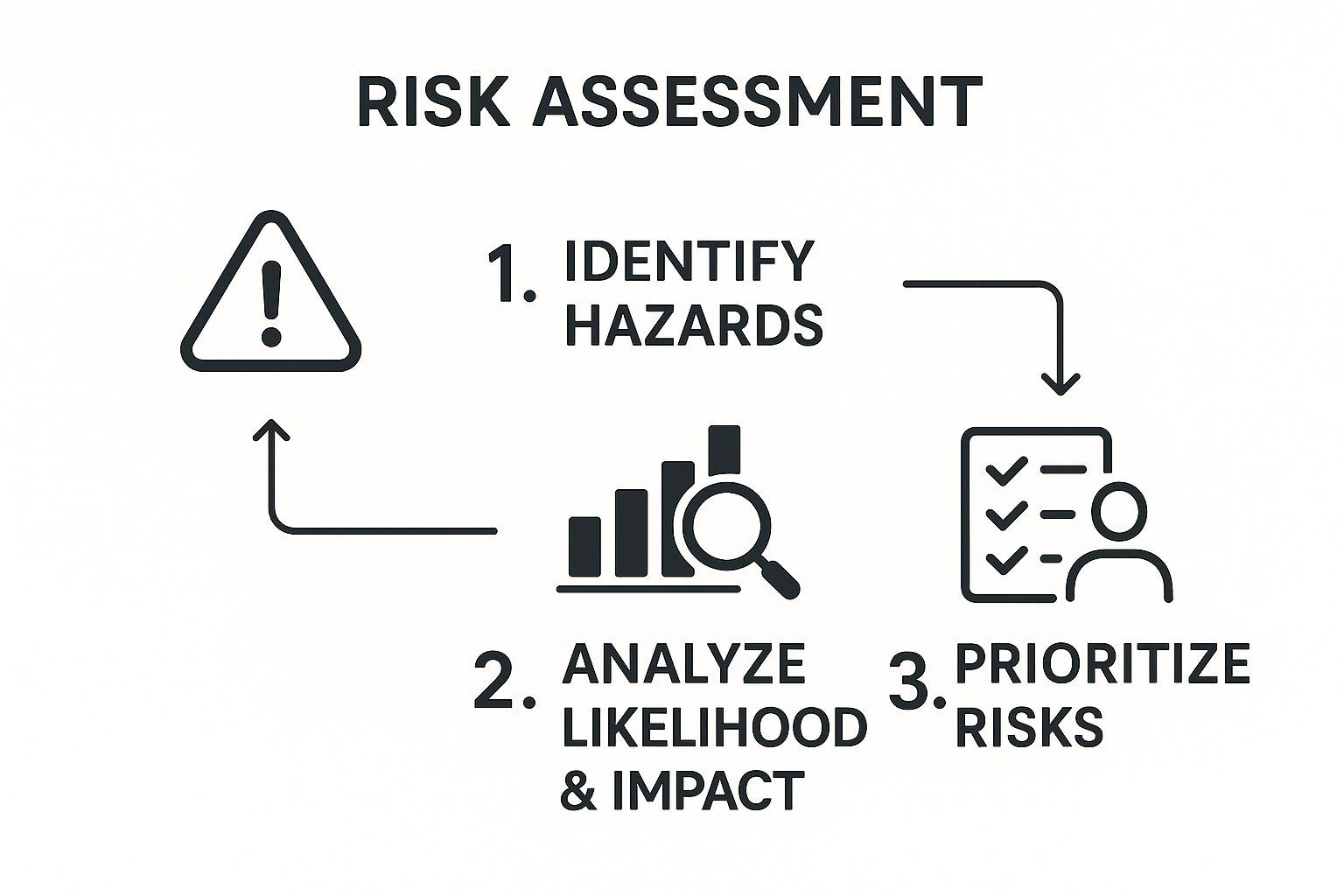
As you can see, analysing likelihood and impact is the crucial middle step. It’s what transforms a simple list of hazards into a prioritised action plan.
From Assessment to Action
Categorising risks this way is the first, essential step toward allocating your resources wisely. It stops your team from wasting precious time and money on low-level threats while a genuine project-killer lurks unnoticed in the background.
A risk matrix forces objective conversations. It moves the discussion from vague “what if” scenarios to a structured debate about probability and consequence, ensuring your focus is always on protecting the project’s core objectives.
Let’s take a real-world example. The risk of a two-day delay from a minor material delivery mix-up might be quite likely, but its overall impact is low. On the other hand, the risk of discovering unforeseen ground contamination during excavation might seem less likely, but its impact on the budget and timeline could be catastrophic.
The matrix makes it visually obvious which one needs more of your attention. The contamination risk, despite its lower probability, demands a far more robust mitigation strategy. This methodical approach is the very heart of successful construction project risk management.
Developing Your Risk Response Playbook
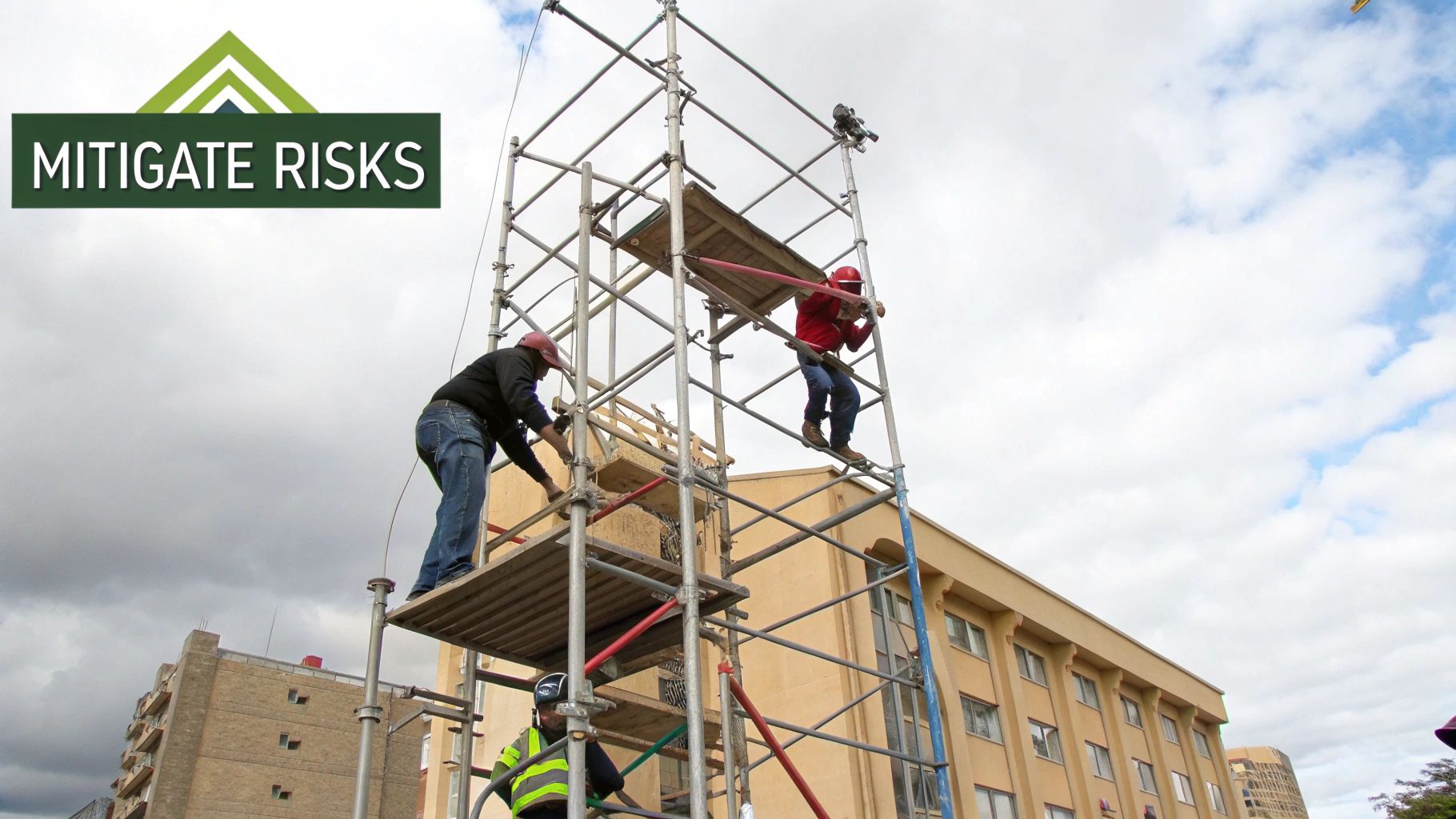
Spotting risks is like getting a diagnosis; responding to them is the treatment that actively shapes the outcome of your project. Once you’ve used a risk matrix to figure out which threats need your attention first, it’s time to build a clear, decisive response plan. This isn’t about creating one rigid strategy. It’s about developing a versatile playbook with four core approaches to handle whatever comes your way.
Think of these strategies as different tools in your project management toolbox. Each is designed for a specific kind of problem, and knowing which one to grab is what turns a potential disaster into a manageable task. These responses are what elevate your risk register from a simple list of worries into a practical, actionable guide for the entire team.
The Four Pillars of Risk Response
For every serious risk you’ve flagged, you have to decide on a game plan. Your response will almost always fit into one of four distinct categories, each with its own logic.
- Avoidance: This is the most direct move. You change the project plan to cut the threat out completely. You aren’t just running away from the risk; you’re intelligently redesigning the path forward to sidestep it altogether.
- Transference: With this strategy, you’re essentially handing off the financial fallout of a risk to someone else. The risk doesn’t vanish, but you ensure your project isn’t the one left holding the bill if things go south.
- Mitigation: This is probably the most common tactic you’ll use. It’s all about taking proactive steps to make a risk less likely to happen or to soften the blow if it does. Think of it as damage control before the damage even happens.
- Acceptance: Let’s be honest, sometimes a risk is too small to justify a major response or just too expensive to completely get rid of. In these cases, you formally acknowledge it exists and plan for the potential consequences, usually by earmarking a contingency fund.
The point of a risk response playbook isn’t to create a risk-free project—that’s a fantasy. The real goal is to make a conscious, strategic decision for every major threat, ensuring nothing is left to chance.
Putting Strategies into Action
So, what does this look like on a real construction site? Let’s say a geotechnical survey comes back with bad news: a section of your site has unstable soil.
An avoidance strategy might be to completely redesign the building’s footprint so it sits on solid ground. Just like that, the soil issue is no longer part of the equation.
Now, consider a different risk, like a key subcontractor going bust. A transference strategy would be to require them to secure a performance bond. This shifts the financial risk of them not finishing the job onto the bonding company.
To tackle the ever-present risk of on-site accidents, a mitigation strategy would be to enforce rigorous daily safety briefings and invest in better personal protective equipment (PPE). You’re actively reducing both the odds and potential severity of injuries.
Finally, what about the risk of minor, short-term delays in material deliveries? An acceptance strategy would be to acknowledge they’re likely to happen and build a small buffer into both your schedule and your budget. This foresight allows you to absorb the small hits without derailing the whole project. This kind of proactive planning is the very essence of effective construction project risk management.
Securing Your Financial and Supply Chain Lifelines
https://www.youtube.com/embed/geDS8UTyD_M
In any construction project, cash flow and materials are the two lifelines keeping everything running. If one gets squeezed, the other feels it almost immediately, and the whole build can grind to a halt. Proper construction project risk management isn’t just about what happens on-site; it’s about treating your finances and supply chain with the seriousness they deserve.
This becomes absolutely critical when you’re growing. The temptation to take on more and bigger jobs is strong, but it’s a dangerous game if your financial foundations aren’t rock-solid. This is a classic trap known as ‘overtrading’—when you commit to new projects without having the cash flow to actually see them through. It’s a huge reason so many construction businesses go under.
The Dangers of Overtrading
Overtrading puts your business on a knife-edge. A single late payment from a client or an unexpected jump in material costs can throw you into a full-blown crisis. You’re left with absolutely no wiggle room for the surprises that are part and parcel of every construction job.
And this isn’t just theory. Over a recent 12-month period, the UK construction industry had to deal with 4,102 company insolvencies. That’s a staggering 17% of all business failures across England and Wales. When you talk to industry insiders, they often point the finger directly at overtrading as a key cause. It’s a harsh lesson in why you simply can’t afford to wing it with your finances. You can dig deeper into these UK construction insolvency trends.
Financial instability is contagious. If a crucial supplier or subcontractor hits a cash flow problem, it instantly becomes your problem. Suddenly, you’re facing delays and scrambling to find a replacement, often at a premium.
Building a Resilient Supply Chain
Your project’s success is completely tied to how reliable your suppliers are. Building a strong supply chain isn’t about reacting when a delivery doesn’t show up; it’s about being proactive and heading off problems before they start.
A smart strategy involves a few key moves to shield your project from disruption:
- Diversify Your Suppliers: Putting all your eggs in one basket for a critical material, like a specific type of timber, is asking for trouble. It pays to have good relationships with several trusted suppliers so you always have a backup.
- Lock in Material Prices: If you’re using materials known for price swings, try to negotiate fixed-price deals or even buy what you need upfront. This protects your budget from nasty surprises down the line.
- Use Protective Contract Clauses: Make sure your contracts are crystal clear about who is responsible for what. Include clauses that outline penalties for late deliveries or failures, shifting some of that risk back onto the supplier.
- Vet Partner Stability: Before you sign anything, do your homework. A little due diligence on a partner’s financial health can stop you from tying your project to a sinking ship.
Taking these steps builds a solid defence. It’s also wise to get a handle on the specifics of sourcing sustainable materials, as this can add another layer of security. Understanding the green building certification requirements helps you choose suppliers who are not only dependable but also tick the sustainability boxes that are becoming more and more important for modern projects.
Adapting to the Modern UK Construction Climate
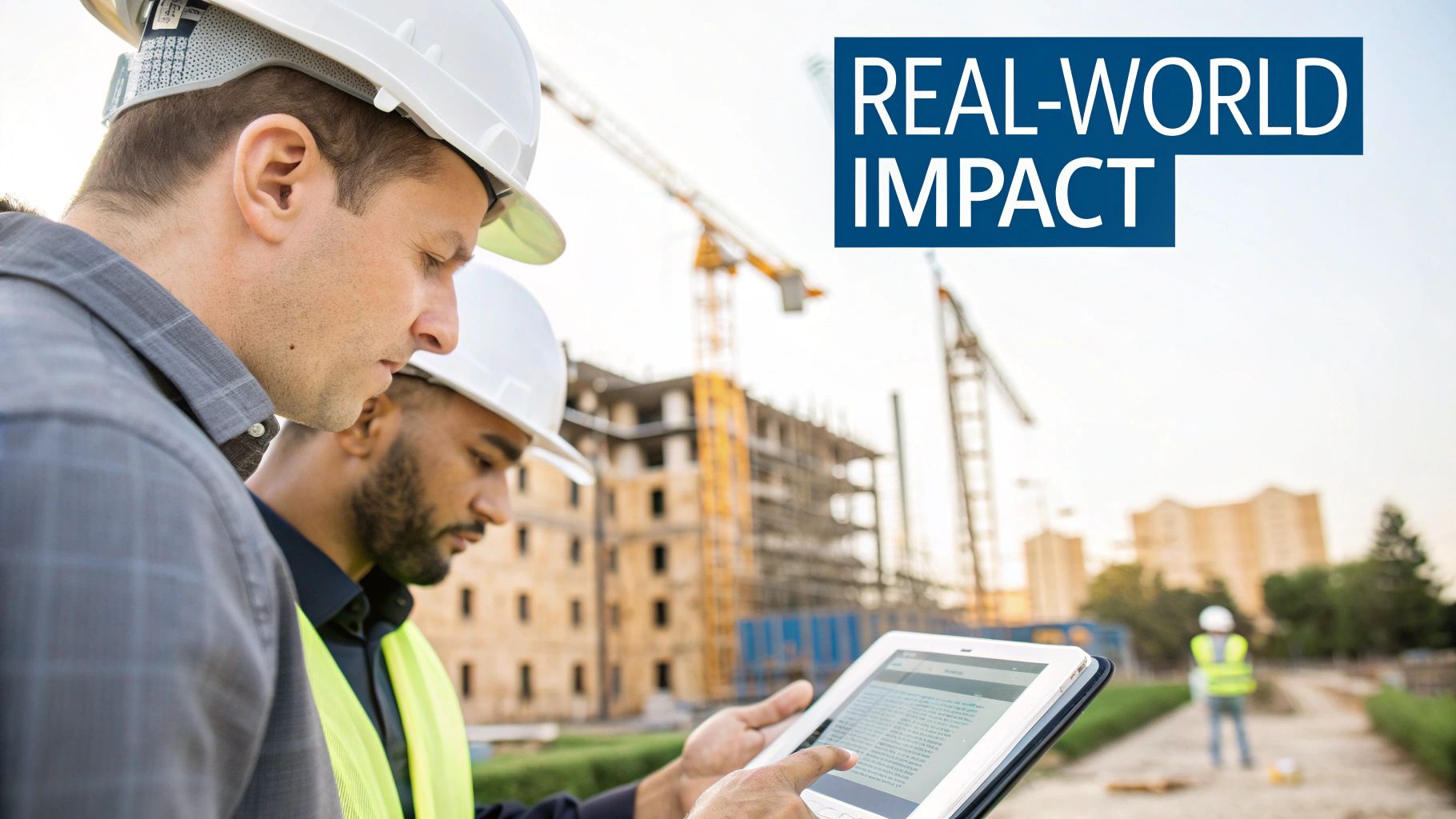
Effective construction project risk management isn’t a theoretical exercise. To do it well, you need to have your feet firmly on the ground, with a sharp eye on the current economic and regulatory landscape. Right now, the UK construction industry is navigating a perfect storm of pressures that can inject a huge amount of uncertainty into any project.
We’re dealing with a tricky mix of fluctuating interest rates, stubborn inflation, and ever-changing building regulations. In fact, the sector has just come through one of its most challenging periods, battling weak economic growth and rising labour costs that have squeezed margins on new builds. For a closer look at what’s been happening, it’s worth reading this analysis of UK construction trends and sector resilience. This is the reality we’re building in, and it demands a risk strategy that’s both proactive and flexible.
Navigating Sustainability and Digitalisation
It’s not just about the economy, though. Two massive shifts are fundamentally changing the nature of project risk: the push for sustainability and the rapid move towards digitalisation. Both are fantastic opportunities, but they also bring a whole new set of challenges that need to be managed with care.
The drive for greener building practices, for instance, introduces a host of new variables you need to get a handle on.
- New Materials: Working with unfamiliar materials or technologies, like advanced mass timber, means you have to be extra diligent. It requires thoroughly vetting suppliers and sometimes even retraining your workforce to get it right.
- Regulatory Compliance: Keeping up with the complex web of environmental certifications and updated building codes is non-negotiable. Get it wrong, and you’re looking at costly delays and hefty penalties.
- Supply Chain Scrutiny: It’s no longer enough to just get materials on-site. Now, you need to ensure your suppliers meet specific sustainability standards, adding another crucial layer of due diligence to your procurement process. We have a detailed guide on sourcing eco-friendly construction materials if you want to dig deeper.
At the same time, our growing reliance on integrated project management platforms and other digital tools opens us up to cyber threats. A data breach or a system failure can grind a project to a halt just as effectively as a flooded site.
Ultimately, mastering risk in today’s climate means looking far beyond the traditional site hoarding. It’s about understanding macroeconomic pressures, responsibly adopting new green technologies, and shoring up your digital defences. A truly forward-thinking risk plan has to connect all these dots to safeguard your project’s success.
Frequently Asked Questions
Even with the best-laid plans, questions always crop up when you start putting risk management into practice. Let’s tackle some of the most common ones I hear from project teams, breaking down the theory into practical advice.
What’s the First Step in Construction Risk Management?
The very first thing you must do is risk identification. It’s a simple truth: you can’t manage a risk you haven’t seen coming. This initial stage is all about methodically brainstorming and documenting everything that could possibly throw a spanner in the works, whether it’s hitting the budget, the timeline, or the final quality.
This can’t be a one-person job, either. To get it right, you need to bring everyone to the table – architects, engineers, the main contractor, and even key subcontractors. That’s the only way to get a true 360-degree view of the potential pitfalls from every single angle.
How Often Should a Risk Register Be Updated?
A classic mistake is to create the risk register, tick the box, and then let it gather dust in a folder. Your risk register should be a living, breathing document that changes as your project does. It absolutely needs a formal review at major project milestones, like when the design is signed off or before major procurement begins.
But just as importantly, it needs to be updated the moment something significant changes. That could be a scope adjustment, a budget revision, or an external factor like a new building regulation. Constant, active monitoring is what makes your risk management plan a useful tool instead of just a document.
What’s the difference between a risk and an issue? It all comes down to timing. A risk is a potential storm on the horizon – something that might happen and cause problems. An issue is a storm that’s already broken; it’s a problem happening right now that needs immediate attention.
Who Is Ultimately Responsible for Project Risk?
While the project manager is usually the one steering the ship on a day-to-day basis, risk is a shared responsibility. It works best when you think of it as a team sport where everyone knows their position.
- The Project Manager is on the hook for creating the plan and making sure it’s followed.
- The Project Owner or Client is the one who ultimately decides which risks are worth taking and which aren’t.
- Contractors and Subcontractors are responsible for managing the specific risks that fall within their remit.
A truly successful project is one where everyone feels empowered to spot and flag potential problems. That collective sense of ownership creates a much safer and more predictable environment for the entire team.
At TimberSol, we know that choosing high-quality, durable materials is one of the most effective ways to mitigate project risks from the outset. Our expertly crafted charred timber offers a reliable and stunning solution for cladding, decking, and fencing. To build with confidence, explore our sustainable products.
