
A Guide to the Properties of Cedar Wood

There’s a good reason cedar has such a premium reputation. It comes down to a potent mix of natural toughness, surprising lightness, and a classic look that never goes out of style. Its inherent ability to fend off decay and insects, combined with incredible stability, makes it a top-tier choice for the UK’s often-challenging climate. It’s these very qualities that also make it the perfect canvas for advanced treatments like Yakisugi.
What Makes Cedar Wood a Superior Choice
When you’re choosing timber for exterior projects, you quickly learn they aren’t all the same. Cedar stands out from the pack, not just for its rich, warm colours, but for a whole set of properties that make it uniquely equipped to handle the UK’s notoriously fickle weather. It’s a material that works just as beautifully as it looks.
You could almost think of cedar as nature’s own high-performance building material. It’s packed with natural oils and compounds that act as a built-in shield against moisture, fungal rot, and insect pests. This means it can face years of rain and damp without needing aggressive chemical treatments, making it a much more environmentally sound option.
Natural Resilience and Stability
One of cedar’s most prized assets is its dimensional stability. Many other timbers will swell, shrink, or even twist when humidity levels change, but cedar keeps its shape incredibly well. This low shrinkage factor is a game-changer for applications like cladding and decking, where you need tight, clean lines that will stay that way for years to come.
This reliability, layered on top of its other strengths, is why developers often choose it when aiming for both quality and longevity. The very name evokes a sense of quality, as seen in developments like the Cedar Pointe New Homes community, where the association with the wood’s desirable properties is a clear selling point.
Cedar’s ability to remain straight and flat, even when exposed to fluctuating moisture levels, is a key reason architects and builders specify it for high-end exterior projects. It provides reliability that other timbers simply cannot match.
These core traits—natural durability, visual appeal, and exceptional stability—are precisely why cedar is our timber of choice for the Yakisugi (also known as shou sugi ban) technique. The charring process doesn’t just add a unique aesthetic; it amplifies the wood’s already impressive resistance, resulting in a building material that is both stunning and incredibly resilient.
A Closer Look at Cedar’s Physical Properties
Cedar’s stellar reputation as a building material goes far beyond its good looks. It’s the timber’s inherent physical traits—its strength, stability, and workability—that truly anchor its status as a premium choice for demanding projects across the UK.
Feather-Light Yet Surprisingly Tough
One of the first things you’ll notice about cedar is its remarkably low density. If you were to hold a plank of cedar and a same-sized plank of oak, the weight difference would be striking. This lightness makes cedar one of the easiest commercial softwoods to work with, cutting down on labour fatigue and making transportation more cost-effective.
But don’t mistake its light weight for weakness. This low density actually boosts its thermal insulation value, helping buildings stay warmer in the winter and cooler in the summer. When used for exterior cladding, it’s like adding an extra, natural layer of energy efficiency to the structure.
An Unwavering Dimensional Stability
Perhaps cedar’s most prized physical quality is its incredible dimensional stability. All wood, as a natural material, expands and contracts in response to moisture in the air. Cedar, however, does this far, far less than most other timbers.
Think of it like this: a wool coat holds its shape in the damp UK air, while a cotton shirt quickly absorbs moisture, becoming heavy and misshapen. Cedar acts much like that wool coat, resisting the swelling, shrinking, and warping that can compromise other woods. This makes it a perfect fit for cladding and decking, where straight lines and tight joints are crucial for both looks and longevity.
Cedar’s low shrinkage factor means it stays true and flat over time, even when faced with the constant shifts in humidity we see across the UK. This reliability prevents unsightly gaps, buckling, and other common moisture-related headaches.
Grain Structure and Homegrown Potential
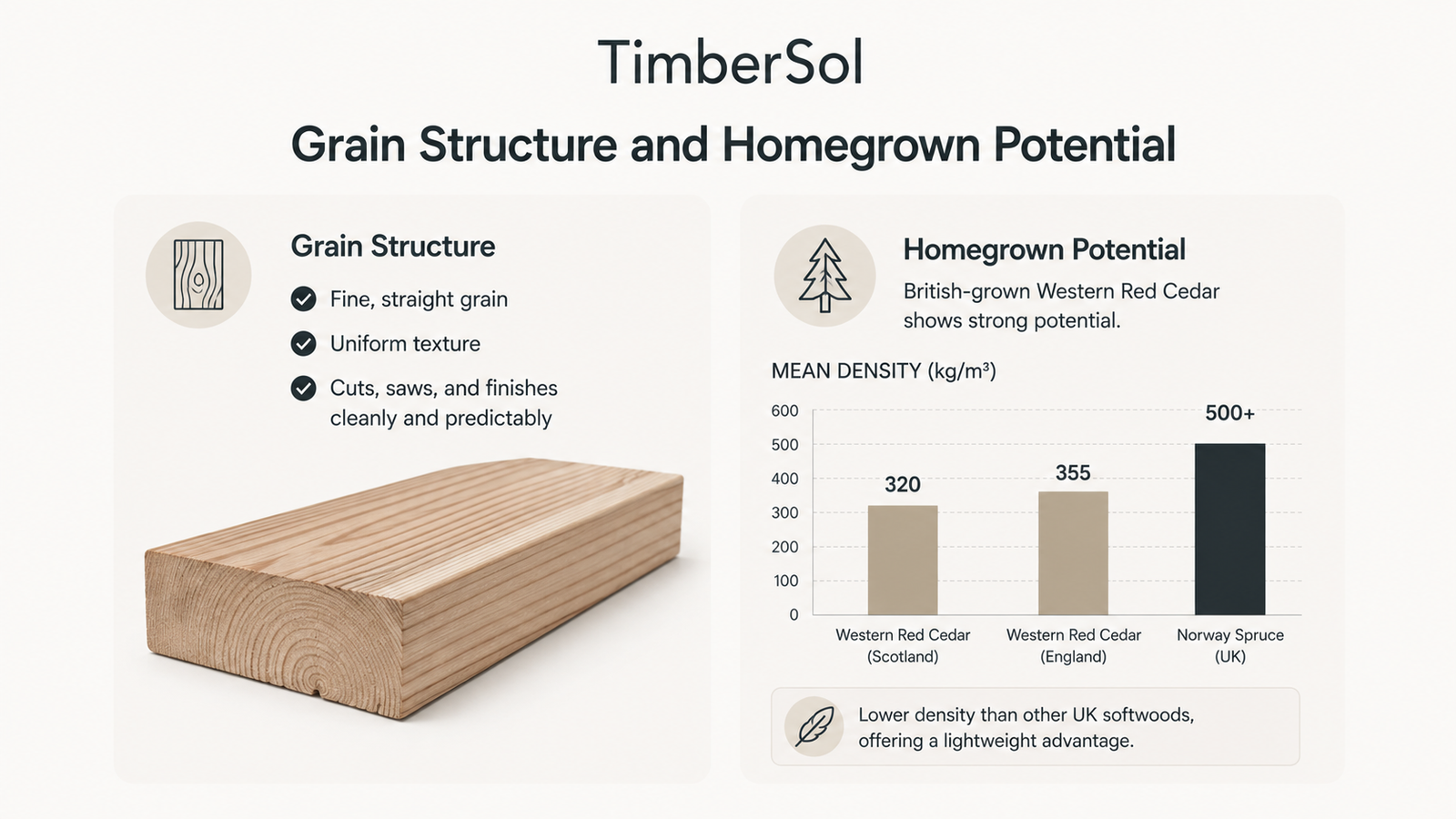
Cedar typically boasts a fine, straight grain with a uniform texture. This isn’t just about aesthetics; this consistent grain structure makes the wood a dream to work with. It cuts, saws, and finishes cleanly and predictably every time.
While much of the cedar in the UK is imported, efforts to diversify British forestry are showing fantastic potential for homegrown varieties. Studies on British-grown Western Red Cedar, for instance, confirm its signature low density, with mean densities measured at around 320 kg/m³ in Scotland and 355 kg/m³ in England. These figures are considerably lower than other UK softwoods like Norway spruce, highlighting cedar’s lightweight advantage. You can dive deeper into the research on UK timber properties from Forest Research for a full comparison. Even if it isn’t used for heavy structural work, this combination of stability and lightness makes it a highly valued material for cladding and fencing.
Understanding Cedar’s Strength and Limitations
While cedar excels in so many areas, it’s vital to have a realistic view of its mechanical properties. Every timber has its own set of talents, and cedar’s strengths lie in endurance and stability, not brute force.
Think of it as a marathon runner rather than a weightlifter—it’s built to withstand the elements over decades, not to bear immense loads.
This distinction is crucial when you’re planning a project. Cedar’s incredible resistance to warping and its lightweight nature make it a premier choice for non-load-bearing applications. It’s the perfect material for cladding, fencing, trim, and decking, where its ability to stay straight and true in the UK’s damp climate is a massive advantage.
A Closer Look at Bending Strength and Stiffness
Mechanical properties like bending strength (how much force it can take before breaking) and stiffness (its resistance to bending under a load) are where cedar shows its more modest side. Compared to denser softwoods like spruce or fir, cedar is considerably more flexible and less strong.
For this reason, you wouldn’t typically use cedar for structural beams, joists, or framing components that need to support the weight of a building. Asking it to do so would be like asking a long-distance runner to compete in a powerlifting competition—it’s simply not what it was built for.
To get a better sense of how different timbers compare, you can explore our detailed guide on the strongest types of wood.
UK Research Confirms Cedar’s Niche
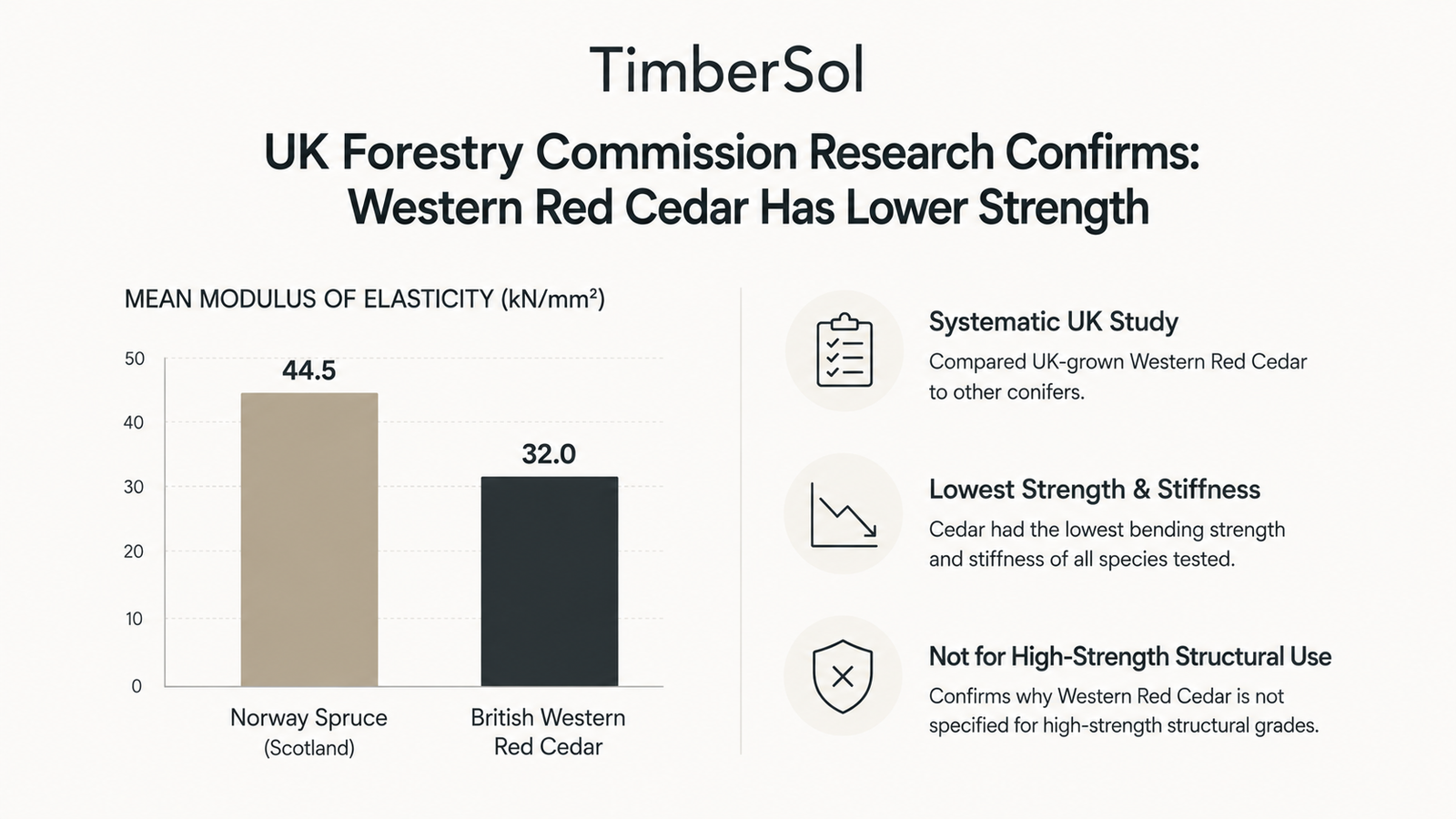
Recent research from the Forestry Commission systematically compared UK-grown Western Red Cedar to other conifers, and the findings confirmed its unique profile. The study found that cedar had the lowest bending strength and stiffness of all species tested, including Norway spruce and western hemlock.
For instance, while Norway spruce from Scotland achieved a mean modulus of elasticity of 44.5 kN/mm², British Western Red Cedar only reached about 32.0 kN/mm². This data reinforces exactly why it isn’t specified for high-strength structural grades.
Cedar’s true value isn’t found in its load-bearing capacity but in its exceptional stability. Its ability to resist warping, twisting, and checking makes it a superior material for applications where dimensional integrity is paramount.
Ultimately, understanding these limitations is the key to using cedar correctly. By selecting it for applications that play to its strengths—like charred cladding or premium fencing—you ensure a final result that is not only beautiful but will perform exceptionally well for years to come.
What Makes Cedar So Tough? A Look at its Natural Chemistry
Ever wondered why cedar lasts so long, even in the damp, unforgiving UK climate? It’s not by accident. Cedar has its own built-in preservation system, a clever bit of natural chemistry that keeps it going for decades without needing any harsh chemical treatments.
This natural resilience is what makes it such a brilliant choice for everything from garden fences to stunning architectural cladding. It’s all down to a few key organic compounds that work together to protect the wood from the inside out.
Thujaplicins: Cedar’s Secret Weapon Against Rot
Deep within the heartwood of cedar, you’ll find powerful compounds called thujaplicins. Think of them as the wood’s personal bodyguards. These are potent, naturally occurring fungicides that actively fight off the fungi responsible for rot and decay.
This is precisely why cedar stands up so well to our persistently damp weather. While other timbers might start to soften and decompose, cedar’s thujaplicins are constantly on guard, stopping rot dead in its tracks.
Polyphenols: More Than Just a Pretty Scent
Working in tandem with the thujaplicins are polyphenols. These are the water-soluble compounds that give cedar its famously pleasant, aromatic smell. But they do much more than just smell nice—they’re a highly effective insect repellent.
These natural oils make the wood taste awful to pests like termites and wood-boring beetles. Instead of becoming a meal, the timber is left alone, which is a massive advantage for ensuring the wood’s structural integrity and long life.
Cedar’s chemical makeup is a masterclass in natural engineering. It creates a multi-layered defence against both fungal decay and insect attack, all without a single artificial additive.
This inherent toughness makes cedar a much more environmentally sound choice than its common alternative: pressure-treated timber. Pressure-treated wood is usually a less durable timber, like pine, that has been pumped full of industrial chemicals to stop it from rotting.
While that process works, it comes with a significant environmental footprint. Cedar, on the other hand, achieves incredible durability all on its own. This makes it the go-to material for projects where you want long-lasting performance and peace of mind, knowing you’ve chosen a truly natural and sustainable solution.
Why Cedar Is a Sustainable Building Choice
When it comes to building with the planet in mind, the materials we choose can make all the difference. Cedar doesn’t just perform beautifully; it also carries some seriously impressive green credentials that set it apart as a genuinely sustainable choice for any project.
Unlike materials manufactured in a factory, cedar is a 100% renewable resource. When it comes from responsibly managed forests, every tree harvested is replaced with new saplings. This creates a healthy, continuous cycle of growth that ensures our forests thrive for generations.
A Natural Carbon Sink
One of cedar’s most powerful environmental benefits is its role as a carbon sink. Throughout its life, a cedar tree pulls carbon dioxide (CO₂) out of the atmosphere, storing it securely within its wood fibres. That carbon stays locked away for the entire time it’s used as timber.
This isn’t a small thing—it actively helps in the fight against climate change by reducing greenhouse gases. When you choose a natural material like cedar over one with a heavy carbon footprint, you’re opting for a product that has a net positive effect on the environment from day one.
Choosing cedar means investing in a material that actively works to clean our air. The carbon stored in cedar cladding or decking remains locked away for decades, contributing to a healthier planet.
Lighter Footprint from Forest to Site
Cedar’s remarkably low density gives it another key sustainability advantage. It’s one of the lightest commercial softwoods you can get, which means it takes less energy to transport it from the forest to the building site. This translates to fewer emissions compared to hauling heavier materials like concrete, steel, or even denser hardwoods.
We can shrink that carbon footprint even more by sourcing UK-grown Western Red Cedar. While not native, it’s now grown commercially right here in Britain, with impressive growth rates of 30–60 cm per year. Its lightweight nature, averaging a density of around 390 kg/m³, significantly cuts down on transport emissions for local projects.
Crucially, Western Red Cedar is not endangered; it holds a ‘Least Concern’ status, making it a responsible and ethical choice.
Of course, the conversation around eco-friendly building is a big one. While cedar is a fantastic option, it’s always wise to be informed about the full range of various green construction materials to make the best decision for your specific needs. Understanding how different materials stack up is key to responsible design, especially if you’re aiming to meet certain green standards. To learn more about that, check out our guide on the leading sustainable building certifications.
How Cedar Excels in Charred Timber Cladding
When you bring all of cedar’s unique qualities together, you get the perfect starting point for the ancient Japanese art of charring wood. This technique, known as Yakisugi (also known as shou sugi ban), isn’t just about aesthetics; it’s a process that amplifies the timber’s natural strengths, and cedar is a perfect match.
The real magic happens in how cedar responds to intense heat. Its low density and straight, consistent grain are vital, as they allow the flame to char the surface evenly without creating weak spots. This controlled burn results in the iconic “alligator skin” texture—a finish that’s not only visually stunning but also incredibly protective.
A Perfect Partnership of Stability and Durability
The charring process is a trial by fire, literally. It involves rapid heating and cooling that would make other woods twist, cup, or warp. But this is where cedar’s exceptional dimensional stability truly shines, proving to be its most critical asset.
Cedar holds its shape remarkably well under this stress, ensuring the final charred cladding boards are straight and true. This makes installation much smoother and helps maintain those crisp, clean architectural lines. The process essentially transforms the wood’s surface into a highly durable layer of carbon.
The carbonised layer created during the Yakisugi process acts as a formidable shield. It significantly boosts cedar’s already impressive natural defences, providing superior protection against moisture, UV degradation, and insect attacks.
This enhanced durability translates into a cladding that needs very little maintenance over its long life. The charring process seals in cedar’s natural oils and creates a barrier that is naturally resistant to rot and pests, making it a fantastic choice for the UK’s often damp and demanding climate. You can dive deeper into the technique in our comprehensive guide to charred timber cladding.
Why Cedar Is the Superior Choice for Yakisugi
Sure, you can char many types of timber, but none perform quite like cedar. Its unique blend of properties makes it the standout choice, delivering a predictable and high-quality finish time after time.
Here’s why it’s a cut above the rest:
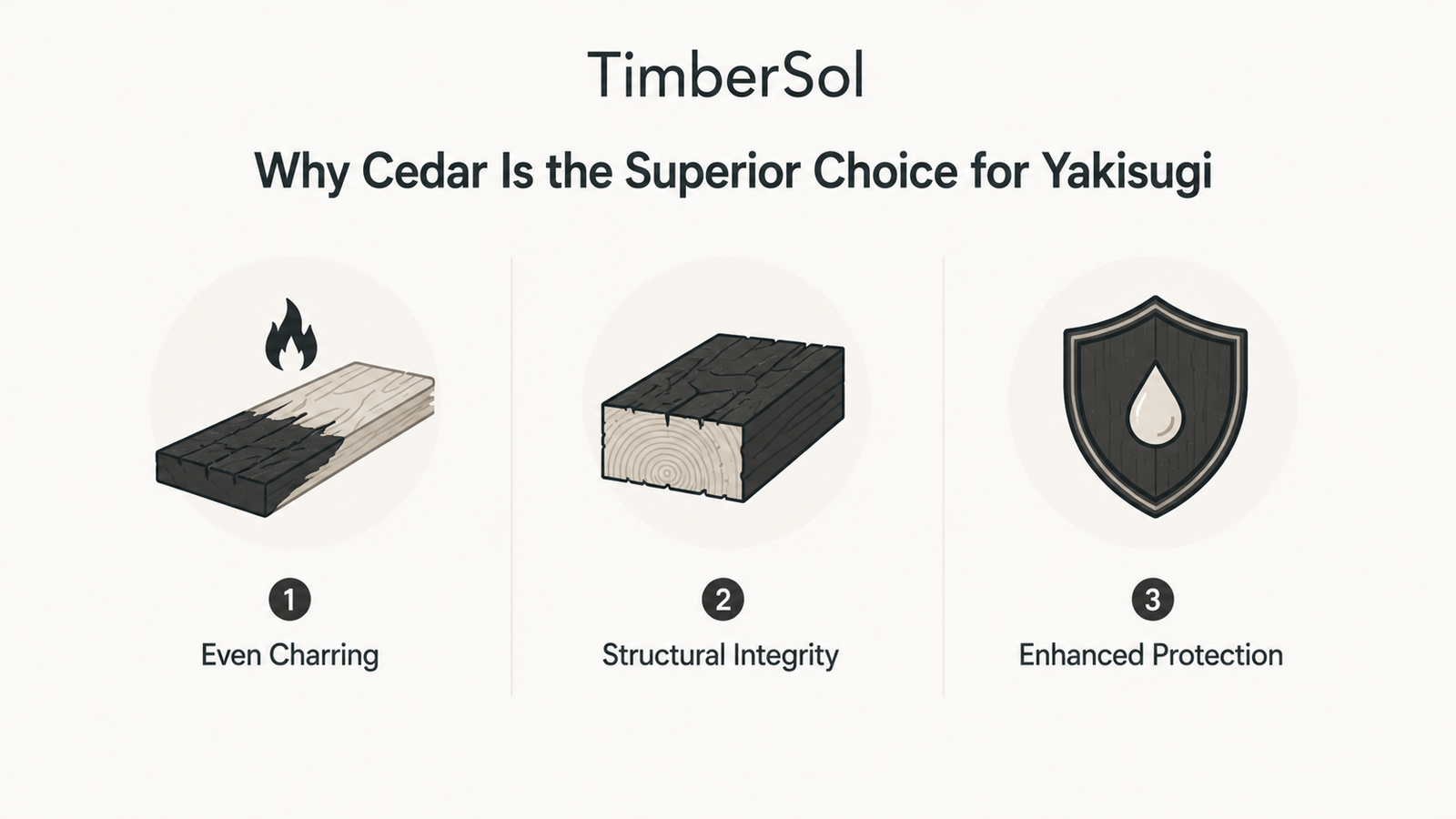
- Even Charring: The wood’s uniform grain structure ensures the flame achieves a consistent char depth across the entire board.
- Structural Integrity: Its inherent stability means the wood doesn’t become brittle or weak during the intense heat treatment.
- Enhanced Protection: The charring process takes cedar’s natural durability and dials it up, creating a product that is as resilient as it is beautiful.
Ultimately, the relationship between cedar and Yakisugi is symbiotic. The wood provides the ideal canvas, and the fire transforms it into a material that excels in both form and function—a perfect marriage of ancient artistry and modern performance.
Common Questions About Cedar Wood
Even after getting to grips with cedar’s properties, a few practical questions always seem to pop up when you’re planning a project. Let’s tackle some of the most common queries we hear, giving you the confidence to make the best decisions for your UK-based build.
Does Cedar Need Treating in the UK Climate?
It’s a great question. While cedar’s natural oils give it fantastic protection against rot, leaving it completely untreated means it will slowly weather to a beautiful, silvery-grey patina. If you’re keen to hold onto that original warm, reddish-brown colour, then a good UV-inhibiting oil or stain is the way to go.
For a finish that offers something truly special in both looks and durability, the ancient Japanese technique of Yakisugi (also known as shou sugi ban) is a superb option. Charring the surface creates an incredibly resilient, low-maintenance barrier that’s tailor-made for the unpredictable UK weather, boosting both its performance and its unique aesthetic appeal.
How Does UK-Grown Cedar Compare to Canadian Cedar?
You’ll find that British-grown Western Red Cedar is often a bit lighter in weight, with a paler, more consistent colour than its Canadian cousin. Crucially, it has that same fantastic dimensional stability and natural resistance to decay, making it a brilliant choice for any exterior work where those properties are a must.
Although its mechanical strength might be slightly less, the real win with locally grown cedar is environmental. You drastically cut down the carbon footprint from shipping and directly support our own domestic forestry industry here in the UK.
One of the most compelling reasons to specify UK-grown cedar is the measurable drop in embodied carbon. Shorter supply chains mean less fuel, fewer emissions, and a genuinely more sustainable product for your build.
Is Cedar a Good Choice for Decking?
Yes, absolutely. Cedar’s incredible stability means it’s far less likely to warp, twist, or cup—common problems for other timbers in Britain’s damp climate. This is a huge plus for decking, as it stays flat and true, giving you a safe and good-looking surface for years.
It’s worth remembering that it is a softwood, so it can be more susceptible to dents and scratches than hardwoods. For a deck that’s going to see a lot of footfall, you might want to opt for thicker boards or add a protective finish to beef up its surface durability.
Ready to bring the superior properties of cedar to your next project? At TimberSol, we specialise in creating beautiful, durable, and sustainable charred timber cladding using the Yakisugi technique. Explore our range of premium products and see how we can bring your vision to life.
