
The Ultimate Guide to Sustainability of Timber

Sustainable timber refers to wood sourced from responsibly managed forests that preserve biodiversity, support natural regeneration, and contribute to carbon sequestration—while providing a low-impact, renewable material suitable for construction and circular use.
This guide explores timber sustainability from multiple perspectives, including forest management practices, carbon storage benefits, and lifecycle impact from sourcing through to reuse. It also examines certification systems such as FSC and PEFC, compares timber with high-emission materials, and highlights the role of circular economy principles alongside techniques like Yakisugi in extending material longevity and performance.
Why Sustainable Timber is More Than Just Planting Trees
Sustainable timber goes far beyond simply planting a new tree for every one that is cut down. It’s about managing the entire forest so it remains a healthy, biodiverse, and productive environment for generations to come. While replanting is essential, true sustainability is much more complex than a basic one-in, one-out cycle.
A responsibly managed forest should be seen less as a tree farm and more as a living, interconnected ecosystem. Best practices focus on protecting soil quality, safeguarding rivers and streams, and preserving habitats for wildlife. This holistic approach ensures that forests not only survive but thrive—maximising their natural ability to absorb carbon from the atmosphere.
Timber as a Carbon Vault
One of the most significant environmental benefits of timber is its natural ability to sequester carbon. As trees grow, they absorb CO₂ from the atmosphere through photosynthesis, storing it within their trunk, branches, and roots. When this timber is harvested and used in construction, that stored carbon remains locked in for the lifespan of the building—often for decades or even centuries.
This effectively transforms buildings into “carbon vaults.” In contrast, materials such as steel and concrete require highly energy-intensive production processes that generate substantial emissions. By choosing sustainable timber, these emissions can be avoided while simultaneously creating long-term carbon storage.
By replacing carbon-intensive materials with timber, the construction industry has the potential to shift buildings from being a major source of emissions to becoming an active part of the climate solution.
The UK’s Growing Commitment to Timber
The environmental potential of timber has not gone unnoticed. In the UK, its sustainability is now a central element of the national strategy to decarbonise the construction sector. Recent data shows that woodland and tree canopy cover in England stands at 14.5%, with a government target to increase this to 16.5% by 2050.
This planned expansion aims to strengthen the UK’s role as a carbon sink while supporting progress towards net-zero goals. A key part of this strategy is increasing the use of home-grown timber in construction. Currently, only 9% of new homes in England utilise timber frames—a stark contrast to Scotland, where the figure reaches 92%. Further details can be found in the Timber in Construction Roadmap published on GOV.UK.
Understanding Responsible Forest Management
To fully understand what makes timber sustainable, it’s essential to look beyond the building site and back to its origin—the forest. Responsible forest management forms the foundation of timber’s environmental credentials. Rather than focusing on simple extraction, it represents a long-term, carefully managed approach that treats forests as complex, thriving ecosystems to be sustained for future generations.
At its core lies a clear and powerful principle.
A healthy, mature forest can be compared to a savings account, where the trees, soil, and wildlife represent the principal capital. Sustainable Forest Management (SFM) operates by harvesting only the “interest”—the natural, ongoing growth—while preserving the original capital so it can continue to regenerate.
This approach ensures that the forest’s overall health and volume are maintained over time. It shifts forestry away from short-term exploitation towards a model of responsible, long-term stewardship.
Core Practices of Sustainable Forestry
So, what does this look like in practice? Sustainable Forest Management (SFM) goes far beyond simply replanting trees. It involves a deliberate set of practices designed to maintain the forest’s complex web of life.
Key practices include:
- Selective Harvesting: Instead of clear-cutting large areas, foresters carefully remove individual or small groups of mature trees. This approach mimics natural events—such as storm damage—allowing sunlight to reach the forest floor and stimulate new growth.
- Strategic Replanting and Regeneration: After harvesting, forests are replanted with a diverse mix of native species. This is not just about replacing tree numbers, but about creating a resilient, biodiverse ecosystem that can better withstand pests, disease, and climate change.
- Protecting Biodiversity: Sustainable forestry focuses on the entire ecosystem, including safeguarding wildlife habitats, protecting streams and rivers from erosion, and preserving ancient “veteran” trees that serve as critical habitats for many species.
A truly sustainable forest is managed not only for timber production, but also for clean air, clean water, biodiversity, and recreation—making it a multi-functional resource that benefits everyone.
This holistic approach ensures that the forest can continue to function as a vital carbon sink, a habitat for wildlife, and a sustainable source of one of the world’s most important building materials.
The Global Forest and the UK Context
Understanding global forestry practices is particularly important for builders and designers in the UK. While woodland cover and timber supply are central to national sustainability goals, there is still significant progress to be made.
Currently, UK woodlands cover around 13.5% of the land area. Although this figure is gradually increasing, the UK still imports approximately 80% of its timber—making it the second-largest net importer globally, after China. Despite substantial investment in nature recovery, including over £7 billion in recent funding, woodland creation targets remain challenging to meet. You can learn more about the challenges and progress by exploring the UK’s woods and trees data from the Woodland Trust.
This reliance on imports means that decisions made within UK construction projects have far-reaching global impacts. Choosing certified, sustainably sourced timber is not just a formality—it directly supports responsible forestry practices, helping to protect biodiversity and sustain the communities that depend on forests worldwide.
By specifying and using certified timber, the UK construction industry can actively drive positive change on a global scale. It ensures that every board, beam, and panel supports a cycle of regeneration rather than depletion. Ultimately, it all comes back to one principle: responsible forest management is the non-negotiable foundation of true timber sustainability.
How to Read Timber Certifications Like FSC and PEFC
When selecting timber for a project, you’re making more than just a material choice—you’re influencing forests, communities, and the wider climate. So how can you be confident it’s the right decision? The answer lies in recognising certification labels, which act as a reliable guarantee of responsible sourcing.
These certifications function like a “good wood” standard, providing clear assurance that the timber originates from well-managed forests. They help ensure that your choice does not contribute to deforestation or unethical practices, making them an essential tool for sustainable decision-making.
The two most widely recognised certification systems are the Forest Stewardship Council (FSC) and the Programme for the Endorsement of Forest Certification (PEFC). Understanding what these labels represent is key to making informed choices with confidence.
The infographic below illustrates the growing impact of the global shift towards certified sustainable timber.
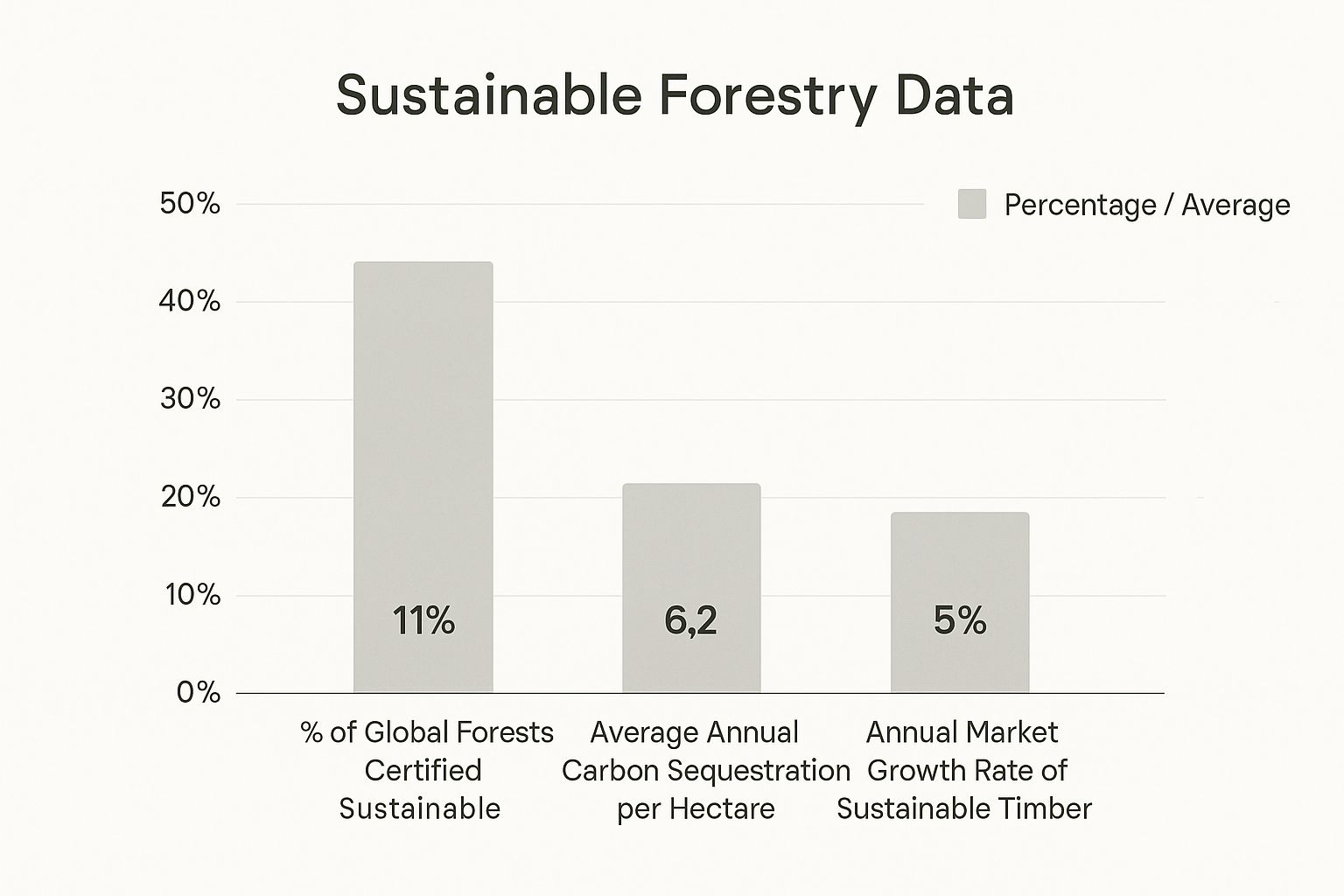
This data highlights a positive feedback loop: as demand for sustainable materials increases, the area of certified forest land expands, which in turn enhances carbon sequestration.
The Forest Stewardship Council (FSC)
The Forest Stewardship Council (FSC) is widely regarded as the global “gold standard” for responsible forestry. Established in 1993, it was created through collaboration between environmental organisations, timber industry stakeholders, and indigenous groups, all aiming to provide a credible system for identifying sustainably managed forests.
An FSC label signifies that the timber has passed a strict, independent audit. Inspectors assess everything from the protection of rare wildlife and high-conservation-value forests to ensuring that the rights of workers and local communities are upheld. It is a top-down system that applies consistent, performance-based standards worldwide, providing clear assurance of responsible sourcing.
The Programme for the Endorsement of Forest Certification (PEFC)
The Programme for the Endorsement of Forest Certification (PEFC) takes a slightly different approach. Rather than operating under a single global standard, it functions as an umbrella organisation that endorses national certification schemes. This “bottom-up” model allows countries to develop forestry standards tailored to their specific environmental conditions and social contexts.
To receive PEFC endorsement, national systems must meet rigorous international benchmarks. This flexibility has enabled PEFC to become the world’s largest forest certification system by area. In the UK, for example, the PEFC-endorsed standard is the UK Woodland Assurance Standard (UKWAS).
Ultimately, choosing either FSC or PEFC-certified timber represents a strong commitment to sustainability. Both systems ensure that forestry practices protect biodiversity, respect local communities, and maintain long-term forest health.
These certifications form part of a broader sustainability framework. To understand how they integrate with systems such as BREEAM and LEED, it is worth exploring a dedicated guide to sustainable building certifications.
FSC vs PEFC: A Quick Comparison Guide
This comparison table is designed to give you a clear, at-a-glance understanding of the key differences between FSC and PEFC, helping you recognise what each certification stands for when selecting timber.
| Feature | FSC (Forest Stewardship Council) | PEFC (Programme for the Endorsement of Forest Certification) |
|---|---|---|
| Approach | A single, global standard applied directly to forests worldwide, creating a consistent ‘gold standard’. | An international umbrella that endorses various national certification systems, offering flexibility. |
| Governance | Governed by three chambers (environmental, social, and economic) with equal voting power. | Governed by its national members, primarily representing forestry and industry interests. |
| Chain of Custody | Requires a minimum of 70% certified fibre for its ‘FSC Mix’ label, the most common type. | Requires a minimum of 70% certified fibre for its ‘PEFC Certified’ label. |
| Best For | Projects demanding the highest level of internationally recognised environmental and social assurance. | Projects where supporting national-level forestry standards and small landowners is a priority. |
At the end of the day, both certifications are driving forestry in a positive direction. The choice often comes down to your project’s specific goals and the availability of certified materials in your area.
Timber’s Journey From Carbon Sink to Circular Product
To fully understand timber’s sustainability, it’s important to look beyond the forest and consider its entire lifecycle. This process—known as Life Cycle Analysis (LCA)—reveals how timber performs environmentally at every stage, from a living tree to a completed building and even into reuse. It begins with a natural process that is both simple and highly impactful.
A tree can be thought of as a natural carbon vault. Through photosynthesis, it absorbs carbon dioxide from the atmosphere and stores that carbon within its structure. This process, known as carbon sequestration, acts as a natural form of carbon capture, with the tree retaining this carbon throughout its lifetime.
From Forest Floor to Building Frame
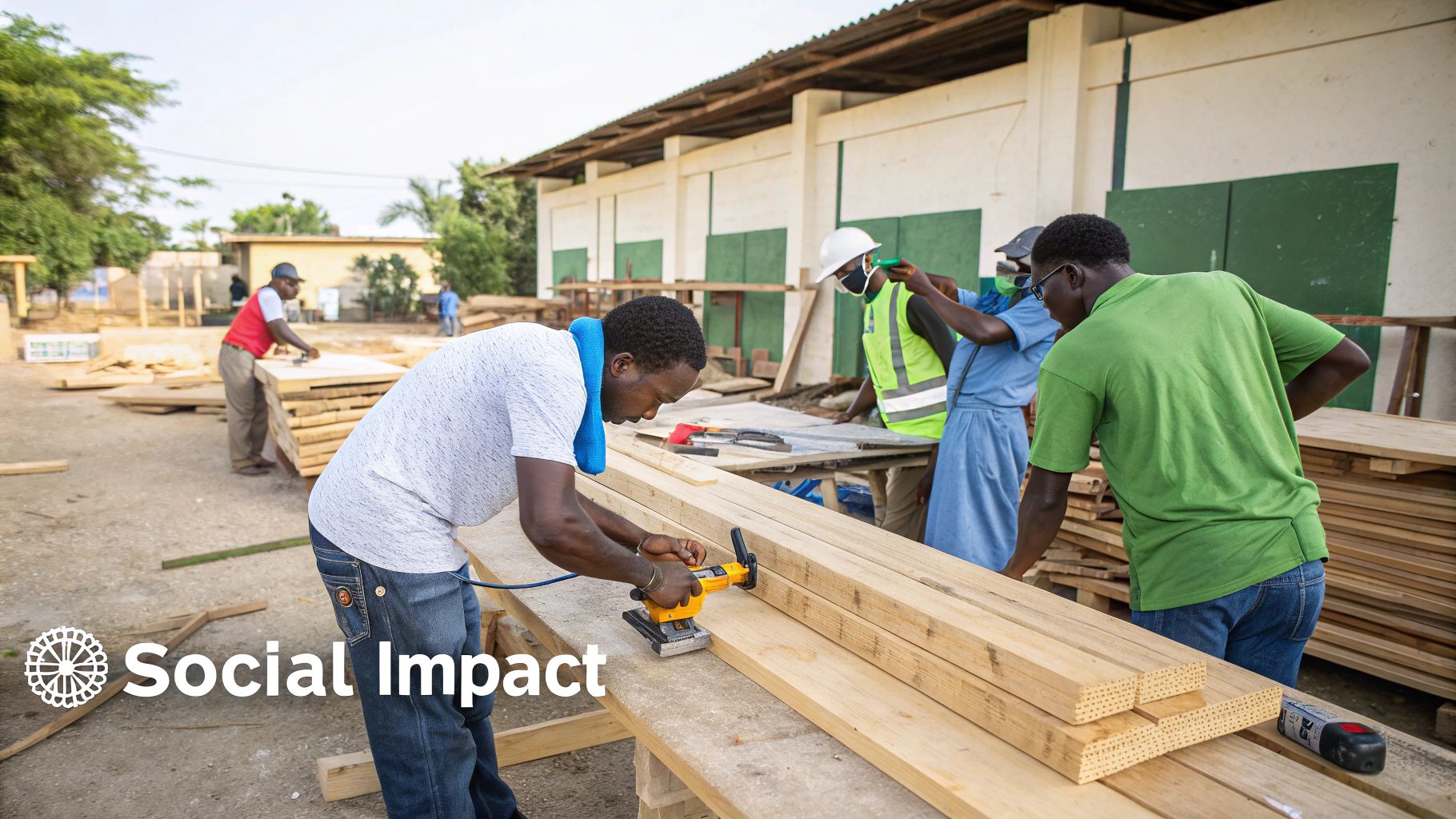
When a tree is harvested from a responsibly managed forest, the carbon it has stored does not disappear—it remains locked within the timber. From there, the material moves to the sawmill, where processing is highly efficient, requiring significantly less energy than the production of materials such as steel or concrete, which are associated with high industrial emissions.
As the timber is used in construction—whether for structural frames, cladding, decking, fencing or flooring—it continues to function as a carbon store. Timber-framed buildings can retain substantial amounts of sequestered carbon for decades, or even centuries, effectively turning the structure into a long-term carbon sink. To get a better sense of the wider carbon impact of building materials, you can explore guides on carbon accounting in construction and real estate.
This lifecycle is what distinguishes timber. It not only reduces emissions by replacing carbon-intensive materials, but also actively removes carbon from the atmosphere and stores it.
By tracking timber from forest to final use, it becomes clear that it is not just carbon-neutral—it is often carbon-negative. The amount of carbon stored within the wood in a building can exceed the total emissions produced throughout its production and construction stages.
Closing the Loop with a Circular Economy
The lifecycle of timber does not end when a building is dismantled. Through the principles of a circular economy, its value can be extended, preventing waste and maximising its environmental benefits. Timber’s end-of-life pathways demonstrate a high level of material efficiency.
This circular process can take several forms:
- Reuse: The most sustainable option is to reclaim whole timber elements. Structural components such as beams, floorboards, and cladding can be carefully removed and incorporated into new projects, preserving both their structural value and stored carbon.
- Repurpose: When structural reuse is not possible, timber can be adapted for new applications. For example, old joists can be transformed into furniture, decorative features, or flooring, ensuring continued use and carbon retention.
- Recycle: If direct reuse is not feasible, timber can be processed into secondary materials such as particleboard, oriented strand board (OSB), or wood pulp for paper production.
In the UK, the construction sector is already demonstrating strong progress in this area. Approximately 81% of construction timber is reused or recycled rather than sent to landfill—significantly outperforming materials like concrete, which stands at around 59%. Even when timber is downcycled into products such as animal bedding or biomass fuel, it remains out of landfill, reducing the risk of methane emissions.
This ability to be reused, repurposed, and recycled makes timber a true champion of the circular economy. For a practical example of this principle in action, reclaimed lumber siding demonstrates how existing timber can be transformed into a visually striking and functional material. By extending its useful lifespan, the carbon stored within the wood remains locked away for longer, completing a genuinely sustainable cycle.
How Yakisugi Aligns With Sustainable Design
Yakisugi is a centuries-old technique that aligns seamlessly with modern sustainable design, enhancing the natural durability of timber without compromising its environmental credentials.
At its core, Yakisugi uses a natural process to protect the material itself, as seen in premium solutions such as charred accoya cladding. By carefully charring the outer layer of timber planks, it creates a durable, carbonised surface that acts as a protective shield. This transformation not only delivers a striking visual finish but also significantly improves the wood’s resilience. Importantly, it eliminates the need for chemical preservatives, paints, or synthetic sealants that may release harmful substances into the environment over time.
The Ultimate Natural Preservative
The effectiveness of Yakisugi lies in how the charring process fundamentally transforms the wood’s properties. The resulting carbonised surface acts as a durable protective barrier against the primary causes of timber degradation, significantly extending lifespan while reducing the need for ongoing maintenance or replacement.
This process provides three key forms of natural protection:
- Pest Resistance: The charred surface is unappealing to insects such as termites and wood-boring beetles, naturally deterring infestation.
- Rot and Moisture Defence: Charring seals the wood’s pores, increasing resistance to water ingress. This limits the conditions required for fungal growth and rot.
- Enhanced Fire Retardancy: Although counterintuitive, the char layer improves fire performance by acting as an insulating barrier, slowing ignition of the underlying wood.
By removing the need for repeated chemical treatments, Yakisugi-treated timber maintains a cleaner environmental profile, ensuring that the sustainability benefits achieved at the sourcing stage are preserved in the built environment.
Durability Meets Aesthetics in Green Building
The appeal of Yakisugi in sustainable architecture extends beyond its practical advantages, with applications ranging from feature facades to charred douglas fir cladding. The technique creates a rich, textured finish that reflects natural processes and highlights the inherent character of the timber. This aligns closely with the principles of green design, where longevity and low environmental impact are key.
For architects and builders focused on sustainability, Yakisugi offers a material that is both highly durable and fully biodegradable at the end of its lifecycle. Unlike chemically treated timber, which can present disposal challenges, Yakisugi remains a natural product. Its extended lifespan reduces material waste and lowers the demand for new resources, reinforcing circular economy principles.
For a deeper understanding of this method, exploring a detailed guide to the Yakisugi technique can provide valuable insight. Ultimately, it demonstrates how traditional practices continue to offer effective solutions for modern construction.
Building a Better Future With Sustainable Timber
When you look closely at what makes timber sustainable, a clear and powerful idea emerges: choosing wood is not just a material decision—it’s an investment in an entire system. This system begins in responsibly managed forests and continues through to buildings that actively contribute to climate solutions. It reflects a deliberate approach that connects sustainable forestry with thoughtful design.
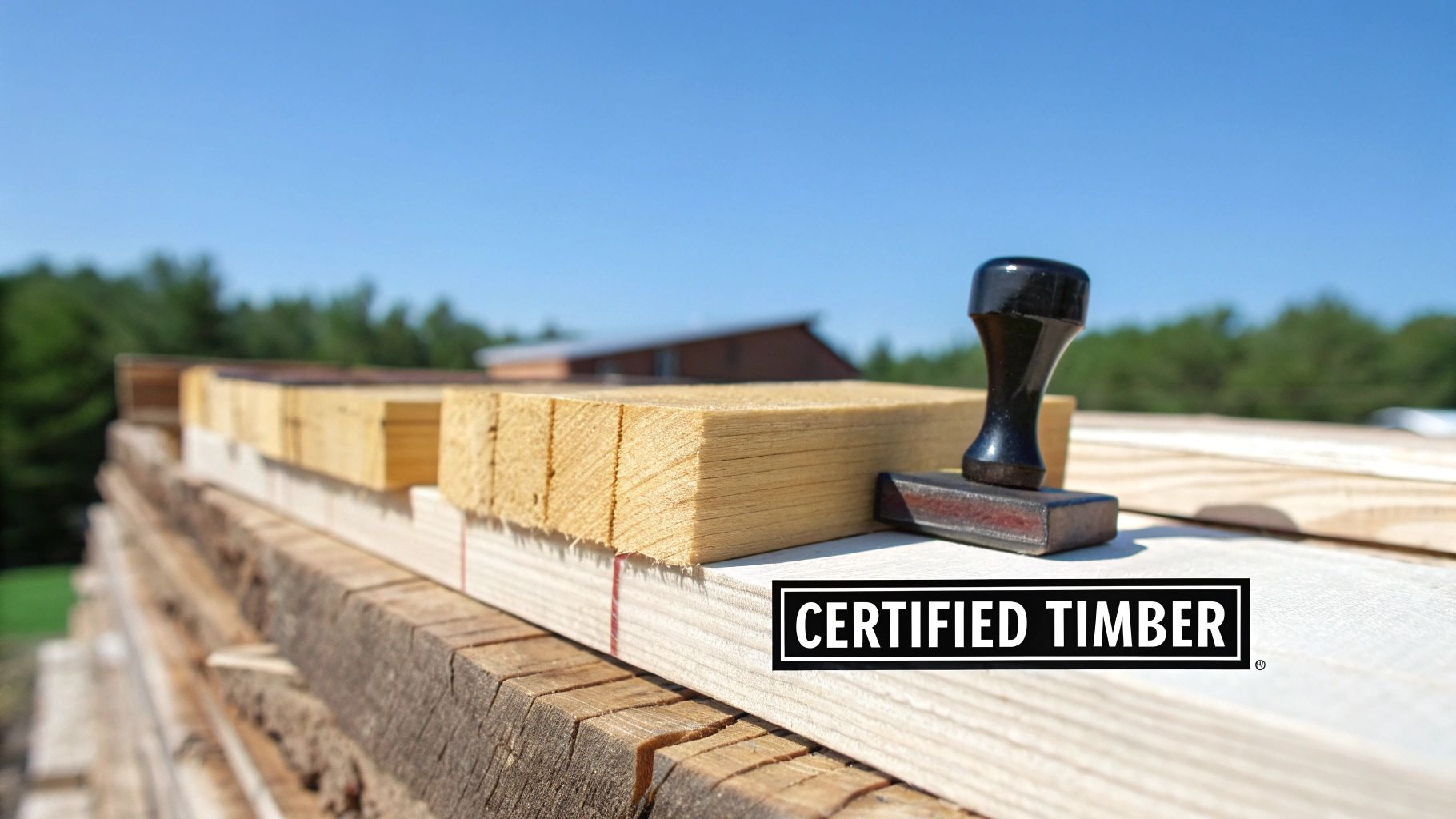
At the core of this approach is a non-negotiable foundation: certified forestry. Certification schemes such as FSC and PEFC provide assurance that timber is sourced from forests managed with a strong focus on biodiversity, regeneration, and community wellbeing. This responsible sourcing forms the essential first link in a chain of positive environmental impact.
From Carbon Vaults to Lasting Value
Another defining advantage of timber is its ability to store carbon. Acting as a natural carbon vault, every beam, joist, and plank within a building contains captured CO₂, securely locked away for the lifespan of the structure. This characteristic fundamentally shifts buildings from being sources of emissions to functioning as carbon sinks.
However, the sustainability story does not end there. A comprehensive approach also embraces the principles of the circular economy—designing with the intention that timber can be reused, repurposed, or recycled, extending its value well beyond its initial application.
By making informed and responsible choices, the built environment can be reshaped. Specifying certified, sustainably sourced timber sends a clear signal that environmental responsibility is as important as structural performance.
At the same time, traditional knowledge continues to influence modern sustainable design. Techniques such as Yakisugi (also known as shou sugi ban) demonstrate how timber’s durability can be enhanced naturally, without the need for harmful chemicals. Through controlled charring, the wood becomes both visually distinctive and highly resilient—showing that the most effective solutions often work in harmony with nature rather than against it.
A Call to Conscious Construction
The case for timber is compelling. For architects, builders, and homeowners, it offers a practical pathway towards a more sustainable built environment. The key is to make informed choices—seeking out certification labels, understanding the material’s full lifecycle, and recognising its unique ability to store carbon.
Timber is more than just a construction material; it is a vital tool for creating buildings that are not only aesthetically pleasing and durable, but also climate-positive. By prioritising its responsible use, we are not simply constructing buildings—we are contributing to a more sustainable future.
Still Have Questions About Sustainable Timber?
Even after exploring forest management practices and certification systems, it’s natural for a few questions to remain. Below, we address some of the most common queries to help you feel fully confident when choosing timber for your next project.
Surely Using Wood for Buildings Harms Forests, Right?
No—provided the timber is sourced from responsibly managed forests. The principle behind sustainable forestry is straightforward: harvesting is carefully controlled so that it never exceeds the forest’s natural ability to regenerate. This ensures that woodland remains healthy, with its overall volume maintained or even increased over time.
From an economic perspective, strong demand for sustainable timber creates a powerful incentive for landowners to maintain forested land. It reduces the pressure to convert valuable woodland into farmland or urban development.
This is why certifications such as FSC and PEFC are so important. They provide clear assurance of responsible forest management. By choosing certified timber, you are not just selecting a material—you are actively supporting the protection of global forests.
How Does Timber Really Stack Up Against Steel and Concrete?
When it comes to environmental impact, timber significantly outperforms traditional materials like steel and concrete. The production of steel and concrete is highly energy-intensive and generates substantial carbon emissions. For example, cement production alone accounts for roughly 8% of global CO₂ emissions.
Timber, by contrast, offers the opposite effect. As a renewable material, it absorbs CO₂ from the atmosphere during growth through carbon sequestration. This carbon remains stored within the wood for the entire lifespan of the building.
As a result, timber-framed structures not only reduce emissions by avoiding carbon-intensive materials but also act as long-term carbon sinks. This gives them a considerably lower initial carbon footprint compared to buildings constructed with steel or concrete.
Is Hardwood a More Sustainable Choice Than Softwood?
Both hardwoods (from broadleaf trees such as oak and ash) and softwoods (from conifers like pine and cedar) can be equally sustainable options. The key practical difference lies in their growth rate—softwoods generally grow much faster, making them a more quickly renewable resource, particularly for large-scale construction.
However, the most important factor is its source. Certification remains the true benchmark of sustainability. Whether choosing hardwood or softwood, FSC or PEFC certification is what ensures the timber has been sustainably sourced, including materials used for douglas fir wood cladding.
Does Treating Timber Make It Less Environmentally Friendly?
It can, depending on the treatment method used. Traditional chemical pressure treatments often rely on substances that may complicate recycling and, over time, can leach into the surrounding environment.
However, more environmentally friendly alternatives are increasingly available, including thermally modified options and exterior solutions such as spruce cladding. Methods such as thermal modification use heat to enhance durability, while natural techniques like Yakisugi (shou sugi ban) protect the wood through controlled charring rather than chemicals.
These approaches extend the lifespan of timber without compromising its environmental performance. Choosing non-toxic treatments or naturally durable timber species is generally the most sustainable option, helping maintain the material’s overall green credentials.
At TimberSol, we are committed to delivering timber solutions that combine outstanding aesthetics with genuine sustainability. With specialist expertise in the Yakisugi technique, we offer products that achieve both striking visual appeal and exceptional durability—without compromising environmental responsibility. Explore our range of charred timber solutions at https://timbersol-backup.elnoirstudio.com.
