
Charred Wood Blog
Ultimate Guide to Green Building Certification Requirements

So, what exactly are green building certification requirements? Put simply, they’re the specific benchmarks a project needs to hit to earn a credential like BREEAM or LEED. These standards are a formal way of proving a building’s environmental performance.
The criteria cover a huge range of factors, from the obvious ones like energy efficiency and sustainable material sourcing right through to water conservation and even the quality of the indoor air.
Why Green Building Certifications Matter in the UK
Diving into sustainable construction can feel a bit overwhelming at first. The best way to get your head around it is to understand why these frameworks exist in the first place. Don’t think of green building certifications as just another box to tick; see them as proven roadmaps for creating buildings that are simply better – more valuable, more efficient, and healthier for everyone who uses them.
What they really offer is a structured, independently verified way to approach sustainable design. This moves us away from vague “eco-friendly” claims and towards real, measurable results, which is becoming essential as both regulations and public expectations get tougher.
Driving Value and Responsibility
The big push towards certified green buildings isn’t happening by accident. For developers and investors, the numbers just add up. Certified properties consistently fetch higher prices, attract top-tier tenants, and cost less to run thanks to smart energy and water management.
But it’s not just about the money. Pressure is coming from all sides:
- Government Regulations: With stricter energy codes and environmental targets, building sustainably is quickly shifting from a “nice-to-have” to a “must-do.”
- Investor Demands: Environmental, Social, and Governance (ESG) criteria are no longer a footnote. They’re now at the heart of major investment decisions, and a certification is the gold standard for proving a building’s green credentials.
- Occupant Wellbeing: People are far more conscious of how their surroundings affect their health. Today’s tenants and buyers want spaces with clean air, plenty of natural light, and materials that aren’t off-gassing harmful chemicals.
A green certification acts as a universal language of sustainability. It communicates a clear commitment to quality, performance, and long-term resilience, distinguishing a property in a competitive marketplace.
You can see this momentum in the market forecasts. The UK’s green building market is set to grow substantially, hitting a valuation of around USD 17.1 billion by 2033 with a compound annual growth rate of 11.10%. You can discover more about the UK’s green building market growth and its key drivers. At the end of the day, these frameworks guide us towards making smarter choices, setting the stage for true excellence in sustainable construction.
Breaking Down BREEAM Certification Requirements
Here in the UK, if you’re talking about sustainable construction, you’re talking about BREEAM. It’s the original green building standard and the one that truly sets the benchmark. Think of it less as a strict rulebook and more as a comprehensive scorecard that assesses a building’s performance from its initial design right through to its long-term use.
The whole system is built around credits. A project is evaluated against a set of targets across ten core categories, and for every sustainable choice made, it earns credits. The more credits you rack up, the better your final rating. This credit-based approach is one of the key green building certification requirements under BREEAM, encouraging project teams to think about sustainability from every possible angle.
The Ten Core BREEAM Categories
BREEAM takes a wide-lens view of what makes a building ‘green’, covering everything from the building’s impact on local wildlife to how comfortable it is for the people inside. Each of these categories is weighted differently, reflecting how critical it is to the overall picture of sustainability.
Here are a few of the big ones:
- Energy: This is often the heaviest hitter, focusing on slashing CO₂ emissions and making the building as energy-efficient as possible once it’s up and running.
- Health and Wellbeing: A crucial category that looks at creating a healthy indoor space. This means thinking about air quality, access to natural light, and thermal comfort.
- Materials: This is all about specifying responsibly sourced, low-impact materials. Having clear lifecycle data for your chosen products is absolutely vital here.
- Water: Credits are awarded for smart measures that cut down on water use, like installing efficient fixtures or setting up rainwater harvesting systems.
- Waste: This category rewards projects that have a solid plan to minimise construction waste and promote recycling and reuse on site.
Other categories—Land Use & Ecology, Pollution, Transport, Management, and Innovation—all add to the final score, painting a complete picture of a building’s green credentials.
How BREEAM Ratings Are Achieved
Once all the credits are tallied up, the total score determines the final BREEAM rating, which ranges from ‘Pass’ all the way up to ‘Outstanding’. Getting one of the higher ratings isn’t something you can tack on at the end; it demands careful, strategic planning right from the very first design sketches. The project team has to sit down and figure out which credits are achievable and will deliver the biggest impact for their specific build.
BREEAM works like a flexible roadmap. It doesn’t force every project down the same narrow path. Instead, it offers dozens of ways for a building to prove its commitment to sustainability, leaving room for creativity and clever, site-specific solutions.
This isn’t just about doing the right thing for the environment, either—it has a real financial upside. In the UK market, a BREEAM certificate can seriously boost a property’s value. In fact, certified developments have shown a 20.6% higher capital value compared to their non-certified counterparts.
Getting through the BREEAM process means weaving sustainability into every decision, from choosing the plot of land to the materials you use for the cladding. For a closer look at how BREEAM stacks up against other frameworks, our guide on understanding various sustainable building certifications is a great place to start. In the end, BREEAM gives us a respected and powerful framework for creating buildings that are not only better for the planet but are also more valuable assets.
Navigating International LEED Requirements
While BREEAM is the long-established standard here in the UK, projects with an international flavour often look to another global heavyweight: LEED. Developed in the United States, Leadership in Energy and Environmental Design is arguably the most widely used green building rating system in the world. It gives us a universally recognised benchmark for what ‘sustainable’ truly means.
Think of LEED like a building’s final report card. It judges performance across several key areas, but before a project can even begin to earn points, it must clear a series of non-negotiable prerequisites. These are the absolute must-haves for every single LEED project, ensuring a solid baseline of sustainable practice is baked in from day one.
Understanding LEED Credit Categories
Once those prerequisites are ticked off, the project team can start chasing credits across various categories to build up its final score. This is where a building really proves it has gone above and beyond the minimum green building certification requirements.
The main categories are:
- Sustainable Sites: This looks at the building’s relationship with its surroundings. It rewards smart site selection and design that treads lightly on local ecosystems.
- Water Efficiency: Credits here are earned for clever strategies that slash both indoor and outdoor water use.
- Energy and Atmosphere: A huge part of the assessment, this category targets major reductions in energy consumption, champions renewable energy, and promotes top-tier building performance.
- Materials and Resources: This rewards the use of sustainably sourced materials, cutting down on construction waste, and thinking about the entire lifecycle of the products used.
- Indoor Environmental Quality: Points are given for creating healthier indoor spaces—think better air quality, plenty of natural daylight, and comfortable temperatures for the people inside.
This graphic breaks down how specific efficiency measures add up to overall energy savings in certified buildings.
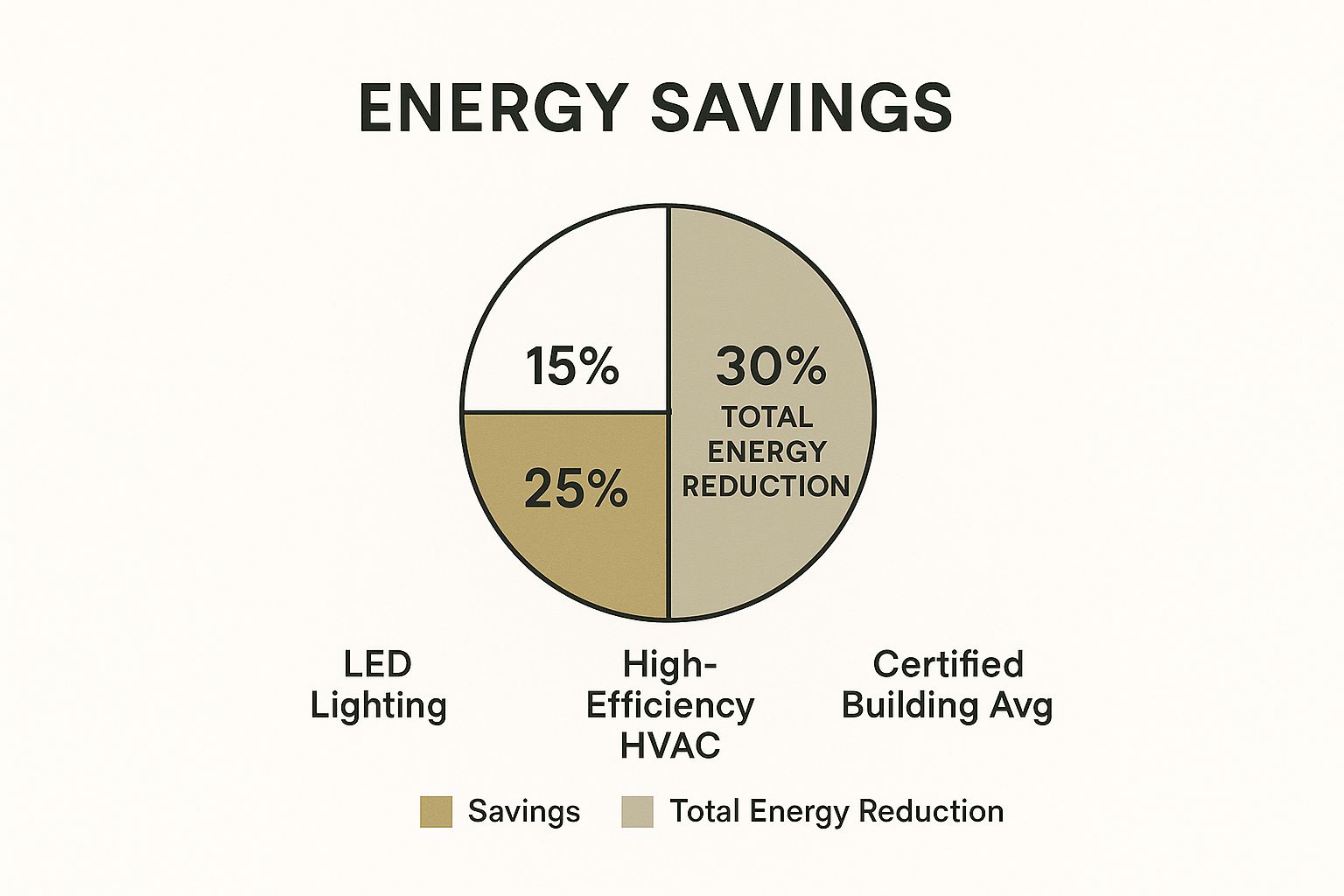
As you can see, while individual upgrades like efficient lighting or a new HVAC system make a big difference, it’s the combined, holistic approach of a fully certified building that delivers the most impressive energy savings.
BREEAM vs LEED At a Glance
For those of us in the UK, it’s helpful to see how these two leading schemes stack up against each other. They have similar goals but take slightly different paths to get there.
| Feature | BREEAM | LEED |
|---|---|---|
| Origin | UK (Building Research Establishment) | USA (U.S. Green Building Council) |
| Scoring Focus | More prescriptive. Sets fixed performance benchmarks that projects must meet. Less flexible but offers clear targets. | More performance-based. Projects must meet mandatory prerequisites, then can choose which credits to pursue. |
| Primary Market | The dominant standard in the UK and has strong traction across Europe. Increasingly used worldwide. | The globally recognised leader, especially in North America and Asia. Often the standard of choice for international projects. |
Ultimately, both are fantastic frameworks. The choice often comes down to the project’s location, its intended market, and the specific sustainability goals of the client.
Achieving LEED Certification Levels
Just like that school report card, a project’s final grade is all about the total score. The more points a building racks up across the different credit categories, the higher the certification level it achieves.
LEED provides a clear, internationally understood language for sustainability. For UK-based firms working on projects with global partners or tenants, achieving a high LEED rating sends an unmistakable message of quality and environmental commitment.
The system is tiered into four distinct levels of achievement:
- Certified: 40–49 points
- Silver: 50–59 points
- Gold: 60–79 points
- Platinum: 80+ points
For UK teams more familiar with BREEAM’s approach, getting to grips with this point-based structure is the first step. It offers a flexible yet demanding path, allowing projects to shine on a globally respected stage and guiding every decision towards a truly world-class standard.
Meeting Health and Wellbeing Requirements with WELL
For a long time, certifications like BREEAM and LEED have rightly focused on a building’s impact on the planet. But there’s been a powerful shift in thinking, one that puts people squarely at the centre of design. Today’s green buildings aren’t just about saving energy; they’re about creating spaces that help people feel healthier and happier.
This is where the WELL Building Standard steps in.
It’s best to see WELL not as a rival to LEED or BREEAM, but as a crucial partner. It offers a detailed roadmap for achieving green building certification requirements by looking at everything through the lens of human health. Developed by the International WELL Building Institute (IWBI), it shifts the conversation from kilowatt-hours to personal wellbeing, ensuring our buildings support us both biologically and psychologically.
WELL is a performance-based system that measures, verifies, and monitors the parts of a building that directly affect our health, all organised around ten core concepts.
The Ten Concepts of WELL
The WELL standard is built on a holistic view of health, covering everything from the quality of the air we breathe to our mental state. To get certified, a project has to meet a set of mandatory preconditions for each concept, and can then aim for a higher score by adding optional optimisations.
Here’s what it covers:
- Air: This is all about ensuring clean air through proper filtration, good ventilation, and cutting down on indoor pollutants. A classic example is using paints and finishes with low levels of Volatile Organic Compounds (VOCs).
- Water: Promotes safe, clean water with effective filtration systems and easy-to-find drinking water stations.
- Nourishment: Encourages healthier eating by making nutritious food easier to find and access within the building.
- Light: Emphasises access to natural daylight and designing lighting systems that support our body’s natural circadian rhythms.
- Movement: Nudges people towards physical activity through smart design choices, like making staircases inviting and easy to use.
- Thermal Comfort: Ensures everyone is comfortable by giving them more control over their own little corner of the building’s temperature.
- Sound: Works to minimise distracting noise, creating an acoustic environment where people can actually focus and get things done.
- Materials: Aims to reduce our exposure to hazardous building materials by championing safer, non-toxic products.
- Mind: Supports our mental and emotional health through design that reduces stress and improves our mood.
- Community: Helps build a sense of belonging and social equity, both inside the building and in the wider neighbourhood.
WELL is fundamentally about designing spaces that don’t just avoid harming us, but actively help us thrive. It acknowledges that the buildings where we spend 90% of our time are one of the most powerful tools we have for supporting public health.
By layering this human-centric approach on top of the environmental focus of other standards, WELL creates a more complete picture of what a “good” building is. A project can earn both BREEAM and WELL certification, proving it’s not only good for the planet but genuinely good for the people inside. This dual focus is truly the future of sustainable design.
Using Sustainable Materials to Meet Certification Goals
It’s one thing to understand the theory behind green building certifications, but it’s another thing entirely to apply it on a live project. The bridge between those two worlds is intelligent material selection. In fact, choosing the right materials is one of the most direct ways you can meet specific green building certification requirements, transforming abstract targets into tangible, credit-earning features.
A perfect example is the rising popularity of charred timber, a technique also known as Yakisugi. This traditional Japanese method does more than just create a stunning, dark finish. It’s a natural process that enhances the wood’s inherent performance, helping it tick boxes across multiple certification categories without a single chemical additive.
How Charred Timber Aligns with Certification Credits
When architects and builders specify a material like charred timber, they’re making a strategic move that can target credits in the most influential green building schemes. It’s a single decision with a ripple effect across a project’s entire sustainability scorecard.
Let’s break down how this works in practice:
- Materials and Resources (LEED & BREEAM): Certification bodies place a huge emphasis on responsibly sourced materials. Using timber from sustainably managed forests—a core principle for any reputable supplier—directly contributes to credits in this category. Wood is also a renewable resource that sequesters carbon, a massive plus in lifecycle assessments (LCA).
- Pollution and Health (BREEAM & WELL): The charring process makes timber incredibly resistant to rot, pests, and moisture. Because of this natural durability, there’s no need for chemical preservatives or toxic coatings. This is a big win, helping projects earn points for avoiding pollutants and using materials with low VOCs (Volatile Organic Compounds).
This choice lines up beautifully with the standards set by BREEAM, LEED, and WELL, all of which reward projects for cutting down on harmful chemicals to create healthier spaces.
Choosing a material like charred timber isn’t just a design choice; it’s a certification strategy. Its inherent properties—sustainably sourced, naturally durable, and non-toxic—directly translate into verifiable credits that push a project closer to its sustainability targets.
Connecting Materials to Biophilic Design
Beyond its technical performance, the unique aesthetic of charred timber plays another crucial role. Its rich texture and natural pattern are a direct nod to the principles of biophilic design—the practice of weaving nature into our buildings to improve human wellbeing.
This is especially relevant for the Health and Wellbeing categories in BREEAM and the Mind concept in the WELL standard. We know that creating spaces with a strong connection to nature can reduce stress and improve focus. By using materials that evoke natural patterns and processes, a project not only earns valuable credits but also creates a more restorative and engaging environment for the people inside.
Ultimately, smart material specification is where green building theory becomes reality. By exploring the full benefits of eco-friendly construction materials, project teams can make informed decisions that satisfy both their design ambitions and the tough demands of certification schemes. It just goes to show how a single, well-considered choice can be a powerful tool for achieving top-tier sustainability ratings.
Understanding UK Building Regulations and Future Trends
While certifications like LEED and BREEAM show a commitment to going above and beyond, they don’t exist in a vacuum. Here in the UK, they sit on top of a solid foundation of mandatory government regulations that every project must meet.
These rules are all about pushing the energy efficiency of our national building stock, setting a legal baseline for performance that everyone has to follow. The two big ones that every developer, architect, and property owner needs to have on their radar are the Minimum Energy Efficiency Standards (MEES) for commercial properties and the ever-present Energy Performance Certificates (EPCs).
Think of an EPC as a property’s energy report card, grading it from ‘A’ (the star pupil) down to ‘G’ (needs improvement). This isn’t just a nice-to-have certificate; the MEES regulations give it real teeth. It’s now illegal to grant new leases for commercial buildings with an EPC rating below ‘E’.
And it’s not just the commercial sector. Residential buildings are under the microscope too. As of early 2024, the average home in England and Wales sat at a ‘D’ rating, which tells you there’s a massive opportunity for improvement right across the country. You can discover more insights on UK home energy performance to see the full picture.
The Next Wave of Sustainable Construction
Looking past today’s rules, the entire conversation around sustainable construction is getting much more sophisticated. We’re moving beyond just how much energy a building uses day-to-day and starting to look at its total lifetime impact.
The focus is shifting from simply making buildings less bad to designing structures that are genuinely restorative and regenerative. This means considering the entire lifecycle impact from day one.
These are the trends that are quickly moving from niche concepts to standard practice:
- Embodied Carbon: This is a huge one. It’s all about the hidden carbon footprint of a building – the emissions released from manufacturing, transporting, and assembling the materials themselves.
- Net-Zero Buildings: The ultimate prize. We’re talking about creating buildings that generate as much renewable energy on-site as they consume over the course of a year, effectively zeroing out their operational impact.
- Smart Technology Integration: Buildings are becoming living, breathing systems. Expect to see more sensors, AI, and smart controls that actively manage energy use, tweak air quality, and keep occupants comfortable without wasting a single kilowatt.
Frequently Asked Questions
When you start digging into sustainable construction, a lot of practical questions naturally come up. Getting your head around the differences between the various schemes is the first step to making the right call for your project.
Here, we’ll tackle some of the most common queries we hear about green building certification requirements, giving you straightforward answers to help you move forward.
Which Green Building Certification Is Best For My UK Project?
For most projects here in the UK, BREEAM is the go-to standard. It’s the one local authorities and industry professionals know inside and out, making it a familiar and reliable choice across the country.
That said, if your project is for a global company, aims to attract international tenants, or you’re chasing worldwide recognition, LEED is a fantastic option. And if the health and wellbeing of the people inside is your number one priority, the WELL Building Standard is unmatched. It’s often used in tandem with BREEAM or LEED to add that crucial human-centric layer.
How Much Does Green Building Certification Cost?
This really depends. The final figure is shaped by your project’s size, its complexity, and the certification level you’re aiming for. The main costs you’ll need to account for are registration and assessment fees, the expense of bringing a qualified assessor on board, and the time your team will spend on documentation.
While there’s an initial investment, certified buildings often pay it back and then some. They typically have lower running costs, command higher property values, and are far more attractive on the market, which can easily offset the upfront expense over the building’s life.
Can Existing Buildings Achieve Green Certification?
Yes, absolutely. All the major certification schemes have specific frameworks for retrofitting and improving existing buildings.
BREEAM In-Use is designed precisely for this, helping assess and upgrade the performance of commercial buildings already in operation. Likewise, LEED for Operations and Maintenance (O+M) focuses on making buildings that are already up and running more efficient. Getting an existing building certified is a brilliant way to slash its environmental footprint and boost its long-term value. For more detailed answers, you can explore our full list of frequently asked questions on sustainable building.
Ready to meet your project’s sustainability goals with materials that make a difference? TimberSol offers premium charred timber solutions that align perfectly with BREEAM, LEED, and WELL requirements. Discover our range of sustainable cladding and decking at https://timbersol-backup.elnoirstudio.com.
