
Top Sustainable Building Certifications for Eco-Friendly Projects

Think of sustainable building certifications as an official stamp of approval for a property’s green credentials. They act a bit like a nutrition label on food, offering a clear, third-party verification of a building’s environmental performance.
Instead of just taking a builder’s word for it, these frameworks provide a structured pathway to create spaces that are genuinely energy-efficient, mindful of resources, and healthier for the people inside. They swap vague claims for tangible, proven results.
What Are Sustainable Building Certifications?

At their heart, these certifications are detailed programmes that measure a building against a tough set of environmental and social benchmarks. They aren’t just a shiny plaque you get at the end; they’re more like a comprehensive roadmap that guides a project from the earliest design sketches right through to construction and daily operation.
An independent body carries out a detailed assessment, scrutinising every decision and material. The whole point is to move past abstract green goals and turn them into measurable achievements, all backed by solid data. Following one of these frameworks helps architects and developers systematically tackle every aspect of a building’s environmental footprint.
What Do These Certifications Actually Measure?
While each certification has its own unique flavour, they all tend to look at a building’s performance across a few core areas. It’s a holistic approach, ensuring a “green” building is sustainable from every angle.
Here’s what they typically dig into:
- Energy Efficiency: How well does the building keep energy use to a minimum? This covers everything from insulation and high-performance windows to efficient heating systems and on-site renewables.
- Water Conservation: They look for smart water use, like water-saving taps and toilets, systems for harvesting rainwater, and landscaping that doesn’t guzzle water.
- Material Selection: The focus is on using recycled, renewable, and locally sourced materials. You can find out more about these in our guide to eco-friendly construction materials.
- Indoor Environmental Quality: This is all about the health and wellbeing of occupants—assessing air quality, natural light, and even acoustics.
- Waste Management: This includes strategies for reducing waste during construction and putting effective recycling programmes in place for when the building is up and running.
These frameworks provide a crucial layer of accountability. They transform a developer’s promise of a “green building” into a verified, transparent, and trustworthy credential that holds genuine market value.
Why They Matter More Than Ever in the UK
Here in the UK, the drive for better, more efficient buildings is gaining serious momentum. The reality is, most homes in England and Wales currently sit at a mediocre ‘D’ rating for energy efficiency, which shows just how much work there is to do.
But there’s good news. A promising 357,000 homes have already hit the top ‘A’ rating for their environmental impact. These high-performers prove what’s possible when sustainability is a priority from day one. This growing slice of the market signals a clear shift towards higher standards, making these certifications absolutely vital for future-proofing any property investment.
So, What’s the Real Payback on a Certified UK Building?
Let’s get straight to the point. Beyond the checklists and technical jargon, every property owner and developer in the UK wants to know one thing: what’s the actual return on this? Getting a building certified isn’t just about feeling good or doing the right thing for the planet; it’s a sharp financial move with real, measurable benefits that hit your bottom line.
Think of it like this: a certified building is a premium asset in a crowded marketplace. A car with a full service history and a top safety rating is always going to be more sought-after, right? It’s the same principle. A building with a verified green credential simply stands out, and that distinction translates into some serious financial upside.
It’s All About Boosting Value and Bringing in the Best Tenants
One of the biggest drivers is the direct impact certification has on a property’s value. In the eyes of investors and lenders, certified sustainable buildings are lower-risk, higher-quality assets. They don’t just cost less to operate; they’re also better prepared for future regulations and the market’s inevitable shift towards sustainability.
The numbers back this up. In the UK, buildings with a BREEAM certification can fetch capital values around 20.6% higher than their non-certified neighbours. That’s a massive premium, and it’s fuelled by huge demand from investors and tenants who need their portfolios to meet modern environmental, social, and governance (ESG) targets. With the UK construction industry under pressure to cut its hefty carbon footprint, these certified properties are setting the standard. You can dive deeper into the UK’s green building market trends in this detailed report.
This value bump is also supercharged by tenant demand. The best businesses want to be in spaces that reflect their brand. A certified building gives them:
- A Story to Tell: Setting up shop in a green-certified building is a powerful way for a company to show its commitment to sustainability to customers, staff, and shareholders.
- The Talent Magnet: A healthy, eco-friendly workplace is a massive draw for attracting and keeping top talent, especially among younger generations who prioritise wellbeing.
- Lower Running Costs: Tenants know they’ll likely face smaller utility bills in a certified space, which makes the lease far more attractive over the long haul.
Putting a Lid on Running Costs
At their core, sustainable building certifications are all about creating incredibly efficient properties. They give you a proven blueprint for optimising everything that costs money—from the electricity bill to water usage and waste disposal.
Following the rigorous standards of a certification programme means you’re essentially baking long-term savings into the building from the moment you break ground. It’s about being smart from day one to minimise waste and get the most out of every resource for decades to come.
This means much lower operating costs for anyone managing the building. We’re talking about the combined impact of smart insulation, high-performance windows, efficient heating and cooling systems, and intelligent lighting all working together to slash energy bills. On top of that, water-saving taps and rainwater harvesting cut water costs, while well-designed waste plans reduce what you’re paying for disposal.
Staying Ahead of UK Regulations
The rulebook in the UK is only getting stricter. We’ve already got the Minimum Energy Efficiency Standards (MEES), which stop landlords from letting commercial properties with poor energy ratings. You can bet those standards are only going to get tougher.
Going for a sustainable building certification is probably the single best way to future-proof your asset against these changes. The whole process pushes a building’s performance well past the legal minimum, making sure it stays compliant and desirable for years. Instead of being forced into expensive retrofits down the line just to keep up, certification puts you ahead of the game. It turns a potential regulatory headache into a genuine competitive advantage.
Comparing the Top Certification Systems
Trying to get your head around sustainable building certifications can feel like learning a whole new language. You’ve got a few major players on the field, and each one has its own rulebook and philosophy. It’s not about finding the single “best” one, but about figuring out which is the right fit for your project, your goals, and even your location.
In the UK, three names consistently come to the front: BREEAM, LEED, and WELL. While they all share the goal of creating better buildings, they get there in very different ways. One is laser-focused on all-around environmental performance, another champions global consistency, and the third puts the health of the people inside front and centre.
Getting to grips with these differences is the key to making a smart decision. So, let’s break each one down to see where they shine.
BREEAM: The UK Gold Standard
BREEAM, or the Building Research Establishment Environmental Assessment Method, is the original benchmark for sustainable building in the UK. Kicking off way back in 1990, it’s deeply woven into the fabric of the British construction industry and is often the go-to standard for proving a building’s green credentials.
Because it was born and raised in the UK, its criteria are perfectly aligned with our local regulations, building habits, and environmental priorities. This makes it a natural, and often simpler, choice for projects on home soil. While other systems like LEED and the health-focused Fitwel have made their mark, BREEAM remains the UK’s primary benchmark. You can find more detail on how these certifications work with UK building practices on buildingcontrolplans.co.uk.
BREEAM looks at the bigger picture, assessing a building against ten key areas:
- Management
- Health and Wellbeing
- Energy
- Transport
- Water
- Materials
- Waste
- Land Use and Ecology
- Pollution
- Innovation
A project scores credits in each category, which are then weighted to give a final score and a rating—from Pass right up to Outstanding. A massive plus is that the whole process is guided by a licensed BREEAM assessor. They work with your team, gather the evidence, and handle the final submission, which takes a huge administrative weight off your shoulders.
This image really drives home the kind of meticulous, evidence-based work that goes into achieving any top-tier certification, whether it’s BREEAM or its international counterpart, LEED.
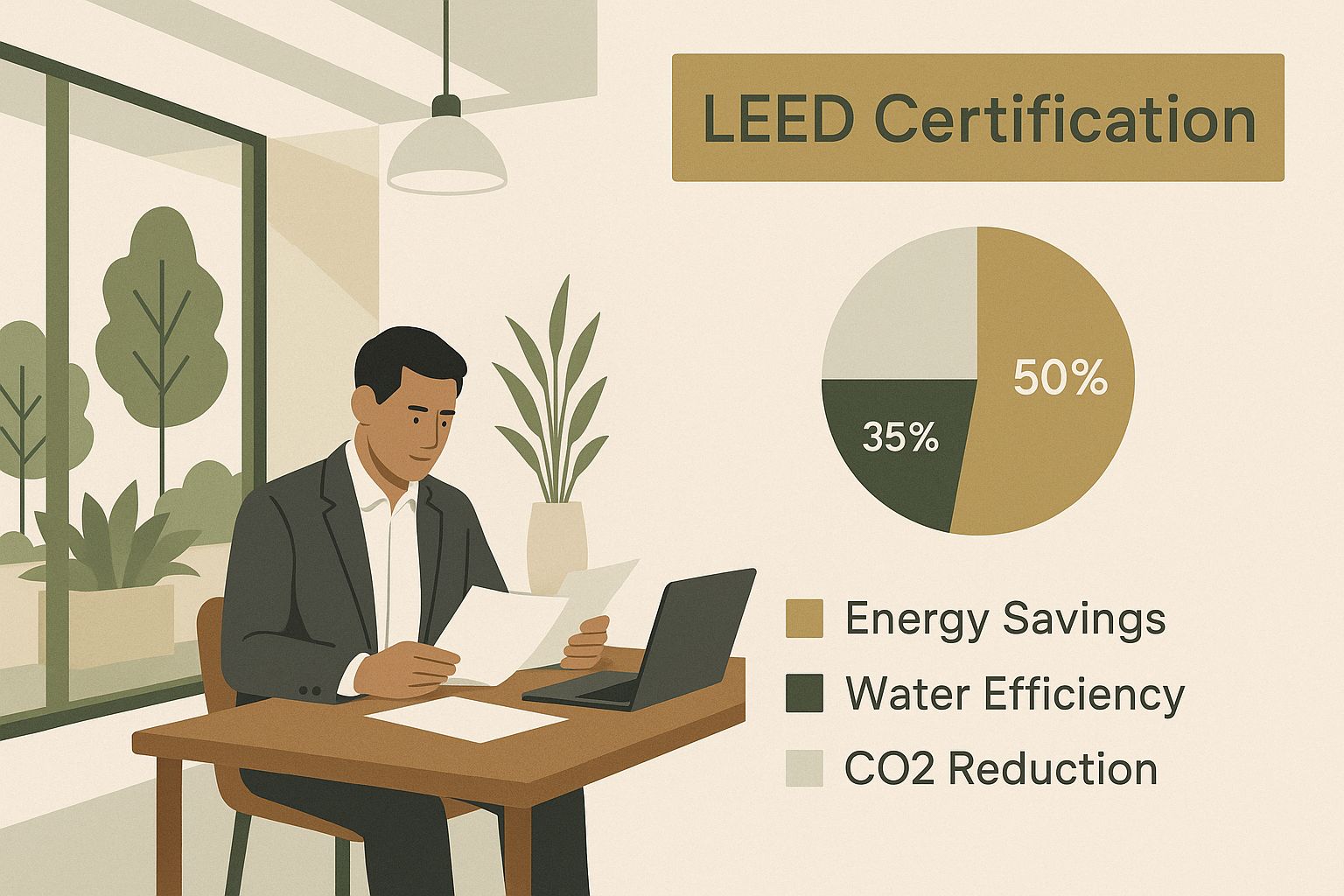
It’s a powerful reminder that these certifications aren’t just handed out; they are earned through rigorous documentation and verification.
LEED: The Global Powerhouse
While BREEAM is the heavyweight champion in the UK, LEED (Leadership in Energy and Environmental Design) is the most recognised name on the world stage. Originally from the US, its flexible, credit-based approach has been adopted in over 180 countries. This makes it the standard-bearer for international companies that need a consistent benchmark across their entire property portfolio.
Think of LEED as more of a pick-and-mix system. It offers a broad menu of credits across different categories, and project teams can choose which ones to go for to hit one of four levels: Certified, Silver, Gold, or Platinum.
This freedom gives architects and developers more room to innovate and focus on the green features that pack the biggest punch for their specific building and climate. The catch? The project team is responsible for compiling all the paperwork and submitting it for review, which means more control but also more hands-on work.
LEED’s biggest strength is its global brand recognition. If you’re a company with offices in London, New York, and Singapore, using LEED gives you a single, powerful way to talk about your commitment to sustainability everywhere.
WELL: The Human-Centric Standard
The WELL Building Standard is a newer player, but it’s quickly gaining ground. While BREEAM and LEED have their eyes on the building’s impact on the planet, WELL flips the script entirely. It focuses squarely on the health and wellbeing of the people inside the building. It’s less about saving kilowatt-hours and more about creating spaces where people can thrive.
WELL is built around ten core concepts that directly affect us every day:
- Air
- Water
- Nourishment
- Light
- Movement
- Thermal Comfort
- Sound
- Materials
- Mind
- Community
It measures things like air quality, access to natural light, acoustic privacy, and even policies that encourage healthy eating. Because it’s so people-focused, WELL is a natural fit for offices, homes, and schools—places where comfort, wellness, and productivity are top priorities. It’s all about designing buildings that don’t just shelter us, but actively support our health.
Comparing BREEAM, LEED, and WELL Certifications
Seeing these three side-by-side makes it easier to spot their unique personalities. The table below breaks down where each system really excels.
| Feature | BREEAM | LEED | WELL |
|---|---|---|---|
| Primary Focus | Holistic environmental performance, perfectly tuned for the UK & Europe. | Global consistency and flexible, performance-based environmental design. | Human health and wellbeing within the built environment. |
| Geographic Strength | The undisputed leader in the UK and a major force across Europe. | Global, with massive recognition in North America and Asia. | Worldwide, with rapid growth in commercial and residential sectors. |
| Assessment Process | A third-party licensed assessor manages the entire evidence and submission process. | The applicant leads the documentation and submits it directly for certification. | Involves performance testing by a WELL Assessor, including on-site measurements. |
| Ideal Use Case | UK-based projects needing a trusted, locally-recognised certification. | International portfolios or projects that need global brand recognition. | Any project where occupant health, wellness, and productivity are the main goals. |
In the end, choosing between BREEAM, LEED, and WELL isn’t about which is “better,” but which one aligns with your vision. BREEAM gives you undeniable credibility here in the UK, LEED offers a passport to global recognition, and WELL puts people first. In fact, many of the most forward-thinking projects are now aiming for dual certifications—like BREEAM and WELL—to prove their commitment to both a healthy planet and healthy people.
Navigating the Certification Process
Pursuing a major sustainable building certification can feel like a mountain of paperwork and technical jargon. But when you get down to it, the process is actually quite logical. It follows the natural flow of a construction project, from the first sketch to the final handover.
The secret to a stress-free certification isn’t some magic formula; it’s about shifting your mindset. Instead of treating certification as a final hurdle to jump over, think of it as a guiding principle from day one. Weaving your sustainability targets into the initial concept is the single best thing you can do. It ensures every decision—from where you build to the materials you choose—is already pushing you toward your goal and helps you avoid costly fixes down the line.
The Phased Journey to Certification
The path to getting certified isn’t a single event but a series of stages that neatly align with your project’s timeline. This structure keeps sustainability at the forefront, making sure everything is tracked, checked, and properly documented from start to finish.
For a new build, the journey typically unfolds in these key steps:
- Project Registration and Goal Setting: This is where you officially kick things off. You’ll register your project with the certification body (like BREEAM or LEED) and declare your target. Are you aiming for BREEAM ‘Excellent’ or LEED ‘Gold’? This decision sets the tone for the entire project.
- Design and Pre-Construction: Now, the real work begins. Your team will bake the certification requirements right into the architectural and engineering plans. This stage is all about detailed energy modelling, selecting the right materials, and designing smart systems for water and waste.
- Construction and Verification: As the building goes up, the focus shifts to execution and collecting proof. It’s a phase that demands diligent record-keeping to show that what was designed on paper has been properly implemented on-site.
- Final Assessment and Submission: Once the dust settles and construction is complete, you’ll compile the final evidence package. This includes everything from receipts for materials to commissioning reports for the building’s systems, all proving you’ve met the standard.
- Certification Awarded: The certifying body then reviews your entire submission. If you’ve ticked all the boxes, your project earns its official certification—a credible, third-party stamp of approval on its green credentials.
The Critical Role of an Accredited Professional
Trying to manage this all on your own would be a headache. That’s where an accredited professional—someone like a BREEAM Assessor or a LEED Accredited Professional (AP)—becomes the most valuable player on your team. They are your guide, translator, and project manager for everything related to certification.
Getting one of these specialists involved early is a game-changer. They can offer crucial advice during the design phase that saves a huge amount of time and money, pointing out the smartest ways to earn credits. Their experience helps the team sidestep common mistakes and make choices that perfectly align with the certification framework.
An accredited professional does more than just tick boxes; they become a strategic partner. They translate the dense technical criteria into practical, actionable steps for architects, engineers, and builders, making sure everyone is pulling in the same direction.
Ultimately, they’re the ones responsible for pulling together all the evidence, managing the documents, and submitting the final application. Having that expert oversight not only smooths out the entire process but also dramatically improves your chances of hitting your target certification without any last-minute panic. They turn a daunting challenge into a clear, achievable goal.
How to Choose the Right Certification
With a few excellent sustainable building certifications on the table, the challenge isn’t finding a good one—it’s picking the one that truly fits your project’s DNA. This decision isn’t a mere technicality; it shapes your building’s entire story, from its market appeal to its long-term performance. Before you even glance at a registration form, you need to step back and ask some fundamental questions.
Think of it like choosing a vehicle. You wouldn’t buy a two-seater sports car for a family of five or a massive lorry for a city commute. The “best” choice depends entirely on your specific needs, your destination, and who’s coming along for the ride. That same logic applies here. Your project’s unique goals are the map that will guide you to the right certification.
Define Your Primary Goals
First things first: you have to get crystal clear on what you want to achieve. What’s the single biggest driver behind this push for certification? Your answer will immediately start to narrow the field.
Think about these common project drivers:
- Maximising Energy Savings: If your main objective is to slash operating costs and create an ultra-efficient building, you’ll want certifications that heavily prioritise energy performance. Both BREEAM and LEED are strong contenders, with rigorous standards for energy modelling and consumption.
- Prioritising Occupant Wellbeing: Maybe your goal is to create the healthiest, most productive space imaginable. This is a huge focus for modern offices and residential projects. In this case, the WELL Building Standard is the obvious front-runner, with its laser focus on air quality, light, and occupant comfort.
- Boosting Market Recognition: Who is your target audience—a local UK market or an international corporation? BREEAM holds immense weight and recognition within the UK. But for a global company needing a consistent benchmark across its entire portfolio, LEED’s international brand power is a major advantage.
Match the Certification to Your Building Type
The nature of your project is another critical factor. Are you starting from scratch with a new build, or are you working with an existing structure? Certification bodies have developed specific pathways tailored to different project types, so you need to find the one that fits.
Selecting the right framework from the start is crucial. It’s like using the correct tool for the job—it makes the entire process smoother, more efficient, and ultimately more successful. An existing building has different challenges and opportunities than a plot of empty land.
A new commercial tower, for instance, has the freedom to integrate sustainability from the ground up. This makes frameworks like BREEAM New Construction or LEED Building Design + Construction (BD+C) the ideal choice.
However, if you’re retrofitting an existing office block, your focus shifts to operational performance and upgrades. Here, you’d look towards BREEAM In-Use or LEED for Operations + Maintenance (O+M). These frameworks are specifically designed to assess and improve the real-world performance of buildings that are already up and running.
This distinction ensures the criteria are relevant and achievable for your specific context. Proper upkeep of an existing building’s exterior, such as its decking, is also part of long-term sustainable management. You can learn more about cleaning algae from decking to preserve materials and avoid unnecessary replacements.
Common Questions About Building Certifications
As you start to explore the world of sustainable building certifications, you’re bound to have questions. These frameworks can be pretty detailed, and it’s completely normal to wonder how they work in practice. Getting to grips with the practical side of things is crucial before you commit.
To help you out, we’ve put together answers to some of the most common questions we hear. Hopefully, this will clear up any confusion and give you the confidence to take the next step.
How Much Does It Cost to Get a Building Certified?
There’s no straightforward answer to this one, as the cost can swing quite a bit. It really depends on which certification you go for, how big and complex your building is, and the rating level you’re hoping to achieve.
Broadly speaking, you’ll be looking at a few main costs. There are the registration fees you pay to the certification body itself, the fees for the specialist consultants who’ll guide you through it all, and of course, any money you need to spend to get the building up to scratch.
It’s easy to get fixated on the initial cost, but it’s far more helpful to see it as a long-term investment. The savings on energy bills, higher property values, and happier tenants often more than make up for the upfront spend.
The best way to keep costs in check? Think about your sustainability targets right from day one. Weaving these goals into the initial design phase is always cheaper and easier than trying to retrofit solutions later on.
Can You Certify an Existing Building?
Yes, absolutely! It’s a common myth that these certifications are just for shiny new constructions. In reality, all the big players have specific schemes created just for buildings that are already up and running.
Take BREEAM, for example. They have their BREEAM In-Use standard, which looks at how existing buildings perform day-to-day. LEED has a similar programme called LEED for Operations and Maintenance (O+M). These frameworks are all about real-world performance.
They typically assess things like:
- Actual energy and water usage over a set period.
- How effective your waste management systems are.
- The quality of the indoor environment and how satisfied the occupants are.
Certifying an existing building is a fantastic way to benchmark its performance, pinpoint where you can make improvements, and show everyone that it’s a genuinely sustainable asset.
How Long Does the Certification Process Take?
The timeline is really tied to the project itself. For a new build, the certification process runs alongside the design and construction. It kicks off right at the concept stage and doesn’t wrap up until the final assessment is done after the building is complete.
For an existing building, it can be much faster. Because you’re working with historical data, it might only take a few months to pull together all the utility bills and operational evidence needed for the assessment.
Ultimately, the speed often comes down to how organised your data is and how quickly your team can rustle up the necessary documents when asked.
Is One Certification Better Than Another?
This is probably the question we get asked the most, but there’s no single “best” certification. The right one for you is the one that best fits your project’s specific goals and location. Each of the main sustainable building certifications has its own unique strengths.
- BREEAM is the gold standard here in the UK. If you want strong local recognition and to align with UK regulations, it’s the obvious choice.
- LEED has a massive international reputation. This is a huge advantage if you’re a global company or want to attract international tenants.
- WELL is the front-runner if your main focus is on human health. It’s all about creating spaces that boost occupant wellbeing and productivity.
The smartest move is to look at your own business objectives and what your target market values, then pick the system that aligns best. For more detailed guides on sustainable building, feel free to explore our additional blog posts.
