
Cladding for a House Exterior: Types, Costs & Best Materials (UK Guide)

Choosing cladding for your home’s exterior is one of those decisions that seems straightforward until you start comparing the options. Timber, composite, fibre cement, uPVC, and stone—each offers something different, from lower maintenance and a longer lifespan to a completely different architectural character. The challenge isn’t finding the material that’s considered “best.” It’s finding one that suits your home, your budget, and the way you actually want to live over the next 20 or 30 years.
A well-chosen cladding system does far more than refresh a façade. It protects your property from the elements, enhances kerb appeal, and, when installed correctly, contributes to the building’s long-term performance. With so many materials available—each offering different costs, maintenance requirements, and visual characteristics—it’s easy to feel unsure about which option is right for you.
In this guide, we’ll compare the most popular exterior cladding materials available in the UK, break down realistic costs, explain the pros and cons of each option, and explore how cladding compares with rendering. Whether you’re renovating an existing property, planning a self-build, or specifying materials for a new project, you’ll come away with a much clearer understanding of which solution is right for your home—and why premium options such as charred timber continue to grow in popularity among homeowners, architects, and builders alike.
Types of House Cladding Materials for Exteriors
Exterior cladding is a protective and decorative outer layer installed over a building’s walls to shield them from the elements, enhance the property’s appearance, and improve thermal performance. Rather than acting as a completely sealed barrier, most cladding systems function as rainscreens, allowing moisture to drain away while protecting the underlying structure from wind-driven rain.
According to TDCA guidance, cladding should be installed over a drained and ventilated cavity that is open at the top and bottom and formed by battens, with a breather membrane separating the wet and dry zones. This managed airflow helps keep moisture out of the structure and extends the lifespan of the boards.
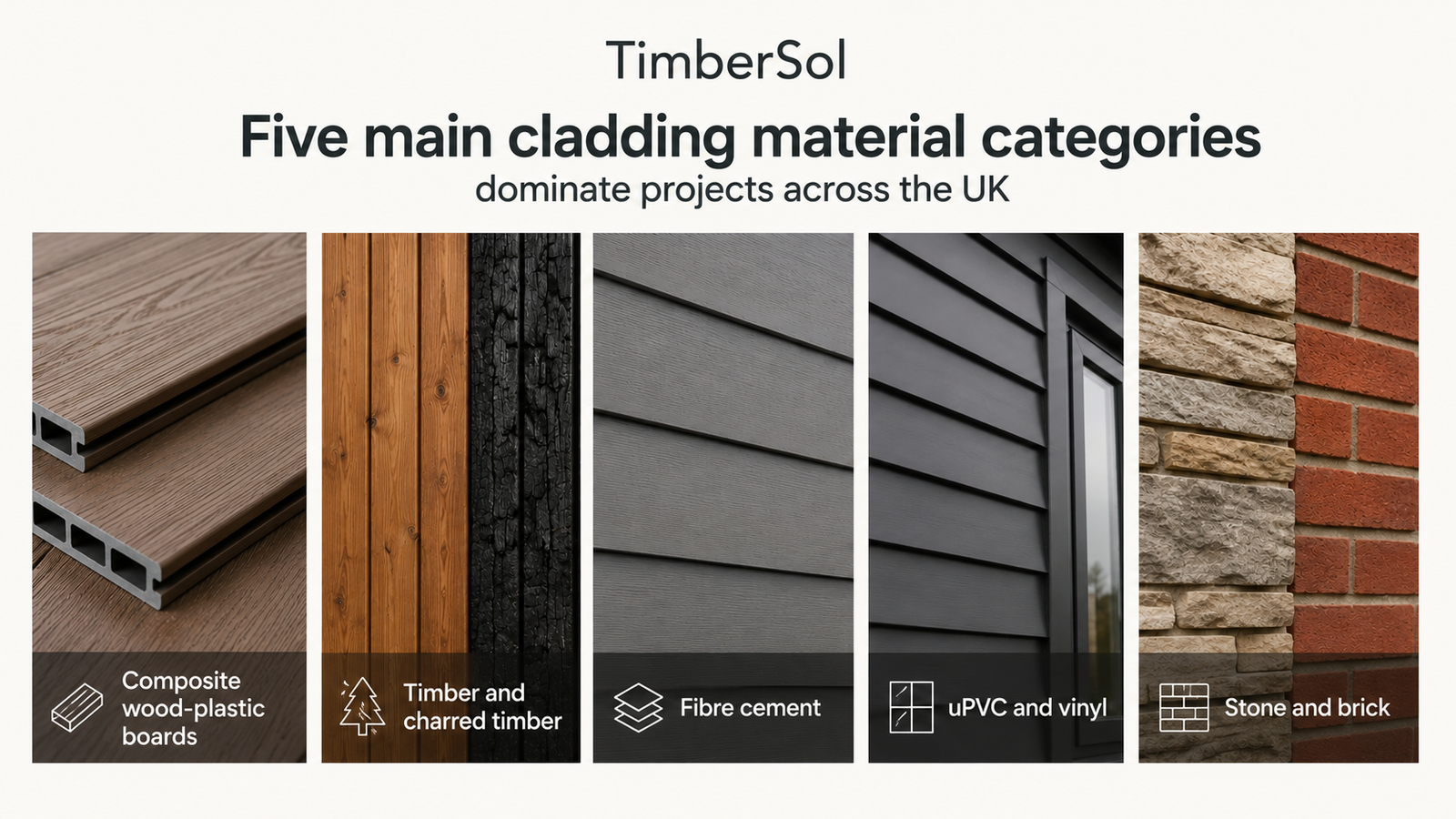
Five main cladding material categories dominate projects across the UK:
- Composite wood-plastic boards – low-maintenance and colour-stable
- Timber and charred timber – natural warmth and character
- Fibre cement – durable and non-combustible
- uPVC and vinyl – the budget-friendly choice
- Stone and brick – premium, durable, and long-lasting
All external timber cladding falls within Use Class 3 (BS EN 335), which covers wood used outdoors above ground. The species’ durability must therefore be appropriate for the level of exposure, achieved either naturally through durable heartwood or through preservative treatment or modification.
| Material | Lifespan | Maintenance | Appearance | Relative cost |
| Composite | 20–30+ years | Very low | Uniform, contemporary | Medium |
| Timber/charred timber | 30–60 years | Low–medium | Natural, characterful | Medium –high |
| Fibre cement | 30–50 years | Low | Smooth, painted finish | Medium |
| uPVC/vinyl | 20–30 years | Low | Practical | Low |
| Stone/brick | 50+ years | Very low | Premium, traditional | High |
Composite Cladding
Composite cladding is a wood-plastic blend that combines timber fibres with recycled polymers to produce boards that resist rot, moisture, and insect attack. The plastic content helps keep out water, allowing the boards to remain stable without the need for sealing, oiling, or repainting. For natural timber cladding, using high-quality wood coatings and protective finishes can further improve weather resistance, reduce UV damage, and help preserve the timber’s appearance over time.
This material retains its colour over time and maintains a uniform, modern finish, making it ideal for homeowners who want the look of timber without the silver-grey weathering of natural wood. It typically costs more upfront than uPVC.
In return, it offers very low maintenance requirements and a long service life, with a typical lifespan of 20 to 30+ years. An occasional wash is all that’s needed to keep the surface clean and looking consistent.
Timber and Charred Timber Cladding
Natural timber species such as cedar, larch, Douglas fir, oak, ThermoWood, and Accoya bring warmth, texture, and character that no synthetic material can match. Each species offers a distinct appearance, from cedar’s rich reddish tones to larch’s pale golden colour.
According to GreenSpec, untreated timber of any species weathers to a near-uniform silver-grey within approximately five years. This colour change should be expected as a natural process rather than regarded as a defect.
Charred timber, also known as Yakisugi or Shou Sugi Ban, takes a different approach. Controlled surface charring creates a protective carbon layer that improves resistance to moisture, insects, and decay. The boards are then brushed and oil-finished to create a distinctive, low-maintenance appearance.
TimberSol supplies charred timber cladding in larch, spruce, oak, ThermoWood, Accoya, and Douglas fir, with custom sizes and a wide range of shades to suit both modern and traditional elevations.
Fibre Cement Cladding
Fibre cement boards are made from cement reinforced with cellulose fibres, creating dense, non-combustible panels valued for their low-maintenance performance. The cement matrix resists rot, fire, and insect attack, allowing the boards to perform reliably on exposed or fire-sensitive elevations.
They also hold painted finishes well, allowing the colour to be refreshed without replacing the boards. As a result, fibre cement typically lasts 30–50 years with only periodic cleaning, making it a practical choice where durability and low maintenance matter more than the natural character of timber.
uPVC, Vinyl and Stone Cladding
uPVC and vinyl cladding sit at the budget end of the market, as the boards are mass-produced, lightweight, and quick to install. They can be cleaned easily with soapy water and resist moisture, making them a practical, low-cost choice for garages, extensions, and rear elevations where appearance is less of a priority.
The trade-off is a more synthetic appearance that lacks the depth and character of timber or stone.
Stone and brick cladding, including brick slips and natural stone, offer the opposite: premium, long-lasting finishes with traditional character and strong kerb appeal at a higher cost. These materials are well suited to heritage properties, conservation areas, and statement front elevations where their lasting visual impact justifies the investment.
How Much Does It Cost to Clad a House in the UK?
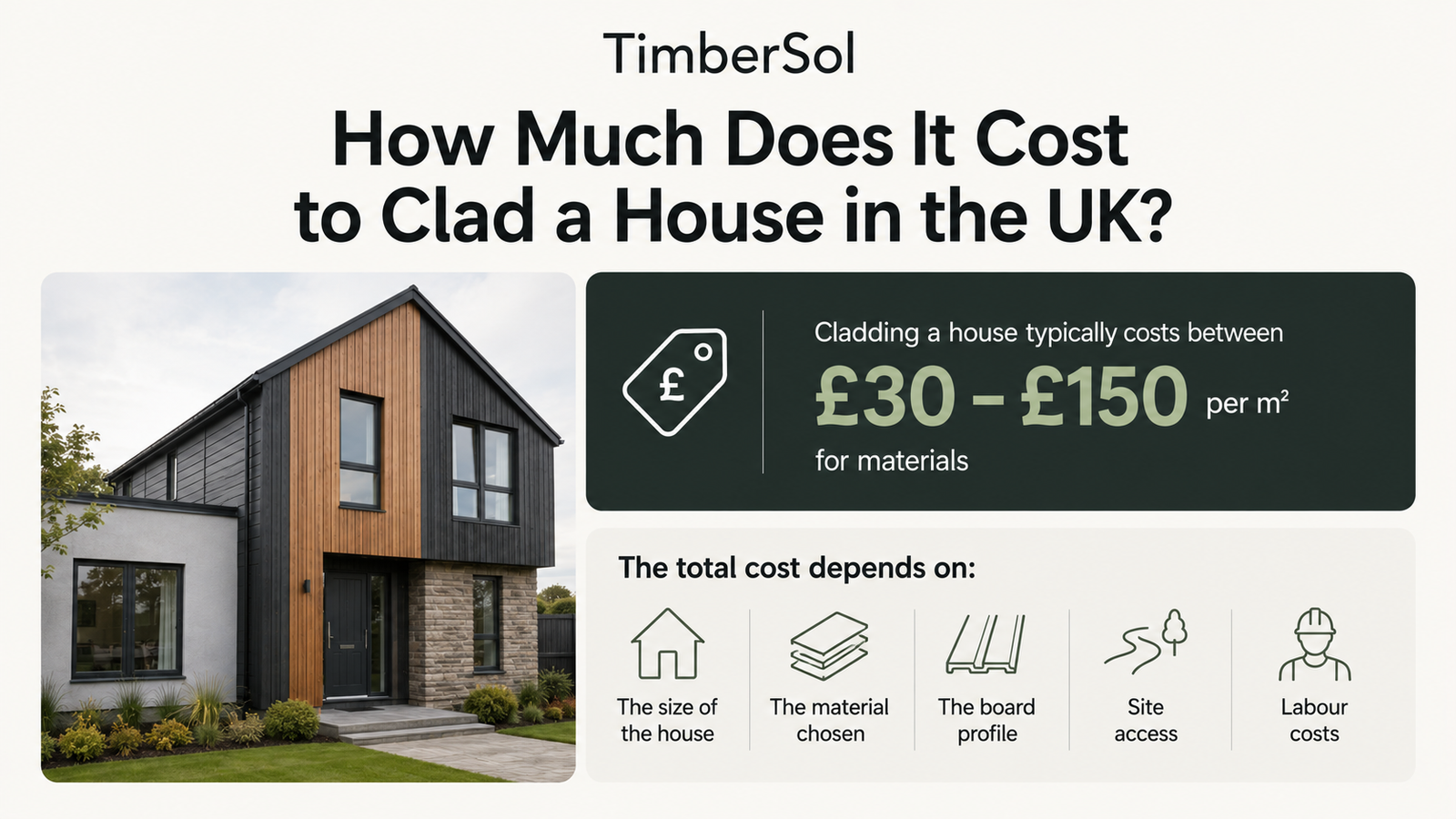
Cladding a house typically costs between £30 and £150 per m² for materials, with uPVC at the budget end, timber and composite in the mid-range, and stone or brick at the premium end. These are typical supply-only costs and may vary depending on the specification, profile, and region.
The total cost depends on the size of the house, the material chosen, the board profile, site access, and labour costs. Installation often adds significantly to the material cost, as fitting a ventilated rainscreen requires skilled workmanship and careful detailing.
For tight budgets, uPVC and vinyl remain the most affordable external wall cladding options. The lower cost comes with trade-offs in appearance and longevity, as the plastic finish lacks the depth and character of timber, charred timber, or stone and tends to weather less gracefully.
Several additional components contribute to the overall cost beyond the cladding boards themselves:
- Pressure-treated battens to form the ventilated cavity
- A breather membrane installed behind the battens
- Corrosion-resistant stainless steel fixings
- Corner trims and edge profiles
These components protect the cladding system, so omitting them may lead to premature failure rather than genuine cost savings.
For larger projects, finance options can help spread the cost over manageable instalments. Requesting a cladding quote provides an accurate estimate based on your property’s elevation, chosen profile, and total square metreage.
What Is the Best Cladding for a House by Style and Budget?
There is no single best cladding material, as the right choice depends on your budget, desired appearance, maintenance requirements, and the level of exposure the walls will face. Matching the material to the project is more important than looking for a one-size-fits-all solution.
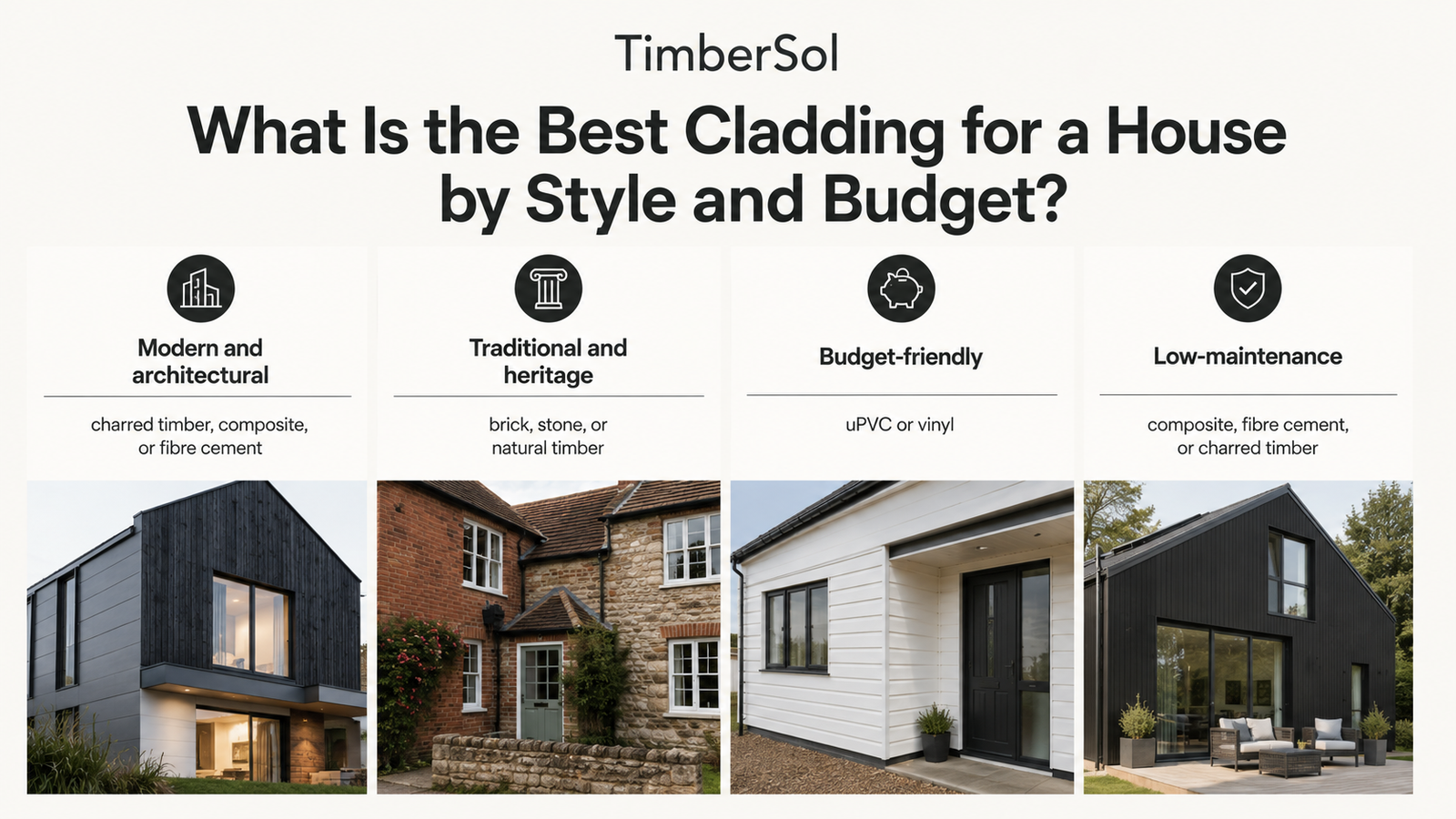
By use case, the options fall into four clear categories:
- Modern and architectural: charred timber, composite, or fibre cement
- Traditional and heritage: brick, stone, or natural timber
- Budget-friendly: uPVC or vinyl
- Low-maintenance: composite, fibre cement, or charred timber
Charred timber enhances a building’s character with a sophisticated, contemporary finish while remaining naturally durable, as the carbon layer resists moisture, insects, and decay. It is well suited to self-builders, architects, and renovators who want a distinctive appearance without constant upkeep.
Shade and profile shape the final appearance just as much as the timber species. Options range from black and anthracite grey to warmer walnut and natural tones, paired with shiplap, shadow gap, or feather-edge profiles to create different textures.
Colour and grain appear differently against brick, render, or rendered extensions in natural daylight. Ordering a cladding sample is a simple, low-commitment way to assess the shade and texture against your building before placing a full order.
Cladding vs Rendering: Which Is Cheaper for a House?
Rendering is often cheaper upfront, while cladding typically offers greater durability and lower long-term maintenance costs. Which option is more cost-effective ultimately depends on the material you choose and your long-term plans.
The gap widens when it comes to lifespan and repairability. Render can crack, stain, or trap moisture and may require recoating every few years, whereas a ventilated cladding system acts as a rainscreen, deflecting wind-driven rain over a drained cavity. As a result, cladding often costs more to install but less to maintain over its service life.
Render is well suited to achieving a smooth, seamless finish on sound, well-prepared walls. Cladding is often the better choice when you want added texture, improved insulation, a way to conceal tired brickwork, or a contemporary appearance that render cannot replicate.
Painting sits at the opposite end of the spectrum. It is the most affordable short-term option, but the finish needs to be renewed regularly, so the initial savings rarely last.
For renovators weighing appearance against maintenance, a charred timber solution such as those offered by TimberSol provides lasting character without the regular repainting cycle associated with render and paint.
Best Low-Maintenance and Long-Lasting Cladding Materials
Fibre cement, composite, and charred timber rank among the lowest-maintenance, longest-lasting cladding materials, as each resists decay, moisture, and insect attack without requiring regular painting or sealing. Fibre cement retains its finish for decades, composite remains colour-stable, and charred timber develops a protective carbon layer that slows weathering.
Even the best cladding material can fail if it is installed incorrectly, so proper installation is essential for long-term performance. Cladding should be installed over a drained, ventilated cavity formed by pressure-treated Use Class 3 battens with a 30-year service life, with a breather membrane behind the battens separating the wet and dry zones.
Good detailing helps prevent rot. Finish the cladding at least 200 mm above ground level to avoid rain splashback, install the boards at a moisture content of around 16% to minimise movement, and use corrosion-resistant austenitic stainless steel fixings.
Orientation matters too. South- and west-facing elevations weather the fastest due to greater exposure to sun and driving rain, while shaded north- and east-facing walls remain damper and may require more maintenance.
Cladding is often permitted development, but listed buildings, properties in conservation areas, and certain building heights may require planning permission or compliance with specified fire performance requirements (Euroclass B or C). Always check local requirements and follow TDCA guidance on flame-retardant treatments.
Cladding House Exterior: FAQ
What Is the Best Exterior Cladding for a House?
No single cladding material is the best choice for every project; the right option depends on your budget, preferred style, and maintenance requirements. Fibre cement and composite are excellent all-round choices for durability, while timber and charred timber offer natural or contemporary character. Use the comparison table to find the material that best suits your project.
How Much Does It Cost to Clad a House in the UK?
Cladding typically costs between £30 and £150 per m² for supply, with uPVC at the budget end and premium timber and stone at the top end of the market. The total cost depends on the size of the house, the material chosen, and labour costs, as installation often adds significantly to the cost of materials. Request a quote for an accurate estimate.
Is It Cheaper to Clad or Render a House?
Rendering is usually cheaper upfront, while cladding typically offers greater durability and lower long-term maintenance costs. The more cost-effective option depends on the material you choose and the condition of your existing walls. Render is best suited to sound, well-prepared walls, while cladding is often the better choice for adding texture, improving insulation, or concealing tired brickwork.
What Is the Cheapest External Wall Cladding?
uPVC and vinyl are typically the most budget-friendly external wall cladding options, as the boards are mass-produced, lightweight, and quick to install. They are best suited to practical, low-maintenance areas such as garages, extensions, and rear elevations.
The trade-off is appearance. uPVC lacks the grain, depth, and character of timber, charred timber, or composite, making it better suited to cost-driven projects than statement elevations.
If you want cladding that combines the warmth and character of timber with genuinely low-maintenance durability, charred timber is well worth considering. At TimberSol, we char larch, spruce, oak, ThermoWood, Accoya, and Douglas fir to a consistent standard before brushing and oiling each board to create a finish that resists moisture, rot, and insect attack in the UK’s climate.
You can choose from profiles such as shiplap, shadow gap, and feather-edge in shades ranging from deep black to natural tones, all cut to your project’s exact specifications. Start by ordering a sample to see and feel the finish in person, then request a quote when you’re ready to move forward.
